India, World Bank discuss land governance reform framework for states
Synopsis
India and the World Bank are working toward a first-of-its-kind assessment framework to benchmark land governance reforms across states — a move that could reshape how India tracks progress on digital land records, property rights, and rural credit access. The push comes as the government acknowledges that land, the largest asset class for most Indian families, remains economically underutilised.
Key Takeaways
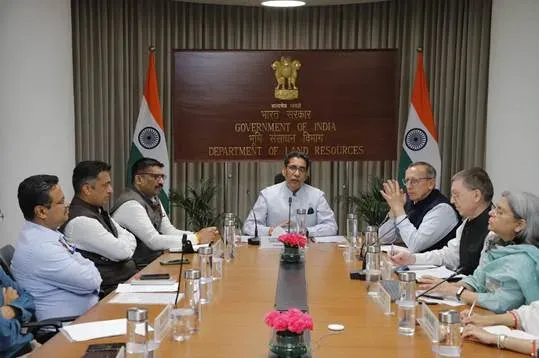
Narendra Bhooshan , Secretary, Department of Land Resources, met World Bank Country Director for India Paul Procee in New Delhi on 16 June 2025 .
The two sides discussed developing an India-specific framework to assess and benchmark land governance reforms across states.
The World Bank shared global best practices on digital land records , property governance , institutional strengthening , and technology adoption .
Secretary Bhooshan highlighted the role of AI , geospatial systems , and digital platforms in modernising land administration.
Active departmental initiatives include land record modernisation, urban property record creation , survey operations, and interoperability of land digital systems.
Deininger , World Bank Lead Economist, and senior officials from the Ministry of Finance also attended the meeting.
The Department of Land Resources Secretary, Narendra Bhooshan, on 16 June 2025 held a high-level discussion in New Delhi with a World Bank delegation led by Country Director for India Paul Procee, aimed at developing an India-specific framework for assessing land governance reforms across states. The meeting, held on Monday, was convened to establish benchmarks for tracking reform progress and enabling evidence-based policy interventions in the land sector.
What the Framework Seeks to Achieve
The proposed assessment framework is designed to facilitate benchmarking of state-level progress, wider dissemination of best practices, and targeted policy interventions in land administration. According to an official statement, the framework would allow states to measure reform outcomes against standardised indicators, enabling more systematic and comparable evaluations across India's diverse land governance landscape.
World Bank Inputs and Global Benchmarks
The World Bank delegation shared international experiences and global best practices across several domains, including digital land records, property governance, institutional strengthening, and technology adoption in land administration. Discussions also covered avenues for knowledge exchange, policy research, and capacity building between India and international counterparts. Klaus W. Deininger, World Bank Lead Economist, was among the senior experts present at the meeting.
India's Land Governance Priorities
Secretary Bhooshan underscored that land remains one of the most significant productive assets for Indian households, playing a pivotal role in agricultural productivity, rural prosperity, urban development, financial inclusion, and broader economic growth. He noted that while land constitutes the largest asset class for a majority of Indian families, its economic potential remains substantially underutilised.
Bhooshan highlighted the urgent need for modern, transparent, and technology-enabled land governance systems that can secure property rights, improve access to institutional credit, and enhance ease of living for citizens. He specifically pointed to the role of geospatial systems, artificial intelligence, digital platforms, and data-driven governance tools in transforming land administration and service delivery.
Ongoing Departmental Initiatives
The Secretary outlined several active programmes under the Department of Land Resources, including modernisation of land records, survey and resurvey operations, urban property record creation, watershed development, and efforts to achieve interoperability across land-related digital systems. He stressed the importance of building an integrated ecosystem where land records can actively support agriculture, credit delivery, urban planning, and citizen services.
The meeting was also attended by P. Narahari, Joint Secretary, Department of Land Resources; Nitin Khade, Joint Secretary (Watershed Management), Department of Land Resources; and Punit Kumar, Director, Department of Economic Affairs, Ministry of Finance, along with other officials. The Department of Land Resources reaffirmed its commitment to partnering with knowledge institutions to advance transparent and citizen-centric land governance across the country.
What Comes Next
The two sides are expected to continue consultations to finalise the contours of the India-specific assessment framework. If adopted, the framework could serve as a policy tool for state governments to identify gaps, adopt best practices, and accelerate land administration reforms — with implications for rural credit access, urban planning, and investment climate across India.
Point of View
Yet inter-state comparability of outcomes remains weak and data on actual property rights security is patchy. The World Bank's involvement brings methodological rigour, but the harder challenge is political: land is a state subject, and states have historically resisted uniform assessment metrics that expose reform gaps. Whether this framework becomes a genuine accountability tool or another consultative document will depend on whether the Centre can build state buy-in and link the benchmarks to fiscal incentives.
NationPress
17 Sept 2026
Frequently Asked Questions
What was discussed at the India-World Bank land governance meeting on 16 June 2025?
Officials from India's Department of Land Resources and a World Bank delegation met in New Delhi on 16 June 2025 to discuss developing an India-specific framework for assessing land governance reforms across states. Topics included digital land records, property governance, AI adoption, capacity building, and knowledge exchange.
What is the proposed land governance assessment framework?
The framework is an India-specific tool intended to benchmark state-level progress on land administration reforms, disseminate best practices, and enable evidence-based policy interventions. It would allow comparative evaluation of how different states are advancing on land digitalisation, property rights, and service delivery.
Why does land governance reform matter for India?
Land is the largest asset class for a majority of Indian families but its economic potential remains underutilised, according to the Department of Land Resources. Improved land governance can strengthen property rights, expand access to institutional credit, support agricultural productivity, and attract investment.
Which technologies are being considered for improving land administration in India?
Secretary Narendra Bhooshan highlighted geospatial systems, artificial intelligence, digital platforms, and data-driven governance tools as key enablers for modernising land administration and improving citizen service delivery across states.
Who attended the India-World Bank land governance meeting?
The meeting was attended by Department of Land Resources Secretary Narendra Bhooshan, World Bank Country Director for India Paul Procee, World Bank Lead Economist Klaus W. Deininger, Joint Secretaries P. Narahari and Nitin Khade from the Department of Land Resources, and Punit Kumar, Director at the Ministry of Finance's Department of Economic Affairs.