EU CBAM compliance: India's exporters get ready for carbon border rules
Synopsis
With the EU's Carbon Border Adjustment Mechanism tightening its grip on carbon-intensive imports, India's Department of Commerce, NABCB, and EEPC convened around 100 exporters in New Delhi to map out the compliance path. The session signals that for Indian engineering and metals exporters, the window to build credible emissions-tracking systems is narrowing fast.
Key Takeaways
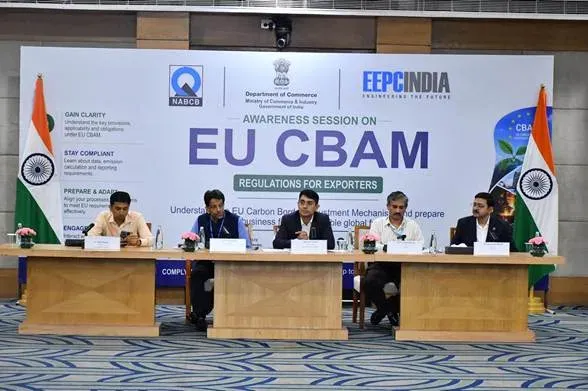
The Department of Commerce , NABCB , and EEPC held an EU CBAM awareness session in New Delhi on 19 August .
Around 100 exporters and industry stakeholders attended the session.
Amit Verma , Joint Secretary, Department of Commerce, reaffirmed the government's commitment to practical compliance solutions for Indian exporters.
Venkateswaran highlighted the need for a credible accreditation and verification ecosystem for emissions data.
EEPC Chairman Pankaj Chadha stressed preparedness across the export value chain, including supplier-level emissions data availability.
The EU CBAM covers sectors including steel, aluminium, cement, fertilisers, and electricity — key Indian export categories.
Indian exporters are adequately prepared to meet emerging sustainability-related requirements in international markets, according to senior government officials who addressed a dedicated awareness session on the European Union Carbon Border Adjustment Mechanism (EU CBAM) in New Delhi on 19 August. The session, organised by the Department of Commerce in collaboration with the National Accreditation Board for Certification Bodies (NABCB) and the Engineering Export Promotion Council (EEPC), drew around 100 participants including exporters and industry stakeholders.
What the Session Covered
Amit Verma, Joint Secretary, Department of Commerce, highlighted the Department's ongoing efforts to build awareness among exporters and facilitate a clearer understanding of evolving regulatory requirements. He reaffirmed that the Department remains engaged with industry and relevant stakeholders and is working toward practical, workable solutions for Indian exporters navigating the new carbon compliance landscape.
Technical sessions provided participants with a comprehensive overview of the EU CBAM framework — covering its applicability, the range of products subject to the mechanism, obligations for exporters, methods for calculating embedded emissions, and the data collection and reporting requirements involved. Accreditation and verification mechanisms were also addressed in detail.
Why Accreditation and Data Matter
N. Venkateswaran, CEO, NABCB, underscored the importance of a credible accreditation and verification ecosystem in building confidence in emissions-related data. He noted that robust verification is central to supporting compliance with CBAM requirements and ensuring that Indian exporters are not disadvantaged in European markets.
Pankaj Chadha, Chairman, EEPC, stressed the importance of awareness and preparedness across the entire export value chain — including the timely availability of accurate emissions-related data from suppliers and other stakeholders. He also called for effective verification mechanisms to help Indian exporters meet their compliance and reporting obligations.
The Broader Compliance Challenge
The EU CBAM, which is being phased in as part of the European Union's broader Green Deal framework, imposes a carbon cost on imports of certain goods — including steel, aluminium, cement, fertilisers, and electricity — based on the greenhouse gas emissions embedded in their production. For Indian exporters, particularly in the engineering and metals sectors, this represents a significant new compliance burden requiring reliable emissions data and third-party verification.
This comes amid growing global scrutiny of carbon-intensive supply chains, with major trading blocs increasingly linking market access to environmental standards. The CBAM's transitional reporting phase is already under way, making preparedness a near-term operational priority rather than a future consideration.
Department's Continued Engagement
The Department of Commerce reaffirmed its commitment to continued engagement with exporters, industry associations, and relevant institutions to build awareness and capacity on emerging sustainability-related trade regulations. The interactive format of the session allowed exporters and industry representatives to seek direct clarifications on compliance and reporting issues — a model the Department is expected to replicate across other export clusters.
With the EU's carbon border rules tightening progressively, Indian exporters who establish robust emissions tracking and verification systems early are likely to be better positioned to protect their market access in Europe.
Point of View
But awareness is not the same as readiness. The EU CBAM's embedded-emissions calculation requires granular, verifiable data from every tier of the supply chain — a standard that most Indian mid-sized exporters are not yet equipped to meet. The government's collaborative model with NABCB and EEPC is the right architecture, but the pace of outreach must accelerate significantly given that the CBAM's transitional phase is already live. India's engineering export competitiveness in Europe now depends as much on carbon accounting as on price.
NationPress
19 Aug 2026
Frequently Asked Questions
What is the EU Carbon Border Adjustment Mechanism (CBAM)?
The EU CBAM is a regulation that imposes a carbon cost on imports of certain goods — including steel, aluminium, cement, fertilisers, and electricity — based on the greenhouse gas emissions embedded in their production. It is part of the European Union's Green Deal and is being phased in progressively, with a transitional reporting phase already under way.
Why does EU CBAM matter for Indian exporters?
Indian exporters, particularly in engineering, metals, and related sectors, must now calculate and report the embedded emissions in their products to maintain access to European markets. Failure to comply could result in additional carbon costs that erode price competitiveness.
What did the New Delhi awareness session cover?
The session, held on 19 August, covered the EU CBAM framework, its applicability, covered products, exporter obligations, embedded emissions calculation methods, data collection and reporting requirements, and accreditation and verification mechanisms. It also provided an interactive platform for exporters to seek compliance clarifications.
Who organised the EU CBAM awareness session for Indian exporters?
The session was jointly organised by the Department of Commerce, the National Accreditation Board for Certification Bodies (NABCB), and the Engineering Export Promotion Council (EEPC), and was attended by around 100 exporters and industry stakeholders.
What is the government doing to help Indian exporters comply with EU CBAM?
The Department of Commerce has reaffirmed continued engagement with exporters, industry associations, and institutions to build awareness and capacity. It is working with NABCB and EEPC to develop practical compliance solutions, including credible accreditation and verification ecosystems for emissions-related data.