Has Indian Railways Electrified 99.2% of Its Broad-Gauge Network, Surpassing Many Nations?
Click to start listening
Synopsis
Indian Railways has electrified 99.2% of its broad-gauge network, a feat that surpasses that of the UK, Russia, and China. This commitment to sustainability and safety includes free Wi-Fi at over 6,000 stations and extensive CCTV surveillance, making rail travel more efficient and secure.
Key Takeaways
- 99.2% of the Broad Gauge network electrified.
- Outpaces UK, Russia, and China.
- Commitment to sustainability with renewable energy.
- Free Wi-Fi at 6,117 railway stations.
- CCTV installed in 1,731 stations for safety.
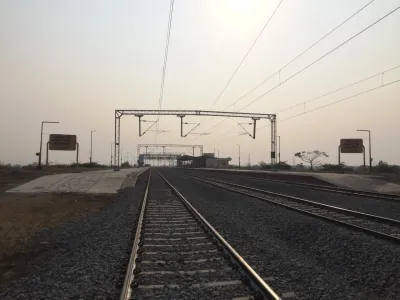
New Delhi, Dec 17 (NationPress) The electrification of the Indian Railways network is being pursued with great urgency, achieving an impressive 99.2% completion rate for the Broad Gauge (BG) network, as shared in Parliament this Wednesday.
This accomplishment significantly outpaces other nations, including the UK at 39%, Russia at 52%, and China at 82%.
Railways Minister Ashwini Vaishnaw highlighted in a written response to a Lok Sabha inquiry that India's progress in railway electrification is recognized worldwide.
He noted that during the financial years 2023-24 and 2024-25, 7,188 and 2,701 Route kilometers (RKM) of electrification were completed, respectively. Furthermore, all new line and multi-tracking initiatives are being approved and constructed with electrification in mind.
In the northeastern states, including Arunachal Pradesh, Meghalaya, Nagaland, Tripura, and Mizoram, the existing BG network has achieved 100% electrification.
Additionally, Assam has reached 92% electrification, with ongoing efforts to cover the remaining network.
The minister reiterated that Indian Railways is dedicated to sustainable operations through almost complete railway electrification, alongside the integration of renewable energy sources like solar and wind, aimed at reducing carbon emissions.
Moreover, free Wi-Fi services are now available at 6,117 railway stations, with no separate funding allocated by the Ministry of Railways for these services.
Accessing the Wi-Fi requires only a mobile number for OTP verification, ensuring user privacy. The railway administration promptly addresses any issues related to the Wi-Fi services.
Additionally, a CCTV Surveillance system has been installed in 1,731 stations and 11,953 coaches to enhance the safety and security of passengers, funded through capital expenditure.
Point of View
This achievement is commendable and showcases India's leadership in railway electrification on a global scale.
NationPress
17/12/2025
Frequently Asked Questions
What percentage of Indian Railways is electrified?
As of now, approximately 99.2% of the Broad Gauge network of Indian Railways has been electrified.
How does India's electrification compare to other countries?
India's electrification rate of 99.2% significantly outpaces countries like the UK (39%), Russia (52%), and China (82%).
What initiatives has Indian Railways taken for sustainability?
Indian Railways is focused on near-total electrification and the use of renewable energy sources, contributing to a reduction in carbon emissions.
What safety measures are implemented for passengers?
Indian Railways has installed CCTV systems at 1,731 stations and 11,953 coaches to ensure passenger safety.
Is free Wi-Fi available at railway stations?
Yes, free Wi-Fi services are provided at over 6,000 railway stations across the country.