How is India Building a Safer and More Robust Future for Air Travel?
Synopsis
India is transforming its aviation landscape, boasting a significant fleet expansion and impressive passenger growth. Discover how officials are committed to enhancing safety and efficiency in air travel, ensuring a secure future for the industry.
Key Takeaways
India is the third-largest domestic civil aviation market.
Fleet size is set to increase significantly by 2025.
Passenger traffic is growing at an average rate of 9% annually.
Safety is a continuous journey requiring vigilance and accountability.
Proactive measures like the National Aviation Safety Plan are being implemented.
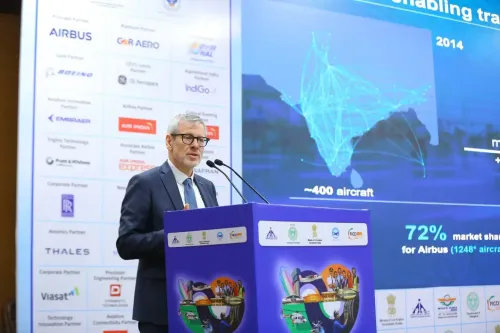
New Delhi, Dec 20 (NationPress) India is proud to be the third-largest domestic civil aviation market globally, with its fleet size growing from 395 aircraft in 2014 to 844 by 2025. This remarkable growth illustrates the sector's extraordinary momentum, according to Samir Kumar Sinha, Secretary of the Ministry of Civil Aviation.
In the past decade, passenger traffic has increased at an impressive average rate of 9 percent annually, while cargo volumes have surged by 2.9 percent, Sinha reported.
“The year 2025 has marked a period of learning and transformation in Indian civil aviation. Although challenges have tested our resilience, they have also strengthened our commitment to enhance safety, efficiency, and public trust. These experiences have united the aviation community with a renewed determination to foster a safer and more robust future for air travel in India,” he stated.
He made these remarks during a seminar organized by the Directorate General of Civil Aviation (DGCA) under the Ministry of Civil Aviation, which brought together senior officials from MoCA, DGCA, industry leaders, and aviation professionals from across India’s civil aviation ecosystem.
Sinha emphasized that “safety is not merely a fixed destination but an ongoing journey—requiring vigilance, compliance, and accountability.”
He cited critical safety issues that resonated strongly with the audience, reinforcing the collective responsibility to maintain a secure aviation environment.
“It’s essential to address operational risks introduced by maintenance errors, as these can lead to mechanical faults and system failures,” he remarked.
Faiz Ahmed Kidwai, Director General of DGCA, reiterated the regulator’s commitment to proactive safety oversight and global alignment.
He highlighted significant initiatives, including the implementation of the Bharatiya Vayuyan Adhiniyam, 2024, the State Safety Programme, and the National Aviation Safety Plan (2024–2028).
The event included three technical sessions that focused on safety challenges such as Runway Incursion, Positive Safety Culture in Aviation, and Maintenance Error.
Experts from regulatory and industry sectors participated in these sessions to discuss root causes, share best practices, and propose mitigation strategies.
The emphasis was on adopting a proactive, risk-based approach to safety management, supported by continuous learning and cross-sector collaboration.
Point of View
The ongoing developments in India's civil aviation sector signal a substantial commitment to enhancing safety and operational efficiency. With the government actively engaging with industry stakeholders, the future of air travel in India appears promising, further establishing the country as a key player in global aviation.
NationPress
20 Jul 2026
Frequently Asked Questions
What is the current size of India's domestic civil aviation market?
India stands as the third-largest domestic civil aviation market in the world.
How much has India's aircraft fleet grown since 2014?
India's fleet has expanded from 395 aircraft in 2014 to a projected 844 by 2025.
What is the annual growth rate of passenger traffic in India?
Passenger traffic in India has been growing at an average rate of 9 percent annually.
What safety initiatives are being implemented by the DGCA?
Key initiatives include the Bharatiya Vayuyan Adhiniyam, 2024, State Safety Programme, and the National Aviation Safety Plan (2024–2028).
Why is safety emphasized in Indian civil aviation?
Safety is viewed as an ongoing journey that requires constant vigilance, compliance, and accountability.