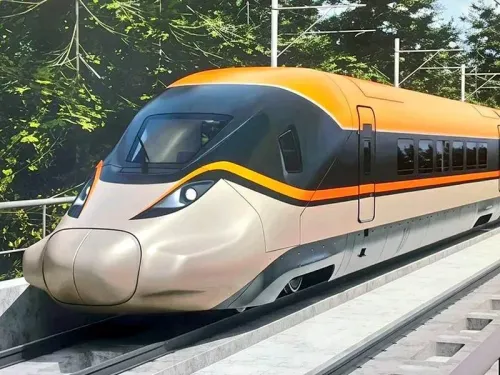
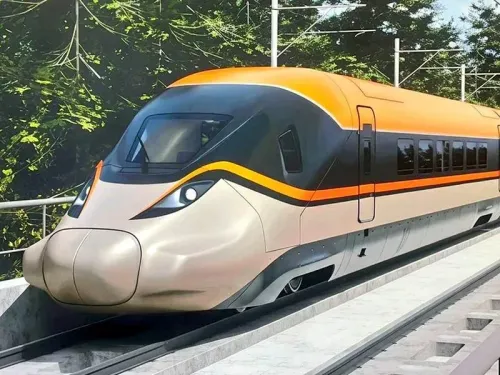
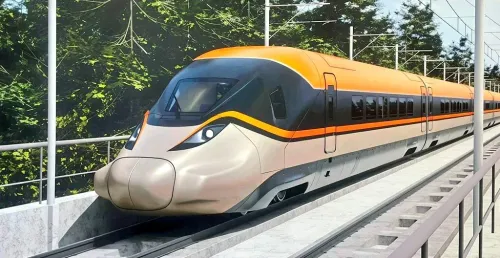
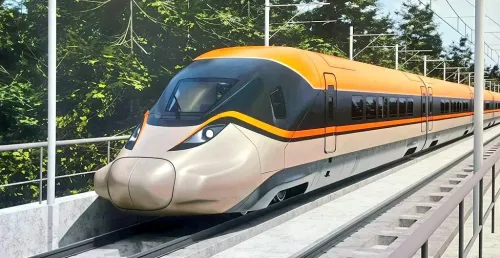
Mumbai–Ahmedabad bullet train corridor: first service by August 2027
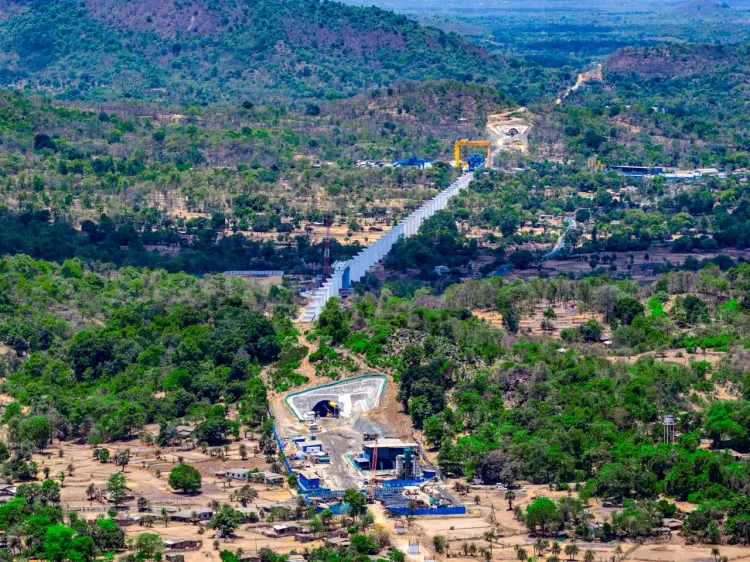
Synopsis
India's first bullet train corridor is no longer a blueprint — it's rising from the ground. With the Full Span Launching Method deployed for the first time in India, construction moving across Maharashtra, Gujarat, and Dadra & Nagar Haveli, and a firm August 2027 launch target, the MAHSR project is fast becoming the testbed for a ₹16 lakh crore national high-speed rail network.
Key Takeaways
The Mumbai–Ahmedabad High-Speed Rail (MAHSR) project is India's first bullet train corridor, spanning 508 kilometres across Maharashtra , Gujarat , and Dadra & Nagar Haveli .
First high-speed service is expected to commence in August 2027 , reducing travel time to approximately 1 hour 58 minutes .
The corridor has a design speed of 350 kmph and an operational speed of 320 kmph , built on Japanese Shinkansen technology.
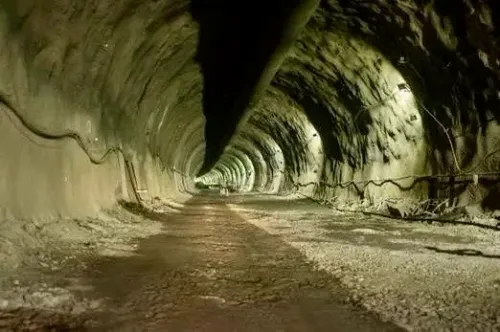
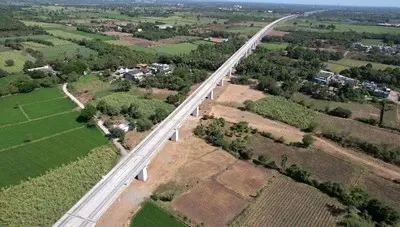
About 90 per cent of the route is elevated; the Full Span Launching Method (FSLM) is being used in India for the first time, reportedly 10 times faster than conventional methods.
The project serves 12 stations , with Sabarmati being developed as a multimodal transit hub.
Proposed national high-speed corridors spanning nearly 4,000 km are expected to attract investments of approximately ₹16 lakh crore .
The Mumbai–Ahmedabad High-Speed Rail (MAHSR) project — India's first bullet train corridor — is advancing steadily across civil works, bridge construction, and tunnelling, with the first high-speed service expected to commence in August 2027, according to an official factsheet released on Friday, 12 June. The 508-kilometre corridor will cut the Mumbai–Ahmedabad journey to under two hours, compared with 8–9 hours by road and 4–5 hours by air including airport procedures.
Scale and Scope of Construction
The MAHSR corridor stretches across Maharashtra, Gujarat, and Dadra & Nagar Haveli, serving 12 stations at Mumbai (BKC), Thane, Virar, Boisar, Vapi, Bilimora, Surat, Bharuch, Vadodara, Anand, Ahmedabad, and Sabarmati. Each station is designed to reflect the character of its host city, integrating contemporary architecture, modern amenities, and multimodal connectivity.
Approximately 90 per cent of the route is elevated. Construction is being carried out primarily through the Full Span Launching Method (FSLM) — a technique being deployed in India for the first time — which is reportedly ten times faster than conventional segmental construction. Noise barriers are being installed on both sides of the viaduct to minimise operational disruption.
Speed and Technology
The MAHSR project is built on Japanese Shinkansen technology and operational standards. Its design speed is 350 kmph and operational speed 320 kmph — a significant leap from the current highest design speed of around 180 kmph achieved by semi-high-speed services such as Vande Bharat. Advanced systems for traction, electrification, and track infrastructure are integral to the corridor's engineering.
The project will connect Mumbai and Ahmedabad in approximately 1 hour 58 minutes, making it one of the fastest intercity links in South Asia.
Building a Domestic High-Speed Rail Ecosystem
Beyond passenger transport, the MAHSR project is being positioned as the foundation for a domestic high-speed rail ecosystem. This includes viaduct construction, ballastless track installation, tunnelling, bridge launching, station-area planning, signalling, and power systems. Specialised training programmes for Indian engineers and technicians are also underway, with the skills developed expected to support future high-speed corridors across the country.
Sabarmati station is being developed as a multimodal hub, integrating the bullet train with metro, BRTS, and conventional railway networks. The surrounding area is being planned under transit-oriented development principles.
India's Broader High-Speed Rail Ambitions
The MAHSR corridor is part of a wider national vision. Proposed high-speed rail corridors spanning nearly 4,000 kilometres are expected to attract investments of approximately ₹16 lakh crore, according to the factsheet. These developments signal a structural shift in India's transport infrastructure planning, with high-speed rail now positioned as a long-term national priority rather than a standalone pilot.
As construction milestones accumulate and the August 2027 launch date approaches, the project's execution quality and timeline adherence will determine whether India's high-speed rail ambitions gain the credibility needed to unlock the next wave of corridor investments.
Point of View
But whether the full 508-kilometre stretch is operationally ready — not just the Gujarat segment. India's ₹16 lakh crore high-speed network vision depends entirely on MAHSR proving that delivery timelines are credible, not aspirational.
NationPress
26 Oct 2026
Frequently Asked Questions
When will the Mumbai–Ahmedabad bullet train start running?
The first high-speed rail service on the Mumbai–Ahmedabad corridor is expected to commence in August 2027, according to an official factsheet released on 12 June. The full 508-kilometre corridor will connect the two cities in approximately 1 hour 58 minutes.
What is the speed of the Mumbai–Ahmedabad bullet train?
The MAHSR corridor has a design speed of 350 kmph and an operational speed of 320 kmph, based on Japanese Shinkansen technology. This compares with a current maximum design speed of around 180 kmph for semi-high-speed services like Vande Bharat.
Which states does the MAHSR corridor pass through?
The 508-kilometre corridor passes through Maharashtra, Gujarat, and Dadra & Nagar Haveli. It serves 12 stations including Mumbai (BKC), Surat, Vadodara, Ahmedabad, and Sabarmati.
What technology is being used to build the bullet train corridor?
The MAHSR project uses Japanese Shinkansen technology and operational standards. Construction relies on the Full Span Launching Method (FSLM), being deployed in India for the first time, which is reportedly ten times faster than conventional segmental construction.
How much will India invest in its broader high-speed rail network?
Proposed high-speed rail corridors spanning nearly 4,000 kilometres are expected to attract investments of approximately ₹16 lakh crore, according to the official factsheet. The MAHSR project serves as the foundation and testbed for this national high-speed rail vision.