India's ease of doing business rank jumps 79 places in 5 years: Govt factsheet
Synopsis
India's official factsheet on 12 years of business reforms tells a story of dramatic rank jumps — from 142nd to 63rd in the World Bank's Doing Business index in five years, and a startup ecosystem that grew from 502 recognised firms to over 2.23 lakh, generating 23.3 lakh direct jobs. The numbers are substantial, but several benchmark methodologies have since changed, making the government's case both compelling and selectively framed.
Key Takeaways
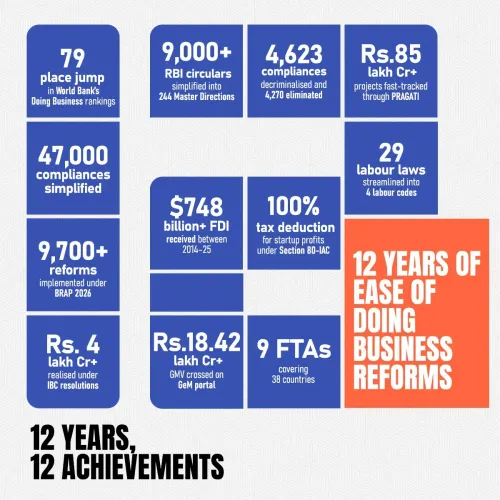
India's World Bank Doing Business rank improved from 142 in 2014 to 63 in 2019 — a jump of 79 positions in five years.
IMD World Competitiveness Ranking placed India at 41st in 2025 , up from 43rd in 2021 .
India has been in World Bank GovTech Maturity Index Group A in 2020, 2022, and 2025 .
Recognised startups grew from 502 in 2016 to over 2.23 lakh by March 2026 , creating 23.3 lakh direct jobs ; 48% have at least one woman director or partner.
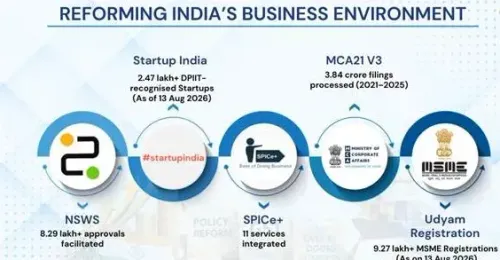
MCA21 processed 3.84 crore filings between 2021 and 2025, with 3.33 crore cleared via Straight Through Process.
Udyam Portal MSME registrations rose from 10,020 in October 2020 to over 8,58,000 by 5 June 2026 .
India's World Bank Doing Business rank surged from 142 in 2014 to 63 in 2019 — an improvement of 79 positions in five years — as sustained regulatory reforms over the past 12 years shifted the country's governance model from compliance-heavy administration to a facilitation-driven ecosystem, according to an official factsheet issued on Sunday, 7 June 2026. The document charts India's progress across multiple global benchmarks covering investor confidence, digital governance, and ease of doing business.
Global Rankings: Where India Stands
The IMD World Competitiveness Ranking 2025, which evaluates economic performance, government efficiency, business competitiveness, and infrastructure, placed India at 41st, up from 43rd in 2021. The factsheet attributes this to stronger governance, expanded digital infrastructure, and a more responsive regulatory framework.
The World Bank's GovTech Maturity Index has placed India in Group A — its highest tier — in 2020, 2022, and 2025, recognising advanced and innovative practices in public service delivery, digital citizen engagement, and core government systems. India has also secured a very high score in the UN E-Government Survey's online services index, alongside high scores in telecommunication infrastructure and human capital indices.
Startup Ecosystem: From 502 to 2.23 Lakh Recognised Startups
The transformation in India's startup landscape is among the most striking figures in the factsheet. In 2016, only 502 startups were officially recognised, generating 308 direct jobs. By March 2026, that figure had risen to over 2.23 lakh recognised startups, collectively creating 23.3 lakh direct jobs. Notably, around 48 per cent of these startups have at least one woman director or partner, reflecting a shift toward greater inclusivity in entrepreneurship.
The Startup India initiative underpins this growth, offering support through a Seed Fund, Fund of Funds, an investor connect portal, and a credit guarantee scheme. The stated aim is to reposition India as a nation of job creators rather than job seekers.
Corporate Compliance: MCA21 and AI-Driven Processing
The MCA21 Project, an AI-driven platform for end-to-end company registration and compliance filings, processed approximately 3.84 crore filings between 2021 and 2025. Of these, 3.33 crore were cleared through the Straight Through Process — a near-automated approval pathway that has reduced processing time and minimised manual intervention, the official statement noted.
MSME Formalisation: Udyam Portal Growth
The Udyam Registration Portal, launched in July 2020, offers a free, paperless, self-declaration-based system for Micro, Small and Medium Enterprises (MSMEs). Registrations on the portal climbed from 10,020 in October 2020 to over 8,58,000 by 5 June 2026, indicating a sharp uptick in MSME formalisation. The portal is part of a broader push to reduce procedural barriers for small businesses across the registration, logistics, and insolvency resolution lifecycle.
What the Numbers Don't Yet Settle
The factsheet presents a cumulative picture of reform momentum, but several of the benchmarks cited — including the World Bank Doing Business Report — have since been discontinued or revised, limiting direct year-on-year comparisons. The IMD ranking improvement of two positions over four years, while positive, is incremental. How these gains translate into private investment flows, formal employment at scale, and sustained GDP growth remains the harder metric to track. Sectoral guidelines and implementation quality will determine whether the regulatory simplification on paper delivers on the ground.
Point of View
But the headline Doing Business figure — a jump from 142 to 63 — draws from a report the World Bank itself discontinued in 2021 amid methodology concerns, which limits its currency as a live benchmark. The IMD gain of two places over four years is real but modest. The startup numbers are the most credible signal: 2.23 lakh recognised firms and 23.3 lakh direct jobs represent structural change, not just regulatory optics. The harder question is whether formalisation on paper — Udyam registrations, MCA21 filings — is translating into productivity and credit access for MSMEs, or merely into a larger compliance database. India's reform story is genuine; its framing consistently cherry-picks the most flattering vintage of each index.
NationPress
26 Sept 2026
Frequently Asked Questions
By how much did India improve its World Bank Doing Business ranking?
India's rank in the World Bank Doing Business Report improved from 142nd in 2014 to 63rd in 2019, an advancement of 79 positions over five years. The improvement is attributed to regulatory simplification, faster incorporation processes, and digitisation of compliance systems.
What is India's rank in the IMD World Competitiveness Ranking 2025?
India ranked 41st in the IMD World Competitiveness Ranking 2025, up from 43rd in 2021. The index evaluates economic performance, government efficiency, business competitiveness, and infrastructure.
How has the Startup India initiative performed?
Recognised startups under Startup India grew from 502 in 2016 to over 2.23 lakh by March 2026, generating 23.3 lakh direct jobs. Around 48 per cent of these startups have at least one woman director or partner.
What is the Udyam Registration Portal and how has it grown?
The Udyam Registration Portal, launched in July 2020, is a free, paperless, self-declaration-based system for MSME registration. Registrations grew from 10,020 in October 2020 to over 8,58,000 by 5 June 2026.
What is India's status on the World Bank GovTech Maturity Index?
India has been placed in Group A — the highest tier — of the World Bank's GovTech Maturity Index in 2020, 2022, and 2025. This category recognises countries with advanced practices in digital government, public service delivery, and citizen engagement.