Electric mobility key to India's energy security and green growth, experts say
Synopsis
India's EV push is not just a transport story — it is an energy security bet. Experts at a CRF panel in New Delhi argued that prioritising domestic electrons over imported molecules, fixing financing architecture rather than piling on subsidies, and electrifying freight alongside passenger vehicles are the three moves that will determine whether India's green mobility transition delivers at scale.
Key Takeaways
Alok Kumar , former Secretary at the Ministry of Power , proposed geography-specific EV mandates, including electrifying commercial fleets in Delhi by 2030 .
Dr Debajit Palit of CRF argued India should prioritise domestically generated electrons over imported energy molecules , framing EV adoption as an energy security strategy.
The real barrier to India's EV scale-up is financing architecture and absorptive capacity , not a shortage of capital, according to panellists.
CRF launched two research publications on EV finance gaps and the role of financial intermediaries in unlocking mitigation finance.
Experts flagged a confidence gap among financial institutions and called for stronger business models, including leasing and totex-based approaches, to improve EV bankability.
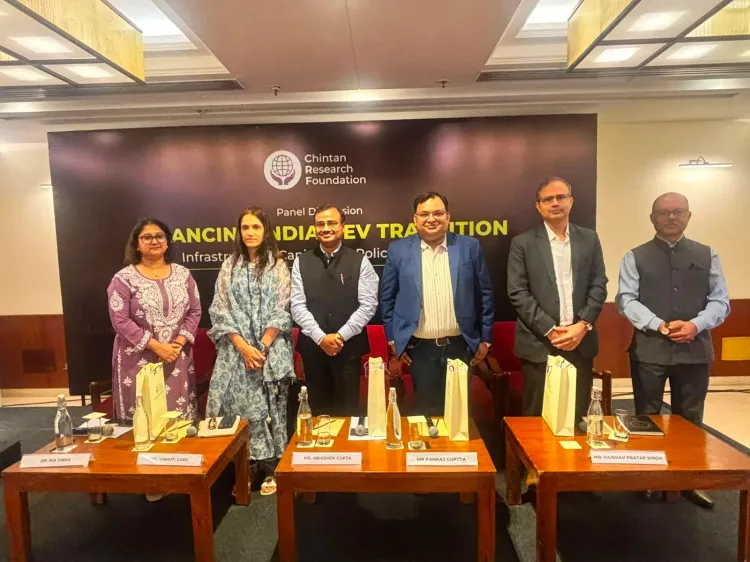
Electric mobility holds transformative potential for India's energy security and green growth, experts said at a panel discussion in New Delhi on Thursday, 25 June, as the country accelerates its transition to electric vehicles (EVs). The event, organised by the Chintan Research Foundation (CRF), brought together policymakers, financiers, and energy researchers to map the road ahead for India's EV transition.
Energy Security at the Core of EV Push
Alok Kumar, Director General of the All India Discoms Association and former Secretary at the Ministry of Power, framed India's energy transition primarily through the lens of affordability and green growth, with emission reduction as a secondary — though significant — benefit. Drawing comparisons with China, Europe, and Norway, Kumar cautioned that India must act decisively while its economic growth window remains open.
He proposed starting with geography-specific mandates — such as electrifying commercial vehicle fleets in Delhi by 2030 — to demonstrate scalability before any wider national rollout.
Electrons Over Molecules: The Strategic Argument
Dr Debajit Palit, Centre Head at CRF's Centre for Climate Change and Energy Transition, made a pointed case for prioritising electrons over molecules. He noted that India imports the vast majority of its energy molecules — barring coal — whereas electrons can be generated and progressively greened domestically. 'Transport electrification is not merely a transport policy,' Dr Palit argued; 'it is an energy security as well as an environmental strategy.'
Dr Palit also stressed that freight electrification deserves equal attention alongside passenger vehicles, and identified the real gap as lying not in capital availability but in financing architecture and absorptive capacity.
New CRF Publications Launched
The session saw the launch of two key research publications by Dr Ria Sinha, Senior Research Consultant at CRF. The first, a research study titled 'Role of Financial Intermediaries in Unlocking Mitigation Finance in India: Challenges and Enablers', and the second, an issue brief titled 'Financing India's EV Transition: Beyond Subsidies Towards a Bankable Ecosystem', together map the structural gaps in India's EV finance landscape.
Infrastructure, Capital, and the Confidence Gap
The first panel discussion, moderated by Anuraag Nallapaneni, Program Lead for Hydrogen at WRI India, featured IV Rao (Distinguished Fellow, TERI), Abhishek Ranjan (CEO, BSES Rajdhani Power Ltd), Gaurav Bhatiani (Senior Advisor, Habitat Emprise and Senior Fellow, Ashoka Centre for a People-Centric Energy Transition), and Shyamasis Das (Fellow, CSEP).
Panellists noted that EV penetration remains low and unevenly distributed across India, with infrastructure, coordination, and financing challenges deeply interlinked. Discussions centred on accelerating fast-charging infrastructure, addressing range anxiety, and a proposed hub model that triangulates mobility patterns, location, and grid capacity to improve utilisation and bankability.
The second panel, moderated by Dr Ria Sinha, included Vibhuti Garg (Director-South Asia, IEEFA), Abhishek Gupta (Head of Appliance and International Business, EESL), Pankaj Guptta (Founder and CEO, BatFIN Pvt. Ltd.), and Vaibhav Pratap Singh (Executive Director, Climate and Sustainability Initiative). Panellists flagged a persistent confidence gap among financial institutions, with several EV ecosystem segments yet to achieve full bankability.
Leasing and Totex Models Gain Traction
Panellists also discussed leasing as a potentially more viable financing option than traditional ownership models, and noted that a shift from capex to totex (total expenditure) approaches has already played a role in electric bus deployment. The consensus: stronger business models — not just more subsidies — are the missing link in scaling India's EV ecosystem. With policy clarity, smarter financing architecture, and grid integration, experts believe the transition can move from pilot to mainstream within this decade.
Point of View
Even as it is the most strategically compelling one. India's oil import bill runs into hundreds of thousands of crore rupees annually; electrifying transport is as much a balance-of-payments intervention as it is a green one. Yet the financing gap identified here — absorptive capacity, not capital scarcity — points to a structural problem that subsidies alone cannot solve. The shift from capex to totex in bus procurement is a quiet success story that deserves far more visibility as a template for two- and three-wheelers. The confidence gap among lenders is real, and until a critical mass of EV assets builds a credible repayment track record, the sector will remain dependent on public finance to de-risk private capital — a dependency that needs an explicit sunset plan.
NationPress
24 Sept 2026
Frequently Asked Questions
What was the focus of the CRF panel discussion on India's EV transition?
The panel, held in New Delhi on 25 June, focused on financing pathways for India's EV transition, covering infrastructure gaps, capital availability, and policy clarity. Experts argued that the primary barrier is not a lack of capital but inadequate financing architecture and absorptive capacity.
Why do experts link electric mobility to India's energy security?
India imports the vast majority of its energy molecules — crude oil, LNG, and others — barring coal. Shifting to EVs powered by domestically generated electricity reduces this import dependence, making transport electrification an energy security strategy as much as an environmental one.
What geography-specific EV mandate did experts propose?
Alok Kumar, former Secretary at the Ministry of Power, proposed electrifying commercial vehicle fleets in Delhi by 2030 as a scalable pilot before a wider national rollout, using targeted mandates to prove the model works.
What new research did CRF release at the event?
CRF launched two publications: a research study on the role of financial intermediaries in unlocking mitigation finance in India, and an issue brief titled 'Financing India's EV Transition: Beyond Subsidies Towards a Bankable Ecosystem,' both authored or coordinated by Dr Ria Sinha.
What financing models did panellists recommend for scaling EVs in India?
Panellists recommended leasing over traditional ownership models, and highlighted the shift from capex to totex (total expenditure) approaches — already used in electric bus deployment — as a template for broader EV financing. Stronger business models, rather than more subsidies, were identified as the key missing link.