Giriraj Singh Hails India's EV Share Crossing 11% in May 2026
Synopsis
Union Textiles Minister Giriraj Singh announced on 9 June 2026 that India's electric vehicle share crossed 11 per cent in May 2026 for the first time, citing PM Modi's clean energy policies, FAME incentives, PLI manufacturing support and the Viksit Bharat 2047 vision as driving forces.
Key Takeaways
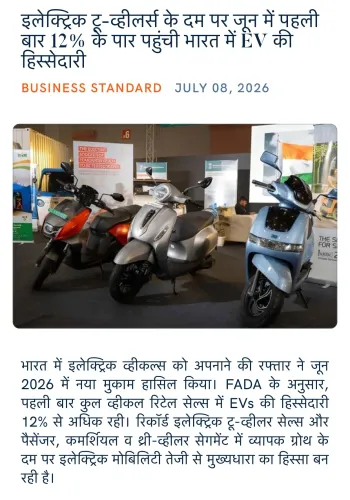
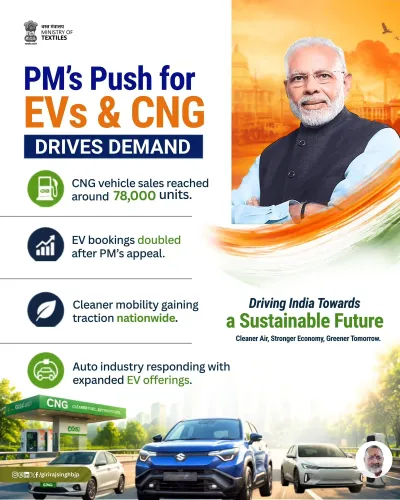
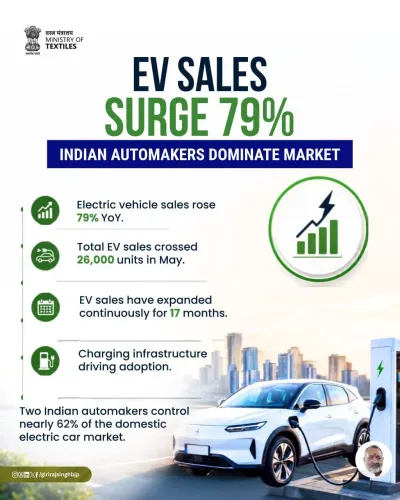
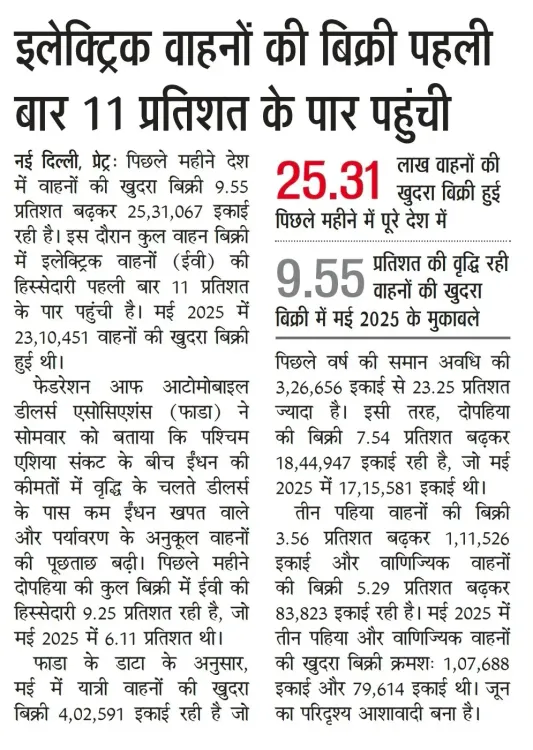
India's electric vehicle share crossed 11 per cent of total vehicle registrations in May 2026 for the first time, according to Union Textiles Minister Giriraj Singh .
The milestone is attributed to the FAME India scheme (launched 2015 ) and the PLI scheme for automobiles (approved 2021 ), which together provide demand and supply-side incentives.
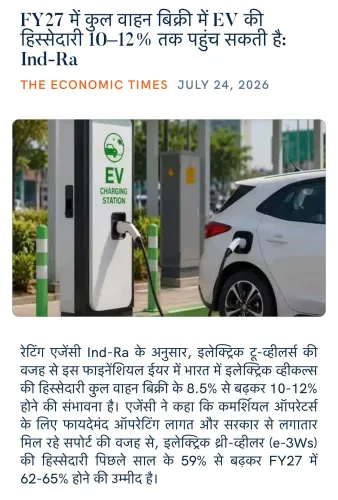
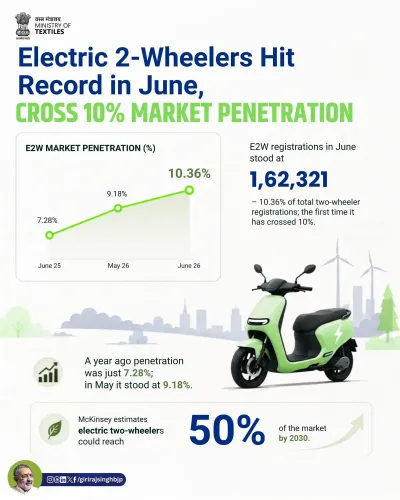
EV growth in India has historically been concentrated in two-wheelers and three-wheelers , with passenger and commercial vehicles expanding more gradually.
The achievement aligns with India's net-zero by 2070 commitment and the Viksit Bharat 2047 vision for a self-reliant, sustainable economy.
Official monthly registration data from the Ministry of Road Transport and Highways and the next Union Budget will be key indicators of whether the trend is sustained.
Union Textiles Minister Giriraj Singh on Tuesday, 9 June 2026 took to X to highlight that electric vehicles crossed an 11 per cent share of total vehicle registrations in May 2026 for the first time, calling the milestone evidence of growing public acceptance, strong policy support and India's commitment to sustainable development.
In his post, Singh wrote — 'मई 2026 में इलेक्ट्रिक वाहनों की हिस्सेदारी पहली बार 11% के पार पहुंच गई है' — ('In May 2026, the share of electric vehicles has crossed 11 per cent for the first time') — attributing the achievement to rising public acceptance, robust policy backing and India's resolve toward sustainable development. He added that under Prime Minister Narendra Modi, India is setting new benchmarks in clean energy, green mobility and a self-reliant automobile sector.
Context
The 11 per cent EV share figure, if confirmed by official registration data, would mark a significant inflection point in India's electric mobility journey. For years, EVs remained a small fraction of total vehicle sales, with adoption concentrated in two-wheelers and three-wheelers. A double-digit share across the broader vehicle market would indicate that the transition is moving beyond niche segments.
Singh's post frames the milestone within the government's Viksit Bharat 2047 vision — the long-term roadmap for a developed, self-reliant India by the centenary of independence — which explicitly includes sustainable mobility and green manufacturing as pillars.
Policy Backdrop
India's EV push rests on several interlocking policy instruments. The FAME India (Faster Adoption and Manufacturing of Electric Vehicles) scheme, first launched in 2015 and extended in a second phase from 2019, provided upfront demand incentives to buyers and manufacturers, lowering the effective purchase price of electric two-wheelers, three-wheelers and buses.
The Production Linked Incentive (PLI) scheme for automobiles and auto components, approved in 2021, extended support further up the value chain, incentivising domestic manufacturing of advanced EV components including battery packs. Both schemes sit within the broader Make in India and Atmanirbhar Bharat frameworks that link industrial policy with India's climate commitments, including the net-zero by 2070 target announced at COP26.
The Make in India programme, announced in 2014, targeted higher domestic value addition across the automobile sector and has increasingly been cited in the context of building a home-grown EV supply chain encompassing cells, motors and power electronics.
Stakeholders and Impact
The primary beneficiaries of sustained EV growth are domestic auto manufacturers that have invested heavily in electric platforms, battery suppliers scaling up cell assembly capacity, and EV buyers who gain from lower running costs and a widening model range. Charging infrastructure operators and state electricity distribution companies also stand to benefit as grid-connected vehicle loads grow.
For the broader economy, higher EV penetration directly reduces crude oil import dependence — a persistent pressure on India's current account — and cuts vehicular emissions in dense urban centres. The government has repeatedly highlighted both dimensions as strategic rationale for its green mobility push.
What's Next
Official monthly EV registration data published by the Ministry of Road Transport and Highways will be closely watched to corroborate the 11 per cent figure and establish whether May 2026 represents a durable trend or a seasonal spike. Analysts and industry bodies will also track whether the passenger vehicle and commercial vehicle segments are catching up with the two- and three-wheeler segments that have historically driven headline EV numbers.
On the policy side, the next Union Budget will be a key watch-point for any fresh outlay announcements extending or expanding FAME or PLI support. Sustained double-digit EV share would strengthen the case for continued incentives while also prompting debate about the timeline for phasing them out as the market matures.
Point of View
Using a mobility metric to reinforce the BJP's broader narrative of measurable progress under PM Modi across sectors beyond his own Textiles portfolio. The framing — linking a market share number to clean energy, self-reliance and Viksit Bharat 2047 — is consistent with the government's habit of bundling industrial and climate wins into a single political message. The 11 per cent figure, once verified by official data, would represent a genuine policy inflection point, but the choice of a Textiles Minister to amplify it also signals a whole-of-government communication strategy ahead of potential budget announcements on EV incentives. Observers will watch whether this signals an imminent policy move, such as FAME extension or PLI expansion, or is primarily electoral positioning.
NationPress
23 Oct 2026
Frequently Asked Questions
What is India's EV market share in May 2026?
According to a post by Union Textiles Minister Giriraj Singh, India's electric vehicle share crossed 11 per cent of total vehicle registrations in May 2026 for the first time. Official confirmation is expected from monthly data published by the Ministry of Road Transport and Highways.
What government schemes support electric vehicles in India?
The primary schemes are the FAME India (Faster Adoption and Manufacturing of Electric Vehicles) scheme, launched in 2015 and extended in Phase II from 2019 , and the Production Linked Incentive (PLI) scheme for automobiles and components, approved in 2021 . Together they provide demand-side buyer incentives and supply-side manufacturing subsidies.
Why is Giriraj Singh commenting on EV policy if he is the Textiles Minister?
Senior cabinet ministers routinely amplify government-wide policy achievements on social media regardless of their specific portfolio. Singh's post appears to be part of a broader BJP communication effort to highlight economic and environmental progress under PM Modi .
What is Viksit Bharat 2047 and how does it relate to EVs?
Viksit Bharat 2047 is the central government's long-term vision for a developed, self-reliant India by the centenary of independence in 2047 . Sustainable mobility and green manufacturing — including domestic EV production — are explicitly part of this roadmap.
Which vehicle segments are driving EV growth in India?
Growth in EV registrations in India has historically been concentrated in two-wheelers and three-wheelers , which benefit most from FAME demand incentives. The passenger vehicle and commercial vehicle segments have been expanding more gradually under the same policy framework.