Giriraj Singh Flags 34.4% Auto Sales Surge, EV Two-Wheelers Cross 2 Lakh
Synopsis
Union Textiles Minister Giriraj Singh highlighted July 2026 auto sales data showing a 34.4% YoY surge in passenger vehicles to 4,69,162 units and a historic first — electric two-wheeler sales crossing 2 lakh in a single month, signalling India's accelerating mobility shift.
Key Takeaways
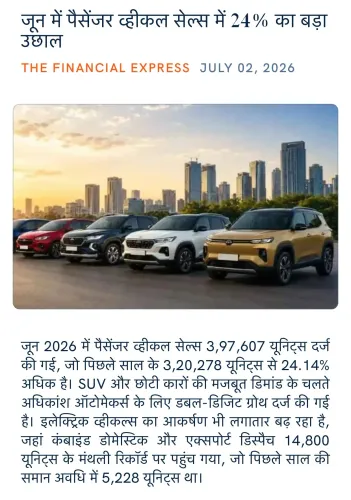
Passenger vehicle sales in July 2026 rose 34.4% year-on-year to 4,69,162 units , per data cited by Union Textiles Minister Giriraj Singh .
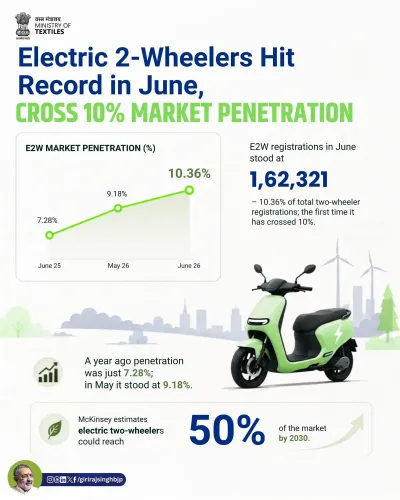
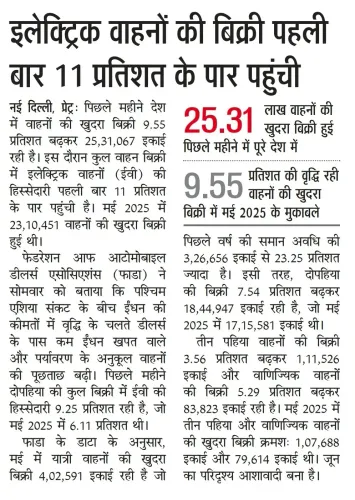
Electric two-wheeler sales crossed 2 lakh units in a single month for the first time, marking a structural milestone for India's EV segment.
The FAME India scheme (Phase II, extended 2021) and the PLI scheme for automobiles (notified 2021) form the key policy backbone behind EV adoption growth.
The Automotive Mission Plan 2016–2026 set long-term targets for the sector's GDP contribution and export scale.
Falling battery prices and sustained policy incentives have shifted electric two-wheelers from niche to volume segment.
Next monthly sales releases and any EV incentive revisions will determine whether July's figures represent a new baseline or a one-month peak.
India's passenger vehicle market just posted its sharpest monthly jump in recent memory — and the numbers are hard to ignore. Union Textiles Minister Giriraj Singh on Tuesday, August 11, 2026, highlighted data showing passenger vehicle sales surged 34.4% year-on-year in July 2026, with 4,69,162 units sold — framing it as proof of a deepening economic confidence in a 'New India.'
Posting in Hindi on X, the minister wrote: 'भारत के वाहन बाजार में तेजी से बढ़ता विश्वास और मांग, नए भारत की बढ़ती आर्थिक शक्ति को दर्शाता है' — 'The rapidly growing confidence and demand in India's vehicle market reflects the rising economic strength of New India.' The headline figures he cited: nearly half a million passenger vehicles sold in a single month, and electric two-wheelers crossing the 2 lakh unit milestone for the first time ever.
Electric Two-Wheelers Break the 2 Lakh Barrier
The EV two-wheeler figure is the sharper story. Crossing 2 lakh units in a single month marks a structural shift — not a blip. Battery prices have fallen steadily over the past three years, and policy scaffolding built under the FAME India scheme (launched 2015, with Phase II from 2019 and a revised outlay extension in 2021) has kept purchase incentives alive long enough to change buyer behaviour at scale. The electric two-wheeler segment, once a niche, is now a volume play.Policy Architecture Behind the Numbers
The surge does not arrive in a vacuum. The Automotive Mission Plan 2016–2026 set long-range targets for the sector's GDP contribution and export ambitions. The Production Linked Incentive (PLI) scheme for automobiles, notified in 2021, pushed manufacturers to invest in advanced vehicle platforms — including EVs — with domestic production at the centre. Together, these interventions created the supply-side conditions that are now meeting a demand-side moment: rising incomes, pent-up replacement demand, and a consumer class increasingly comfortable with electric mobility.What the Sales Data Signals for India's Mobility Shift
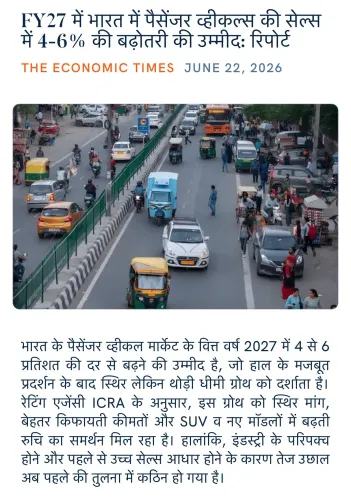
A 34.4% YoY jump in passenger vehicles in one month is not routine. It suggests either a genuine demand acceleration or a base-effect correction — possibly both. The more durable signal is the EV two-wheeler number: two lakh units in a month means the segment has genuine, repeatable scale. Industry bodies that track monthly volumes will be watched closely in the coming months to see whether July 2026 is a peak or a new floor. Any revision to EV incentives or charging infrastructure targets in upcoming policy statements will be the next variable to watch. India's auto sector is no longer just recovering from pandemic disruption — it is rewriting its own growth curve. The question now is whether the infrastructure and grid capacity can keep pace with the demand the policy has unlocked.Point of View
Falling battery costs, and PLI-driven domestic manufacturing has reached a tipping point. The 34.4% passenger vehicle jump, while striking, will need context from subsequent months to distinguish genuine demand acceleration from base-effect arithmetic. The broader arc is clear — India's auto sector is transitioning from a recovery story to a structural growth story, and the government is keen to own that narrative.
NationPress
26 Sept 2026
Frequently Asked Questions
What were India's passenger vehicle sales figures for July 2026?
According to data cited by Union Textiles Minister Giriraj Singh, 4,69,162 passenger vehicles were sold in July 2026 , a 34.4% increase year-on-year.
When did electric two-wheeler sales in India first cross 2 lakh units in a month?
Electric two-wheeler sales crossed the 2 lakh unit mark in a single month for the first time in July 2026 , as highlighted by Minister Giriraj Singh.
What is the FAME India scheme and how does it support EV adoption?
FAME India (Faster Adoption and Manufacturing of Electric Vehicles) was launched in 2015 to promote EV manufacturing and adoption. Phase II, implemented from 2019 and extended with a revised outlay in 2021 , specifically supported electric two-wheeler buyers through purchase incentives.
What is the PLI scheme for automobiles in India?
The Production Linked Incentive (PLI) scheme for automobiles was notified in 2021 to incentivise domestic manufacturing of advanced vehicles, including electric vehicles, by linking government support to incremental production targets.
Why is Giriraj Singh commenting on auto sales data if he is the Textiles Minister?
Senior cabinet ministers in India frequently comment on broad economic indicators as part of the ruling party's public communication strategy, even when the data falls outside their direct portfolio. Giriraj Singh posted the figures to highlight India's overall economic momentum under the 'New India' framing.