Giriraj Singh Hails 79% EV Sales Jump, Cites Modi-Led Policy Push
Synopsis
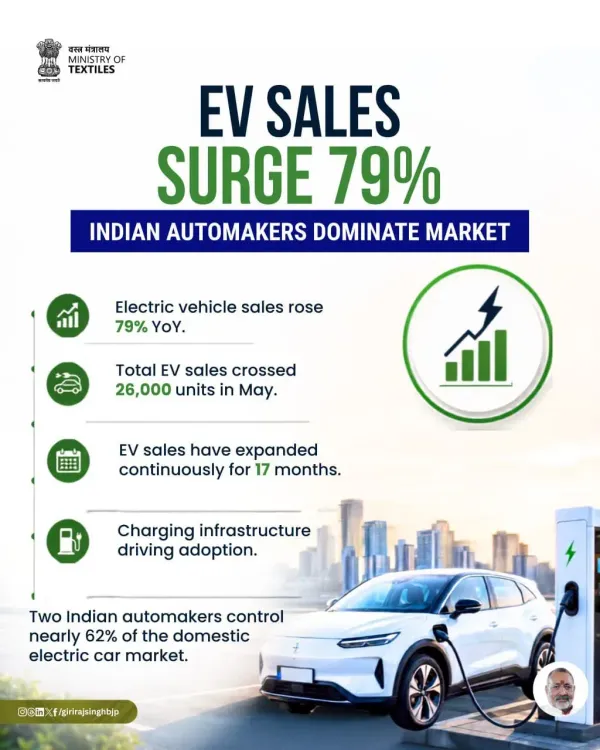
Union Textiles Minister Giriraj Singh on June 6, 2026, cited a 79 per cent year-on-year jump in EV sales as proof that Prime Minister Modi's policy ecosystem — spanning FAME subsidies, PLI incentives, and Make in India — is accelerating India's shift to green, self-reliant mobility.
Key Takeaways
Union Textiles Minister Giriraj Singh posted on June 6, 2026 highlighting a 79% year-on-year rise in EV sales in India.
Singh attributed the growth to government policy initiatives and infrastructure development under PM Narendra Modi's leadership.
Indian automakers are described as playing a leading role in the domestic EV market.
India's EV policy architecture includes the FAME India scheme (launched 2015) and the PLI scheme for automobiles (2021).
The government's EV push aims to reduce oil import dependence and meet Paris Agreement climate commitments.
Future policy focus is expected on revision of FAME II outlays and expansion of charging infrastructure at the state level.
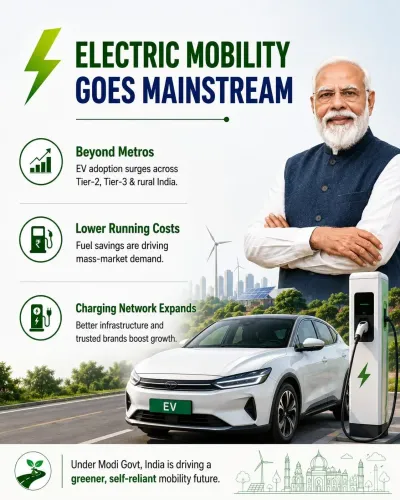
Union Textiles Minister Giriraj Singh on Saturday, June 6, 2026, credited the central government's policy initiatives and infrastructure development for driving what he described as a revolution in electric vehicle adoption in India, pointing to a 79 per cent year-on-year surge in EV sales and highlighting the leading role of domestic automakers in the home market.
Context
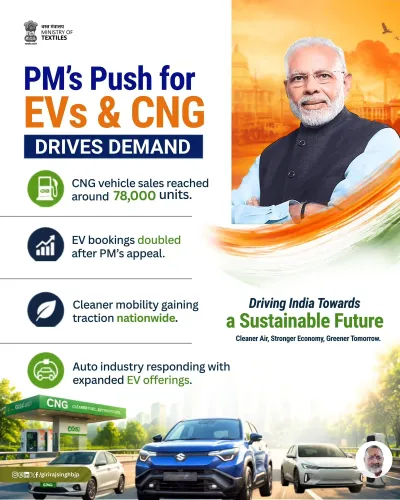
In a post on X, Singh wrote: 'सरकार की नीतिगत पहलों और मजबूत इंफ्रास्ट्रक्चर के सहयोग से देश में इलेक्ट्रिक वाहनों (EV) की क्रांति तेजी से आगे बढ़ रही है' — 'Backed by the government's policy initiatives and robust infrastructure, the electric vehicle revolution in the country is advancing rapidly.' He added that a 'robust ecosystem' built under the leadership of Prime Minister Narendra Modi is steering India toward a 'green and self-reliant future.'
Singh used the hashtags #EVMobility, #GreenIndia, #MakeInIndia, #GoodGovernance, and #SustainableFuture, signalling alignment with the government's broader manufacturing and sustainability messaging.
Policy Backdrop
India's electric mobility push has been built on a layered policy architecture spanning over a decade. The National Electric Mobility Mission Plan (NEMMP) 2020, unveiled in 2013, laid the initial groundwork for hybrid and electric vehicle promotion through demand creation and manufacturing support.
The FAME India (Faster Adoption and Manufacturing of Electric Vehicles) scheme, launched in 2015 under Phase I and significantly expanded in Phase II from 2019, has provided subsidies for EV purchases and investment in public charging infrastructure. Complementing this, the Production Linked Incentive (PLI) scheme for automobiles, introduced in 2021, offers financial incentives to domestic manufacturers of advanced automotive components, including batteries and EV parts, as part of the broader Make in India and Atmanirbhar Bharat agenda.
Stakeholders and Impact
Indian automakers have emerged as key beneficiaries and drivers of this transition, with domestic players reportedly holding a dominant share of the home EV market. The combination of demand-side subsidies under FAME and supply-side support under PLI has encouraged local production of components, reducing dependence on imports.
For EV buyers, policy support has translated into lower upfront costs and a gradually expanding network of charging points. India's EV push also carries strategic significance: cutting oil import bills and meeting commitments under the Paris Agreement on climate change are long-standing government objectives that electric mobility directly advances.
What's Next
Attention in the near term is likely to focus on parliamentary discussions around the extension or revision of FAME II and PLI scheme outlays in upcoming budget sessions. State-level EV policies and new charging infrastructure tenders will also be closely watched as indicators of how the national push translates to ground-level adoption.
Singh's post, while coming from the Textiles Ministry rather than the auto or heavy industries portfolio, reflects the ruling party's effort to amplify the EV growth narrative across its senior leadership ahead of what is expected to be a politically significant budget cycle.
Point of View
Delivered without a source citation, functions as political signalling ahead of a budget cycle where FAME and PLI renewals will be contested. By tying EV growth explicitly to Atmanirbhar Bharat and green commitments, the messaging simultaneously addresses domestic manufacturing audiences and international climate observers. The pattern suggests the party is positioning EV success as a cross-cutting 'Modi dividend' story rather than a sector-specific achievement.
NationPress
14 Sept 2026
Frequently Asked Questions
What did Giriraj Singh say about EV sales in India?
Giriraj Singh stated on June 6, 2026, that India's EV sales have grown by 79 per cent on a year-on-year basis, crediting government policy initiatives and infrastructure development under PM Narendra Modi's leadership.
What is the FAME India scheme?
FAME India (Faster Adoption and Manufacturing of Electric Vehicles) is a central government scheme launched in 2015 that provides subsidies for EV purchases and funds charging infrastructure; Phase II ran from 2019 and extended these incentives further.
How does the PLI scheme support electric vehicles in India?
The Production Linked Incentive (PLI) scheme for automobiles, introduced in 2021, offers financial incentives to domestic manufacturers of advanced automotive components including batteries and EV parts, encouraging local production under the Make in India programme.
Why is the Indian government pushing electric vehicles?
The government's EV push aims to reduce India's dependence on oil imports, meet climate commitments under the Paris Agreement, and build domestic manufacturing capacity under the Atmanirbhar Bharat initiative.
Which Indian automakers are leading in the EV market?
Giriraj Singh's post states that Indian automakers are playing a leading role in the domestic EV market, though it does not name specific companies; domestic players have been the primary beneficiaries of FAME subsidies and PLI incentives.