Giriraj Singh flags India's EV share crossing 12% in June
Synopsis
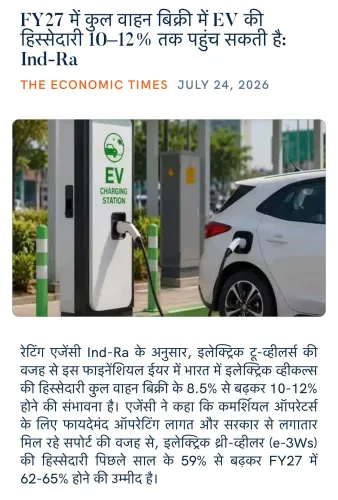
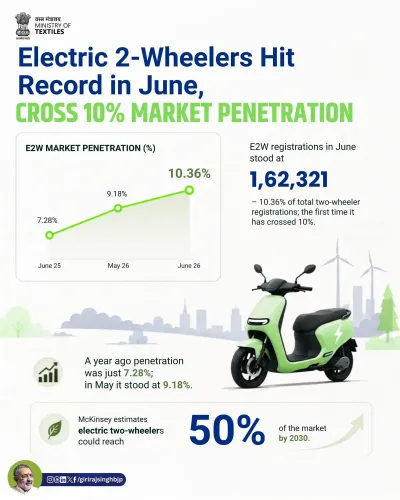
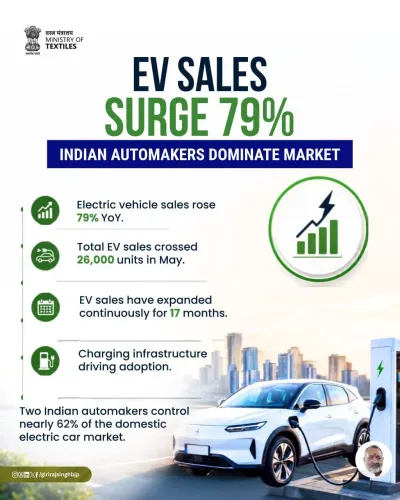
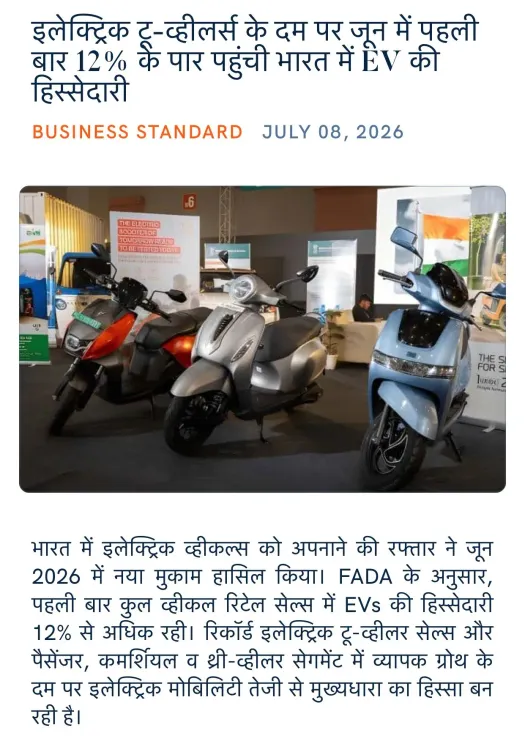
India's electric vehicle penetration crossed 12 per cent for the first time in June 2026, driven by electric two-wheelers. Union Textiles Minister Giriraj Singh highlighted the milestone on 8 July 2026, reflecting gains from successive central schemes including FAME II and the PLI for automobiles.
Key Takeaways
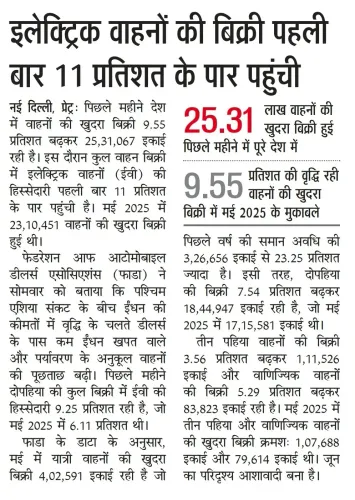
India's EV penetration crossed 12 per cent for the first time in June 2026 .
Electric two-wheelers were the primary driver of this milestone, consistent with their dominant share of EV registrations.
The achievement builds on the FAME Phase II scheme (Rs 10,000 crore outlay) and the PLI scheme for automobiles (over Rs 26,000 crore outlay), both of which prioritised electric two-wheelers.
NITI Aayog roadmaps have targeted significant electric two-wheeler penetration by 2030 , and June's figure marks a measurable step toward that goal.
Higher EV adoption in two-wheelers directly reduces India's petrol import dependence, supporting the country's net-zero by 2070 commitment.
July 2026 registration data and upcoming state budget announcements will indicate whether the trend above 12 per cent is sustained.
Union Textiles Minister Giriraj Singh on Wednesday, 8 July 2026, shared data showing that India's electric vehicle penetration crossed 12 per cent for the first time in June 2026, driven primarily by electric two-wheelers. The minister shared the milestone via the NaMo App, underlining the government's emphasis on tracking clean-mobility metrics.
Context
The post shared an industry report indicating that EV penetration in India breached the 12 per cent mark in June 2026 — a first for the country. Electric two-wheelers (e2Ws) were cited as the primary driver of this milestone, consistent with their dominant share of total EV registrations in India over recent years.
India's vehicle fleet is overwhelmingly two-wheeler-heavy, and that segment has historically responded fastest to purchase incentives, making it the engine of EV adoption statistics month after month.
Policy Backdrop
The milestone comes on the back of a decade-long policy push. The government launched FAME India Phase I in 2015 to offer upfront purchase incentives for electric and hybrid vehicles, followed by FAME Phase II in 2019 with a Rs 10,000 crore outlay that specifically prioritised electric two-wheelers and public transport.
The Production Linked Incentive (PLI) scheme for automobiles, notified in 2021 with an outlay exceeding Rs 26,000 crore, aimed to deepen domestic manufacturing of EVs and components. A separate PLI scheme for Advanced Chemistry Cells, also approved in 2021, targeted localisation of battery manufacturing — a critical cost driver for electric vehicles.
NITI Aayog has published roadmaps targeting a significant share of electric two-wheelers in Indian mobility by 2030, and the June figure represents a measurable step toward those goals.
Stakeholders and Impact
The 12 per cent penetration figure is consequential for two-wheeler buyers, who stand to benefit from a maturing market with more model choices and potentially lower prices as volumes scale. Auto manufacturers and battery suppliers operating in the electric two-wheeler segment see the number as validation of demand-side momentum.
For the broader economy, higher EV adoption in the two-wheeler segment directly reduces dependence on petrol imports, aligning with India's stated goal of achieving net zero by 2070. State governments that have layered their own subsidies on top of central schemes are also watching monthly penetration data closely to calibrate future policy.
What's Next
Industry bodies are expected to release July 2026 EV registration data in the coming weeks, which will indicate whether the June breakthrough was a one-month spike or the start of a sustained trend above 12 per cent. Analysts will watch whether state budget cycles bring new or extended two-wheeler subsidy announcements that could sustain momentum.
The government's longer-term target of transforming India's mobility mix means that monthly EV penetration figures are likely to remain a closely tracked policy barometer through the rest of the decade.
Point of View
Even if the number is still modest by global standards. The fact that a senior minister from the Textiles portfolio amplified the data signals the BJP government's broader political investment in EV adoption as a cross-sectoral achievement narrative. The milestone is structurally anchored in two-wheelers, which means penetration gains remain highly sensitive to subsidy continuity — a policy risk that the upcoming FAME successor framework will need to address. Sustaining momentum beyond 12 per cent will require the demand-side gains of the last decade to be matched by supply-side deepening in battery and component manufacturing.
NationPress
7 Oct 2026
Frequently Asked Questions
What is India's EV penetration as of June 2026?
India's EV penetration crossed 12 per cent for the first time in June 2026, driven primarily by electric two-wheelers.
Which vehicle segment is driving EV adoption in India?
Electric two-wheelers are the dominant driver of EV adoption in India, accounting for the bulk of monthly EV registrations due to their large share of the overall vehicle fleet and their sensitivity to purchase incentives.
What government schemes support electric two-wheelers in India?
The FAME Phase II scheme, launched in 2019 with a Rs 10,000 crore outlay, specifically prioritised electric two-wheelers. The PLI scheme for automobiles, notified in 2021 with over Rs 26,000 crore, further supports domestic EV manufacturing.
Why did Giriraj Singh post about EVs when he is the Textiles Minister?
Senior ministers frequently amplify cross-sectoral government achievements on social media. Singh shared the EV penetration data via the NaMo App, reflecting the BJP government's broader push to highlight clean-mobility milestones.
What is India's EV target for 2030?
NITI Aayog has published roadmaps targeting a significant share of electric two-wheelers in Indian mobility by 2030, though the specific percentage target varies across policy documents.