Giriraj Singh Hails Record EV Sales Surge in September
Synopsis
India's EV sales hit a record 3.33 lakh units in September 2026, up 74% year-on-year, as Union Textiles Minister Giriraj Singh credited the PM E-DRIVE scheme and wider model availability for driving the milestone adoption surge.
Key Takeaways
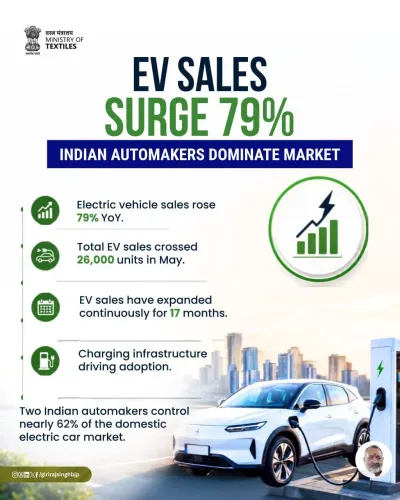
India's EV sales reached a record 3.33 lakh units in September 2026 , a 74% year-on-year jump.
Union Textiles Minister Giriraj Singh attributed the surge to the PM E-DRIVE scheme and an expanding range of electric models.
PM E-DRIVE combines demand incentives for buyers with support for charging infrastructure, succeeding the FAME-II scheme that ran until 2024.
The PLI scheme for automobiles (announced 2021 ) has supported domestic EV manufacturing, broadening model availability.
Rising EV adoption directly addresses India's oil import dependence and supports its 2070 net-zero target .
Sustainability of the monthly sales record through the post-festive season will be the key indicator to watch.
India's electric vehicle revolution just hit a new high-water mark. Union Textiles Minister Giriraj Singh took to X on Thursday, October 15, 2026, to flag a milestone the auto sector has been building toward for years: EV sales in India surged 74 per cent year-on-year in September 2026, reaching a record 3.33 lakh units.
In his post, the Minister wrote: 'भारत में EV की बिक्री सितंबर में 74%(YOY) बढ़कर 3.33 लाख यूनिट्स के रिकॉर्ड स्तर पर पहुंच गई है' — 'EV sales in India have risen 74% (YoY) in September to a record level of 3.33 lakh units.' He attributed the jump to the government's PM E-DRIVE scheme and a rapidly expanding range of electric models drawing buyers in.
PM E-DRIVE's role in the sales jump
The PM E-DRIVE scheme is the Central government's current flagship instrument for accelerating electric mobility — combining demand-side incentives for buyers with support for charging infrastructure buildout. It builds on the foundation laid by the FAME-II scheme, which ran from 2019 to 2024 and first normalised EV subsidies at scale across two-wheelers, three-wheelers, and buses.
The Production Linked Incentive (PLI) scheme for automobiles and auto components, announced in 2021, added a manufacturing push — encouraging domestic players to scale up EV production and reduce import dependence on critical components. The combination of fiscal pull and supply-side manufacturing incentives has steadily thickened the pipeline of affordable, locally produced models reaching showroom floors.
Why India's EV push is bigger than a sales number
India is the world's third-largest automobile market, and its dependence on oil imports remains a structural economic pressure point. Every lakh EVs that displace petrol and diesel vehicles chips away at that import bill — directly serving the government's twin goals of energy security and progress toward its 2070 net-zero emissions target.
September's record reading reflects more than a policy nudge. Expanding model availability across segments — from budget two-wheelers to mid-range passenger cars — has broadened the buyer base well beyond early adopters. When the vehicles are there and the incentives are real, demand follows. That is exactly the pattern playing out now.
The next test will be whether these monthly peaks can hold through the post-festive season and whether a mid-term review of PM E-DRIVE maintains the incentive intensity that is clearly working. For now, the numbers speak for themselves — India's electric shift is accelerating, and September just raised the bar.
Point of View
Data-backed win to amplify as it defends its industrial and energy transition policy record. The explicit mention of PM E-DRIVE signals an effort to brand the sales milestone firmly to the current scheme, drawing a clear policy-to-outcome narrative. The broader arc here is India's deliberate pivot from subsidy-led awareness (FAME-II) to scaled adoption — and a 74% YoY surge suggests that pivot is gaining real commercial momentum. Whether the government can sustain incentive intensity without fiscal strain will define the next chapter of this story.
NationPress
15 Oct 2026
Frequently Asked Questions
What was India's EV sales figure in September 2026?
According to Union Textiles Minister Giriraj Singh's post, India's EV sales reached a record 3.33 lakh units in September 2026, marking a 74% year-on-year increase.
What is the PM E-DRIVE scheme?
PM E-DRIVE is a Central government scheme that provides demand incentives to EV buyers and supports the development of charging infrastructure, succeeding the earlier FAME-II scheme which ran from 2019 to 2024.
Why is Giriraj Singh commenting on EV sales if he is the Textiles Minister?
As a senior BJP leader, Giriraj Singh frequently amplifies government policy achievements beyond his direct portfolio, using his social media presence to highlight milestones across the economy.
What was the FAME-II scheme and how does it relate to current EV policy?
FAME-II (Faster Adoption and Manufacturing of Electric Vehicles Phase II) was launched in 2019 and provided demand-side subsidies for EVs until 2024 . PM E-DRIVE is its successor, continuing and expanding the incentive framework.
How does rising EV adoption benefit India's economy?
India is the world's third-largest automobile market and a major oil importer. Higher EV adoption reduces the country's dependence on imported oil, easing the trade deficit and contributing to India's 2070 net-zero emissions target .