How has India's fish production increased by 38% under PMMSY?
Synopsis
Discover how India's fish production has surged by an impressive 38% since the launch of the Pradhan Mantri Matsya Sampada Yojana in 2020. This growth is driven by advancements in aquaculture and increased exports, marking a significant milestone for the fisheries sector.
Key Takeaways
Fish production in India has increased by 38% since the PMMSY launch.
Exports of fish products are currently valued at Rs 62,408.45 crore.
The average aquaculture productivity has risen to 4.7 tonnes per hectare .
Government initiatives focus on enhancing fisheries technology and value addition.
Five fisheries business incubation centers have been established to support startups.
New Delhi, Dec 17 (NationPress) India's fish production has seen a remarkable rise, escalating from 141.60 lakh tonnes in 2019–20 to approximately 197.75 lakh tonnes by 2024–25, marking a growth of 38% since the initiation of the Pradhan Mantri Matsya Sampada Yojana (PMMSY) in 2020, as reported to Parliament on Wednesday.
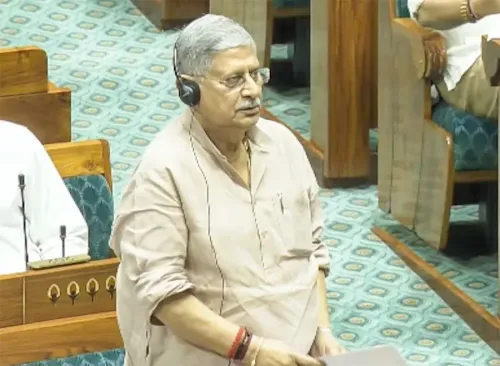
In response to a Lok Sabha inquiry, Fisheries, Animal Husbandry, and Dairying Minister Rajeev Ranjan Singh conveyed that this significant growth is primarily attributed to the advancement of inland aquaculture, development of marine fisheries, enhancement of the value-chain infrastructure, and various policy initiatives under the PMMSY scheme.
Currently, India's exports of fish and fishery products stand at Rs 62,408.45 crore, showcasing robust sector performance. Since the PMMSY's implementation in 2020-21, export revenues have surged by approximately 33.7%, rising from Rs 46,662.85 crore in 2019-20 to Rs 62,408.45 crore by 2024-25.
By early 2025, India's average aquaculture productivity has reached around 4.7 tonnes per hectare, up from nearly 3 tonnes per hectare before the PMMSY launch. The top five states contributing to inland fish production are Andhra Pradesh, West Bengal, Uttar Pradesh, Bihar, and Odisha, with Bihar ranking fourth, as per the minister's statement.
The Gross Value Added (GVA) of the fisheries sector for 2023-24 is reported at Rs 3,68,124 crore, a significant increase from Rs 2,12,087 crore in 2018-19. The share of the fisheries sector in the GVA of the agriculture sector has grown from 7% in 2018-19 to 7.55% in 2023-24.
The Central Government is concentrating on fisheries technology, aquaculture, and value addition by supporting numerous interventions along the fisheries value chain. These include quality fish production, expansion, diversification, and intensification of aquaculture, promotion of export-oriented species, technology infusion, robust disease management and traceability, as well as training and capacity building. They are also focused on creating modern post-harvest infrastructure, complete with seamless cold chain and processing facilities, the minister elaborated.
Technology integration has been bolstered with the establishment of 52,058 reservoir cages, 22,057 RAS & Biofloc units, and 1,525 sea cages sanctioned under the PMMSY, representing an investment of Rs 3040.87 crore.
The Department of Fisheries has partnered with various research institutions under the Indian Council of Agricultural Research (ICAR) and private incubators to enhance the fisheries startup ecosystem.
Furthermore, the department has facilitated the establishment of five fisheries business incubation centers, including the LINAC-NCDC Fisheries Business Incubation Centre (LlFIC), Guwahati Biotech Park in Assam, National Institute of Agricultural Extension Management (MANAGE) in Hyderabad, ICAR-Central Institute of Fisheries Education (CIFE) in Mumbai, and ICAR-Central Institute of Fisheries Technology (CIFT) in Kochi. These centers aim to provide mentorship and training for developing business models for fisheries startups, cooperatives, FPOs, and SHGs, as stated by the minister.
Point of View
The growth in India's fisheries sector under the PMMSY is not just an economic boon but a significant step towards ensuring food security and sustainability in aquaculture. The government's initiatives are commendable, yet continuous efforts are required to maintain this momentum and address challenges effectively.
NationPress
6 Oct 2026
Frequently Asked Questions
How much has fish production increased in India?
India's fish production has surged by 38%, increasing from 141.60 lakh tonnes in 2019–20 to approximately 197.75 lakh tonnes by 2024–25.
What factors contributed to the growth in fish production?
The growth in fish production has been primarily driven by advancements in inland aquaculture, marine fishery development, and strengthened value-chain infrastructure.
How much do fish exports contribute to the economy?
India's fish and fishery product exports currently stand at Rs 62,408.45 crore, reflecting a strong performance in the sector.
What is the average aquaculture productivity in India?
India's average aquaculture productivity has increased to approximately 4.7 tonnes per hectare by early 2025.