India's Fish Production Surges: A Decade of Growth

Synopsis
India's fish production has more than doubled in the last decade, now standing at 197.75 lakh tonnes for 2024-25. This remarkable growth solidifies India's position as the world's second-largest producer of marine products, creating millions of jobs and boosting seafood exports significantly.
Key Takeaways
India's fish production has surpassed 197.75 lakh tonnes in 2024-25.
The sector has generated 74.66 lakh employment opportunities.
Frozen shrimp remains the leading export item.
India accounts for 8% of global fish production.
The PMMSY continues to play a crucial role in fisheries development.
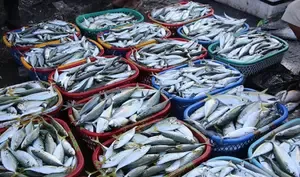
New Delhi, April 6 (NationPress) India's fish production has experienced an impressive growth, more than doubling in the span of a decade, reaching 197.75 lakh tonnes in 2024-25 from 95.79 lakh tonnes in 2013-14. This achievement positions India as the second-largest producer of marine products globally, according to a factsheet released by the Central government on Monday.
The fisheries sector has also been pivotal in generating approximately 74.66 lakh direct and indirect jobs since the implementation of various fisheries-related schemes starting in 2014-15, emphasizing its crucial role in promoting inclusive and sustainable economic development, as highlighted in the official statement.
In parallel, seafood exports have surged, hitting Rs 62,408 crore in FY 2024-25. Frozen shrimp continues to dominate the export market, with the US and China being the primary buyers, showcasing the sector's expanding scale and enhanced global competitiveness.
India now contributes about 8 percent of the world's fish production. With the Union Budget for 2026-27 allocating an unprecedented Rs 2,761.80 crore in annual support for the fisheries sector, it is anticipated that fish production will continue to grow.
This budget includes Rs 2,530 crore designated for targeted government initiatives, which encompass financial aid, capital subsidies, insurance coverage, capacity-building programs, infrastructure development, and welfare support systems aimed directly at benefiting both fishers and fish farmers.
The Pradhan Mantri Matsya Sampada Yojana (PMMSY), initiated in 2020, remains a core component of fisheries development with a budget allocation of Rs 2,500 crore in 2026-27. This comprehensive plan focuses on enhancing production, developing infrastructure, and improving the value chain. Additionally, the Modern Aquaculture initiative introduced under PMMSY and the Pradhan Mantri Matsya Kisan Samridhi Sah-Yojana (PM-MKSSY) have highlighted the importance of formalization, insurance, and financial inclusion in the sector.
The introduction of the Kisan Credit Card (KCC) for fisheries has significantly improved access to institutional credit, benefiting around 4.39 lakh fishers. Furthermore, insurance coverage has been extended to 3.3 million beneficiaries, while livelihood support has reached about 7.44 lakh fisher families.
The fisheries sector stands as a vital contributor to India's economy, supporting the livelihoods of nearly three crore people, particularly within marginalized coastal and inland communities.
As the sector's significance continues to grow, it now accounts for nearly 7.43 percent of Agricultural Gross Value Added (GVA), the highest share among agriculture and allied sectors. This increasing importance is further supported by consistent policy prioritization.
Since the commencement of the Blue Revolution in 2015, the fisheries sector has evolved from traditional practices to a more organized, technology-driven, and value-chain-focused framework in alignment with the Sustainable Development Goals (SDGs). Recent policy interventions have emphasized integrated value chain development across marine, inland, and aquaculture areas. Investments in fishing harbors, landing centers, cold-chain logistics, processing facilities, deep-sea vessels, and advanced aquaculture systems have bolstered export competitiveness and enhanced value addition.
According to the Economic Survey 2025-26, collective institutions have been strengthened with the establishment of 2,195 Fisheries Farmer Producer Organisations (FFPOs), supported by an investment of Rs 544 crore aimed at improving market access and financial inclusion.
Moreover, by January 2026, nutritional and livelihood support during fishing bans and lean periods has benefitted approximately 4.33 lakh fisher families, with a total allocation of Rs 1,681.21 crore, enhancing income stability and social protection.
Point of View
I view India's remarkable growth in fish production over the past decade as a testament to effective governmental policies and the sector's vital role in economic development. This progress not only supports livelihoods but also showcases India's potential in the global seafood market.
NationPress
15 Oct 2026
Frequently Asked Questions
What is the current fish production in India?
India's fish production reached 197.75 lakh tonnes in 2024-25.
How many jobs has the fisheries sector created?
The fisheries sector has generated approximately 74.66 lakh direct and indirect jobs.
What is the significance of the PMMSY?
The PMMSY is a pivotal scheme focusing on enhancing fish production, infrastructure development, and value chain improvements.
Which countries are the main markets for Indian seafood exports?
The primary markets for Indian seafood exports are the USA and China.
What has been the impact of the Blue Revolution?
The Blue Revolution has transformed the sector towards a more organized and technology-driven approach.