India's Fisheries Sector Attracts Rs 39,272 Crore Investment Since 2015 and Seafood Exports Surge

Synopsis
India's fisheries sector has seen significant growth, with a remarkable investment of Rs 39,272 crore since 2015. This boost has led to an increase in seafood exports and production, supporting millions of livelihoods and enhancing food security across the nation.
Key Takeaways
Investment: Rs 39,272 crore since 2015.
Employment: Supports nearly 30 million livelihoods.
Production Growth: From 141.64 lakh tonnes to 197.75 lakh tonnes by 2024-25.
Export Value: Seafood exports have doubled to Rs 62,408 crore.
Market Reach: Exports to over 130 global markets.
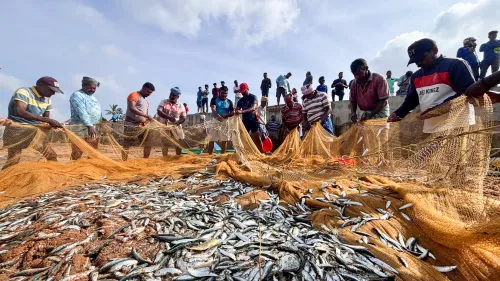
New Delhi, April 3 (NationPress) The Indian government announced on Friday that the country's fisheries sector has emerged as a crucial player in enhancing food security, generating employment, and boosting export revenues, supported by a remarkable investment of Rs 39,272 crore since 2015.
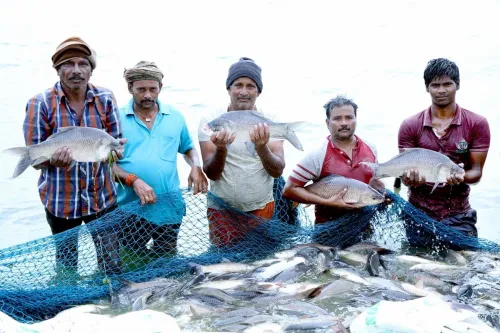
As reported by the Ministry of Fisheries, Animal Husbandry and Dairying, this sector provides livelihoods to nearly 30 million fishers and fish farmers at the grassroots level and supports nearly double that number throughout the supply chain.
India has now positioned itself as the second-largest aquaculture producer in the world, contributing approximately 8 percent to global fish production.
Additionally, domestic fish output increased from 141.64 lakh tonnes in 2019-20 to 197.75 lakh tonnes projected in 2024-25, reflecting an average annual growth rate of about 7 percent.
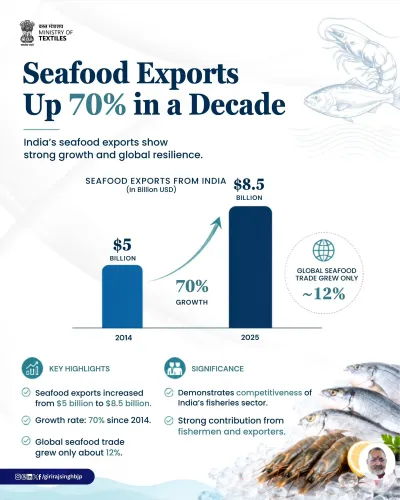
Seafood exports have more than doubled in the last decade, soaring from Rs 30,213 crore in 2013-14 to Rs 62,408 crore anticipated in 2024-25, primarily fueled by shrimp exports, which are valued at Rs 43,334 crore.
India currently exports over 350 varieties of seafood products to around 130 international markets, with the United States representing 36.42 percent of total export value in 2024-25, followed by China, the European Union, Southeast Asia, Japan, and the Middle East.
The proportion of value-added products in the export mix has surged from 2.5 percent to 11 percent, amounting to $742 million.
In an effort to diversify and lessen reliance on a limited range of commodities, the government is advocating for high-value species such as tuna, seabass, cobia, mud crab, tiger shrimp, and seaweed under the Pradhan Mantri Matsya Sampada Yojana (PMMSY). Investments are also being made in cold-chain logistics, modern fishing ports, and digital traceability systems.
India received a comparability determination from U.S. authorities in 2025 under the Marine Mammal Protection Act, ensuring uninterrupted seafood exports to its largest market.
The government also reported that the widespread implementation of Turtle Excluder Devices on shrimp trawlers is progressing across coastal states.
On the regulatory side, the Sanitary Import Permit system has been completely digitized and integrated with the National Single Window System, reducing approval time from 30 days to 72 hours.
Looking ahead, the government aims to increase value-added exports, establish inland export hubs, and strengthen India's market presence in regions such as the UK, EU, ASEAN, and West Asia over the next five years.
Point of View
It’s evident that India's fisheries sector is rapidly evolving into a cornerstone of the national economy. With substantial investments and strategic government initiatives, the future looks promising, not only for food security but also for enhancing India's presence in global markets. The focus on diverse and high-value species will bolster resilience against market fluctuations, ensuring sustainable growth.
NationPress
24 Sept 2026
Frequently Asked Questions
What is the total investment in India's fisheries sector since 2015?
The total investment in India's fisheries sector since 2015 is Rs 39,272 crore.
How much fish does India produce annually?
India's fish production is projected to rise from 141.64 lakh tonnes in 2019-20 to 197.75 lakh tonnes by 2024-25.
What percentage of global fish production does India account for?
India accounts for approximately 8 percent of the world's fish output.
Which country is the largest market for Indian seafood exports?
The United States is the largest market for Indian seafood exports, accounting for 36.42 percent of the total export value.
What initiatives are being taken to enhance the fisheries sector?
Initiatives include promoting high-value species, investing in cold-chain logistics, and digitizing the Sanitary Import Permit system.