India's Food Export Ambitions: Piyush Goyal's Call to Action
Synopsis
In a significant address, Piyush Goyal highlights India's potential to become the leading exporter of agricultural and processed foods, backed by impressive growth in food exports and strategic trade agreements. Discover the opportunities and protective measures ensuring farmers and businesses thrive.
Key Takeaways
Piyush Goyal calls for collaboration to boost India's food exports.
India's food export value is nearing Rs 5 lakh crore.
Significant growth observed in various food export categories.
Trade agreements provide access to 38 developed nations.
Protection of domestic interests during trade negotiations is prioritized.
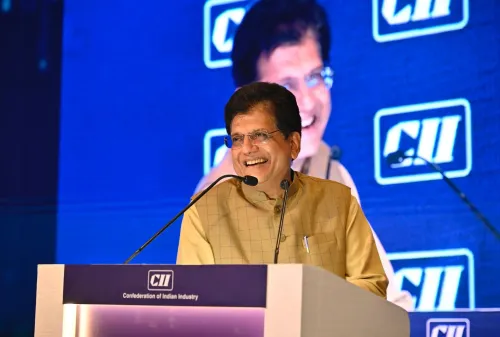
New Delhi, March 10 (NationPress) The Minister of Commerce and Industry, Piyush Goyal, urged stakeholders from the food, agriculture, and hospitality industries to collaborate in positioning India as the premier exporter of agricultural and processed foods globally. He emphasized the tremendous opportunities available due to India’s expanding trade agreements and the increasing global appetite for Indian products.
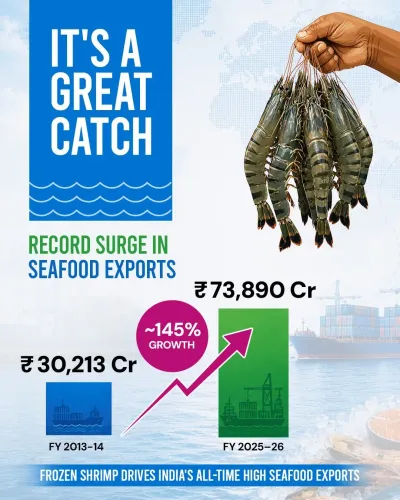
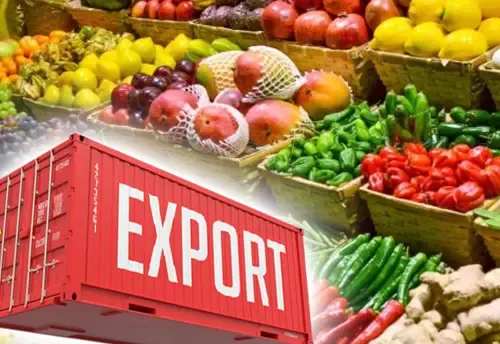
Speaking at the launch of the 40th edition of 'AAHAR – The International Food & Hospitality Fair' in the capital, Goyal revealed that India’s food and agricultural exports — which encompass farm products and fisheries — are approaching the impressive mark of Rs 5 lakh crore (over $55 billion) annually, ranking India as the seventh-largest exporter of agricultural produce worldwide.
He pointed out that over the last 11 years, from 2014 to 2025, there has been remarkable growth in India's agri and food exports. Exports of processed foods have quadrupled, while fruit and pulses exports have tripled. In addition, processed vegetable exports have increased fourfold, cocoa exports have tripled, and cereal exports have seen a twofold rise. Notably, rice exports have surged by 62 percent in this timeframe.
Goyal expressed that these accomplishments should motivate India to aim for the top spot in the global agricultural and processed food export arena. He reiterated that this ambition is attainable and aligns with Prime Minister Narendra Modi's vision for India to become the “food basket of the world.”
The Minister pointed out that the nine Free Trade Agreements (FTAs) signed by India in the past three and a half years have granted access to 38 developed nations, creating vast market prospects for Indian exporters. He mentioned that India currently enjoys preferential market access covering nearly two-thirds of global trade, enhancing its appeal as an investment hub and allowing Indian businesses to integrate into international value chains.
Goyal emphasized that during FTA negotiations, the government has diligently protected the interests of domestic stakeholders, particularly farmers, fishermen, and MSMEs. He assured that sensitive sectors like dairy have been safeguarded, with no concessions granted to foreign producers. Additionally, genetically modified (GM) products have not been given duty concessions or market access.
He clarified that essential agricultural commodities, including rice, wheat, maize, soy meal, and various pulses, have been shielded in trade discussions. In the sugar industry, concessions have generally been avoided to prevent imports that could negatively impact India’s sugarcane farmers and local producers.
These protective measures are designed to safeguard India's domestic strengths while simultaneously creating new global opportunities for Indian products. Goyal appealed to industry stakeholders and the business community to raise awareness at the grassroots level regarding how India's FTAs protect national interests while expanding international trade avenues.
He also encouraged farmers and entrepreneurs to leverage the Rs 1 lakh crore Agriculture Infrastructure Fund, focusing on food processing and value addition, which can enable access to higher-value global markets. An increasing number of small enterprises are entering the food processing sector, generating new growth and employment opportunities.
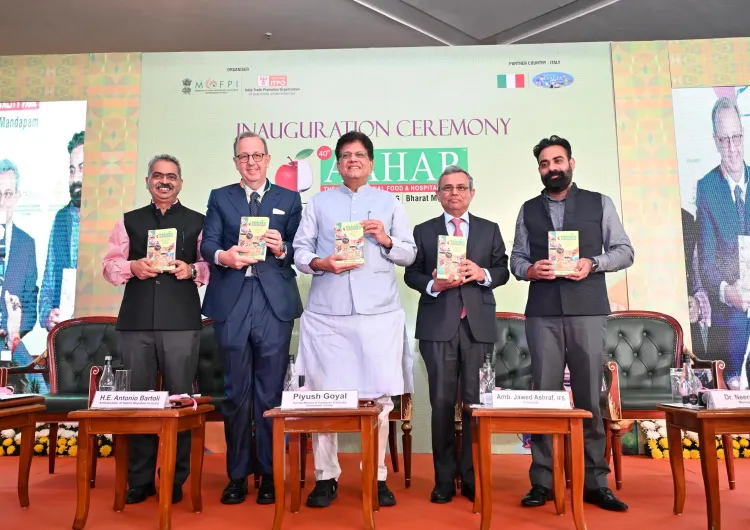
For the first time, AAHAR has a partner country, Italy, and Goyal announced that the exhibition will open to the general public on March 13 and will continue through Saturday, inviting visitors, particularly the youth, to explore the strengths of the food, beverage, and hospitality sectors from India and around the world.
Point of View
India is poised for significant growth in agricultural exports, reflecting both ambition and a commitment to its farmers.
NationPress
29 Sept 2026
Frequently Asked Questions
What is the current annual value of India's food exports?
India's food and agricultural exports are nearing Rs 5 lakh crore, which translates to over $55 billion annually.
How have India's food exports changed over the years?
From 2014 to 2025, exports of processed foods have quadrupled, fruit and pulses exports have tripled, and rice exports alone have increased by 62%.
What measures has the Indian government taken to protect domestic farmers?
The government has safeguarded sensitive sectors, including dairy, and has ensured that key agricultural commodities like rice and wheat are protected during trade negotiations.
What opportunities exist for farmers in India?
Farmers can utilize the Rs 1 lakh crore Agriculture Infrastructure Fund to enhance food processing and access higher-value global markets.
What is the significance of the AAHAR fair?
The AAHAR fair is an international food and hospitality exhibition that showcases India’s strengths in these sectors, with Italy as the first partner country.