Piyush Goyal hails record seafood exports, Blue Economy push
Synopsis
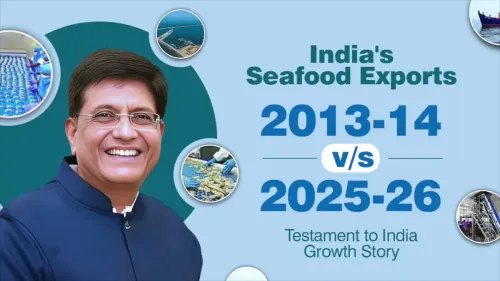
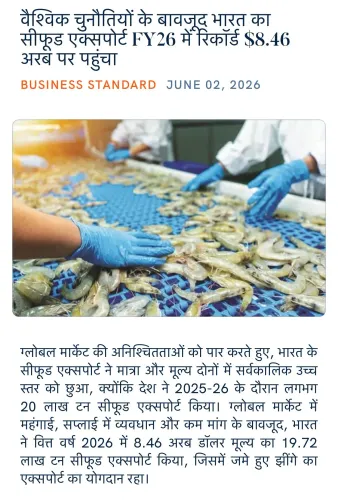
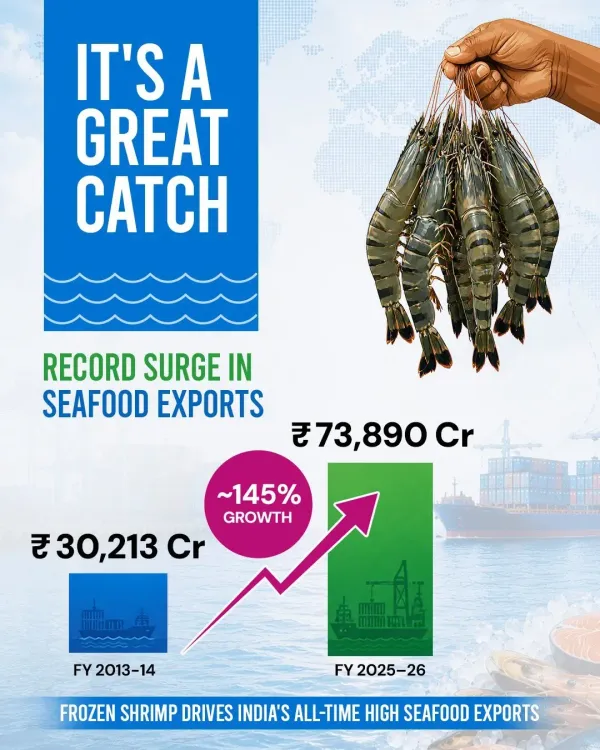
Union Commerce and Industry Minister Piyush Goyal said India's seafood exports have reached an all-time high in FY 2025-26, with shipments rising nearly 145% since FY 2013-14. He framed the surge as evidence that the Blue Economy is emerging as a powerful growth engine, benefiting fisherfolk through wider market access.
Key Takeaways
Piyush Goyal said India's seafood exports hit an all-time high in FY 2025-26.
He cited a nearly 145% jump in seafood exports since FY 2013-14.
The minister linked the gains to India's expanding Blue Economy.
Pradhan Mantri Matsya Sampada Yojana, launched in 2020, anchors the fisheries modernisation push.
MPEDA, set up in 1972, remains the nodal body for seafood export promotion.
Coastal states including Andhra Pradesh, Kerala and Gujarat are key export hubs.
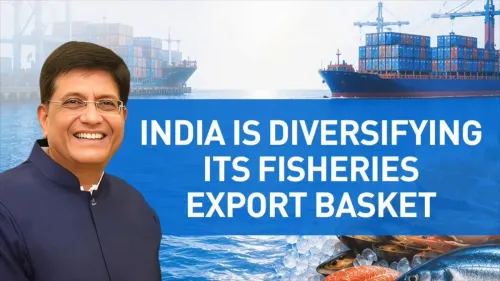
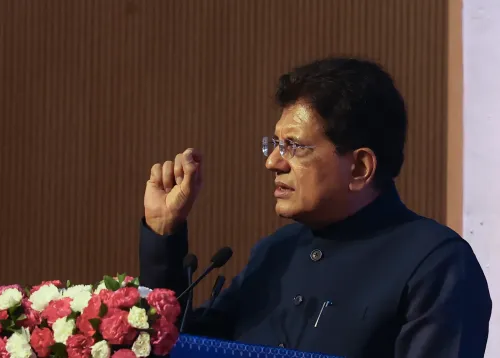
Union Commerce and Industry Minister Piyush Goyal on Wednesday said India's fisherfolk are reaping the benefits of wider market access and rising shipments, declaring that the country's seafood exports have hit an all-time high in FY 2025-26. In a post on X, the minister linked the surge to the broader expansion of India's Blue Economy as a strategic growth driver.
'Our fisherfolk are benefiting from expanded markets and rising exports, with seafood exports reaching an all-time high in FY 2025-26,' Goyal wrote. He added that exports have jumped by 'nearly 145% since FY 2013-14', framing the marine sector as 'a powerful engine of growth'.
Context
The minister's message positions the fisheries sector at the centre of India's export-led growth narrative. By anchoring the gains to a base year of 2013-14, Goyal sets the achievement against the timeline of the National Democratic Alliance government's tenure, a recurring frame in official communications on trade performance.
The Blue Economy, which broadly covers fisheries, aquaculture, coastal tourism, shipping and marine biotechnology, has been identified by policymakers as a priority sector to diversify India's export basket beyond traditional categories such as engineering goods and textiles.
Policy backdrop
The seafood export push has been underpinned by the Pradhan Mantri Matsya Sampada Yojama (PMMSY), a central scheme launched in 2020 with an outlay aimed at modernising fisheries infrastructure, raising fish production and strengthening the value chain for marine exports. The scheme covers cold-chain logistics, harbour upgrades and support for aquaculture farmers.
The Marine Products Export Development Authority (MPEDA), a statutory body under the Commerce Ministry set up in 1972, remains the nodal agency for promoting seafood exports, certifying quality and opening new markets through trade missions.
The Foreign Trade Policy 2023 also flagged agriculture and marine products as focus areas, with targets that align with the government's stated ambition of doubling overall merchandise exports. Bilateral engagements with key buyers in the United States, China, the European Union, Japan and West Asia have shaped tariff access for Indian shrimp, frozen fish and value-added marine products.
Stakeholders and impact
The most direct beneficiaries cited by the minister are India's fisherfolk, a politically significant constituency along the long coastlines of Andhra Pradesh, Tamil Nadu, Kerala, Gujarat, Odisha and West Bengal. Aquaculture farmers, particularly shrimp producers in coastal Andhra Pradesh, have historically driven the bulk of India's seafood export earnings.
Exporters and processors stand to gain from higher shipment volumes, although the sector remains exposed to global price swings, anti-dumping investigations in importing markets and disease outbreaks in farms. Sustainability concerns around wild-catch fisheries and traceability requirements in Western markets continue to shape the regulatory conversation.
For coastal economies, the linkage between fisheries growth and the wider Blue Economy framework also intersects with the Sagarmala port-led development programme, which seeks to reduce logistics costs and improve last-mile connectivity for export cargo.
What's next
Attention will turn to MPEDA's detailed annual export statistics, which will break down the headline number by commodity and destination market. Industry watchers will also track the next Union Budget for any revisions to fisheries allocations, credit support and incentives under production-linked or export-promotion schemes.
For the government, sustaining the marine export momentum will depend on diversifying buyer markets, defending tariff access in ongoing trade negotiations and ensuring that the gains at the aggregate level translate into incomes for small fishers and aquaculture farmers on the ground.
Point of View
The messaging also taps into a politically sensitive coastal constituency ahead of state-level contests. The Blue Economy framing signals that maritime sectors will continue to receive policy oxygen alongside manufacturing-focused schemes. The real test, however, will be whether headline export gains translate into sustained price realisation for small fishers and aquaculture farmers.
NationPress
14 Sept 2026
Frequently Asked Questions
What did Piyush Goyal say about seafood exports?
Piyush Goyal said India's seafood exports have reached an all-time high in FY 2025-26 and have grown by nearly 145% since FY 2013-14, calling the Blue Economy a powerful engine of growth.
What is the Blue Economy in India?
The Blue Economy refers to the sustainable use of ocean and coastal resources, covering fisheries, aquaculture, shipping, coastal tourism and marine biotechnology, and is treated as a priority sector for India's export diversification.
What is the Pradhan Mantri Matsya Sampada Yojana?
PMMSY is a central scheme launched in 2020 to modernise India's fisheries sector, expand aquaculture, build cold-chain and harbour infrastructure, and support marine exports.
Which states drive India's seafood exports?
Coastal states including Andhra Pradesh, Tamil Nadu, Kerala, Gujarat, Odisha and West Bengal account for the bulk of India's marine product exports, with Andhra Pradesh leading in shrimp aquaculture.
Who regulates seafood exports from India?
The Marine Products Export Development Authority, or MPEDA, set up in 1972 under the Commerce Ministry, is the nodal body that regulates, certifies and promotes India's seafood exports.