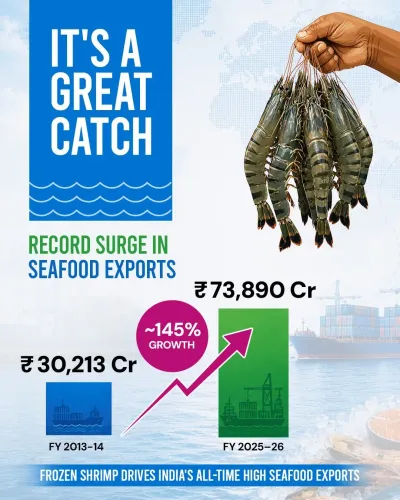
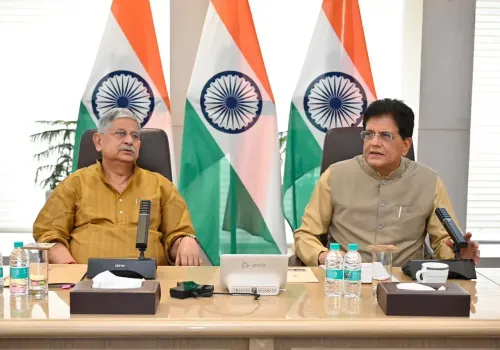
Goyal flags India's growing diversity in fish exports
Synopsis
Commerce Minister Piyush Goyal has flagged that India is exporting a more diverse variety of fish, marking a shift from shrimp-heavy marine trade. Backed by the Rs 20,050 crore PMMSY and MPEDA's market-access work, the trend reflects India's Blue Economy push and efforts to reduce commodity concentration risk in seafood exports.
Key Takeaways
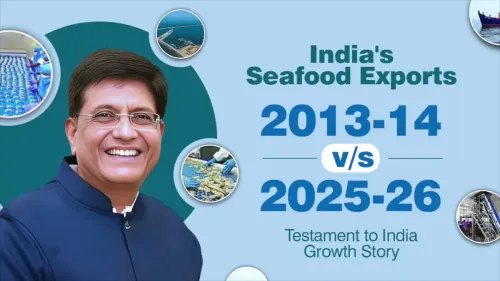
Union Commerce Minister Piyush Goyal stated on 5 June 2026 that India is exporting a more diverse variety of fish.
India's marine exports have historically been dominated by shrimp ; diversification into tuna, squid and value-added products is a stated policy goal.
The Pradhan Mantri Matsya Sampada Yojana , launched in 2020 with an outlay of Rs 20,050 crore , is the primary scheme driving fisheries modernisation and export diversification.
The Marine Products Export Development Authority (MPEDA) , established in 1972 , regulates quality standards and negotiates market access for Indian seafood in the EU, US and Japan .
Broader species diversification reduces industry exposure to shrimp price volatility and disease risk while supporting coastal and rural incomes.
The next MPEDA annual export data release and any new bilateral market-access agreements will be key indicators of progress.
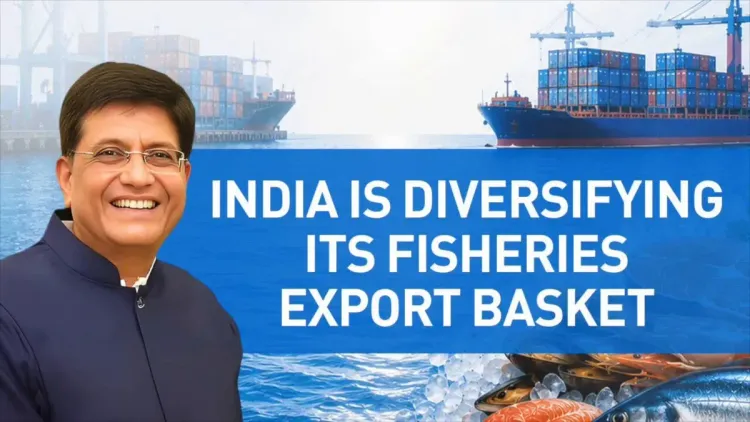
Union Commerce and Industry Minister Piyush Goyal on Friday, 5 June 2026 highlighted that India is now exporting a more diverse variety of fish, signalling a shift in the country's marine products trade profile beyond its traditional reliance on shrimp.
Context
The minister's post draws attention to a structural change in India's seafood export basket. For decades, shrimp dominated India's marine exports, accounting for the lion's share of foreign exchange earnings from the sector. A gradual diversification toward species such as tuna, squid, cuttlefish and value-added fish products has been an explicit policy goal for several years.
The Marine Products Export Development Authority (MPEDA), the statutory body under the Ministry of Commerce and Industry, has been tasked with expanding the range of seafood items that meet the quality standards demanded by key markets including the European Union, United States and Japan.
Policy Backdrop
The diversification push is rooted in two flagship interventions. The Blue Revolution scheme, launched in 2015, sought integrated aquaculture development to enhance fish production and productivity across species. It was succeeded and expanded by the Pradhan Mantri Matsya Sampada Yojana (PMMSY), launched in 2020 with an outlay of Rs 20,050 crore — the largest-ever investment in India's fisheries sector.
PMMSY explicitly targets modernisation of fishing infrastructure, cold-chain logistics and value-added processing, all of which are prerequisites for exporting a wider variety of marine products rather than primarily raw or frozen shrimp. MPEDA, established in 1972, continues to anchor quality regulation and market-access negotiations that enable new species to enter regulated overseas markets.
Stakeholders and Impact
Seafood exporters stand to benefit from reduced concentration risk — dependence on a single commodity like shrimp exposes the industry to price volatility and disease outbreaks in aquaculture ponds. A broader export basket provides a cushion against such shocks and opens new revenue streams.
Aquaculture farmers and coastal fishing communities are the upstream stakeholders. Demand for a wider variety of species incentivises investment in diversified aquaculture and sustainable wild-catch practices. This aligns with the government's broader goal of linking fisheries growth to improved rural and coastal incomes. India's Blue Economy ambitions also frame marine exports as a strategic pillar, not merely an agricultural sub-sector.
What's Next
The next release of annual marine products export statistics by MPEDA will be closely watched to quantify how much the species composition of exports has shifted. Analysts will also track any new market access agreements with the EU or Japan, which could unlock demand for species currently facing regulatory or tariff barriers.
If the diversification trend holds, it would mark a meaningful step in India's effort to reduce dependence on a narrow basket of marine items — a vulnerability that global supply chain disruptions have repeatedly exposed in recent years.
Point of View
Not merely an aspiration. It fits a broader pattern of the Commerce Ministry using social media to frame sectoral data as proof of scheme efficacy — in this case, the Rs 20,050 crore PMMSY. The timing matters: with global seafood supply chains still adjusting post-pandemic and Indian shrimp facing periodic anti-dumping scrutiny in Western markets, diversification is both an economic hedge and a diplomatic asset. Whether the claim translates into statistically significant shifts in MPEDA export data will determine how durable this narrative proves.
NationPress
20 Oct 2026
Frequently Asked Questions
What did Piyush Goyal say about India's fish exports?
Commerce Minister Piyush Goyal stated on 5 June 2026 that India is now exporting a more diverse variety of fish, indicating a broadening of the country's marine export basket beyond its traditional reliance on shrimp.
Which government scheme supports India's fisheries export diversification?
The Pradhan Mantri Matsya Sampada Yojana (PMMSY), launched in 2020 with an outlay of Rs 20,050 crore, is the flagship scheme aimed at modernising fisheries infrastructure, improving cold-chain logistics and boosting value-added seafood exports.
What is MPEDA and what role does it play in fish exports?
The Marine Products Export Development Authority (MPEDA) is a statutory body under the Ministry of Commerce established in 1972. It promotes, regulates and monitors India's seafood exports, sets quality standards for international markets and works to secure market access in the EU, US and Japan.
Why is India trying to diversify its fish exports beyond shrimp?
Shrimp dominance exposes India's marine export earnings to commodity price swings, disease outbreaks in aquaculture, and trade measures such as anti-dumping duties. Diversifying into tuna, squid and value-added products reduces this concentration risk and opens new revenue streams for exporters and coastal communities.
Which countries are the main buyers of India's marine exports?
The European Union, the United States and Japan are among the largest and most regulated destination markets for Indian seafood. Gaining and maintaining market access in these regions requires meeting strict quality and food-safety standards overseen by MPEDA.