GSLV-F17 launches EOS-05: Andhra leaders hail ISRO's heaviest Earth observation satellite

Synopsis
India now has its first dedicated imaging satellite in geosynchronous orbit. GSLV-F17's successful placement of EOS-05 — ISRO's heaviest Earth observation satellite — gives the country persistent high-altitude surveillance coverage for the first time, a capability with direct implications for national security and disaster management.
Key Takeaways
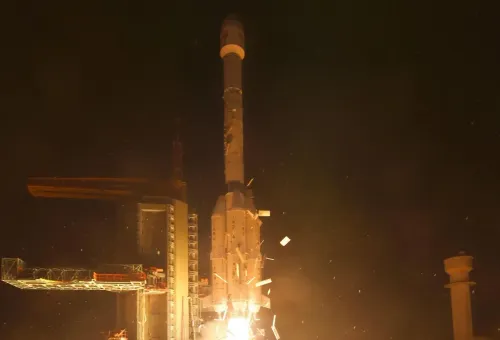
ISRO successfully launched GSLV-F17 from Satish Dhawan Space Centre, Sriharikota on 4 September .
EOS-05 is India's first dedicated imaging satellite from a geosynchronous orbit, and ISRO's heaviest Earth observation satellite to date.
Andhra Pradesh Governor S.
Abdul Nazeer and Chief Minister N.
Chandrababu Naidu congratulated the ISRO team on the milestone.
Deputy CM Pawan Kalyan , also science and technology minister, called it a new chapter in Bharat's space journey.
Opposition leader Y.
Jagan Mohan Reddy also praised the mission, noting its value for weather monitoring and disaster management.
The satellite will enable near-continuous Earth observation coverage, with in-orbit testing expected before full operations begin.
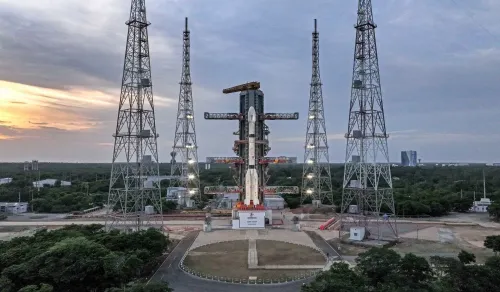
Andhra Pradesh Governor S. Abdul Nazeer and Chief Minister N. Chandrababu Naidu on Friday, 4 September congratulated ISRO scientists on the successful launch of the GSLV-F17 rocket, which placed India's heaviest Earth observation satellite, EOS-05, into geosynchronous orbit. The mission lifted off from the Satish Dhawan Space Centre in Sriharikota, marking a significant leap in India's space-based surveillance and Earth observation capabilities.
A Historic Milestone for India's Space Programme
Governor S. Abdul Nazeer described the mission as a defining achievement, noting that EOS-05 is India's first dedicated imaging satellite from a geosynchronous orbit — a capability considered crucial for continuous surveillance and national security. He said the successful deployment adds another landmark to ISRO's growing list of accomplishments.
This is also the heaviest Earth observation satellite ISRO has placed in orbit to date, underlining the organisation's expanding launch and payload capabilities.
What the Chief Minister and Deputy CM Said
Chief Minister N. Chandrababu Naidu called the development a proud moment for India's space journey. In a post on X, he said: 'Congratulations to ISRO on the successful launch of GSLV-F17 and the precise placement of EOS-05 into its intended orbit. This remarkable achievement reflects the strength of India's space capabilities and the dedication of our scientists and engineers. My best wishes to the entire ISRO team for many more milestones ahead.'
Deputy Chief Minister Pawan Kalyan, who also holds the science and technology portfolio, described the mission as a new milestone in Bharat's journey from Earth to the stars. He said: 'EOS-05 is India's first-ever imaging satellite from a geosynchronous orbit, strengthening our Earth observation capabilities. Heartiest congratulations to the brilliant ISRO scientists, engineers, technicians and everyone involved in this historic mission.' Kalyan also credited the mission's momentum to the leadership of Prime Minister Narendra Modi, saying India's space programme continues to inspire its youth and strengthen its standing among the world's leading spacefaring nations.
Opposition Joins in Congratulating ISRO
Former Chief Minister and YSR Congress Party (YSRCP) President Y. S. Jagan Mohan Reddy also extended his congratulations, describing the launch as a source of 'immense pride.' He said: 'I commend the scientists and engineers whose dedication and precision made this achievement possible. The mission strengthens weather monitoring, disaster management and national development, inspiring immense pride in India's expanding space capabilities and progress.'
Why EOS-05 Matters
The placement of EOS-05 into a Sub-Geosynchronous Transfer Orbit gives India a persistent, high-altitude vantage point for Earth observation — useful for applications ranging from border surveillance and disaster response to agricultural monitoring and urban planning. Unlike lower-orbit satellites that pass over a region periodically, a geosynchronous imaging satellite can maintain near-continuous coverage of a fixed area, a capability India has not previously had from its own dedicated asset.
With this launch, ISRO cements its position as one of the few space agencies globally capable of placing heavy payloads into geosynchronous orbit reliably. The next phase will involve in-orbit testing and calibration of EOS-05's imaging systems before it becomes fully operational.
Point of View
Particularly given its security environment. The real story is less about the congratulations and more about what a 24/7 high-altitude imaging asset means for border monitoring and rapid disaster response. Whether ISRO's operational uptake keeps pace with its launch cadence remains the harder question mainstream coverage tends to skip.
NationPress
4 Sept 2026
Frequently Asked Questions
What is the GSLV-F17 mission and what did it carry?
GSLV-F17 is an Indian Space Research Organisation launch vehicle that successfully placed the EOS-05 Earth observation satellite into a Sub-Geosynchronous Transfer Orbit on 4 September from Sriharikota. EOS-05 is ISRO's heaviest Earth observation satellite and India's first dedicated imaging satellite from a geosynchronous orbit.
Why is EOS-05 significant for India?
EOS-05 gives India its first dedicated imaging capability from geosynchronous orbit, enabling near-continuous surveillance of a fixed area. This has direct applications in national security, border monitoring, disaster management, weather forecasting, and agricultural planning.
Who congratulated ISRO on the GSLV-F17 launch?
Andhra Pradesh Governor S. Abdul Nazeer , Chief Minister N. Chandrababu Naidu , Deputy Chief Minister Pawan Kalyan , and former Chief Minister Y. S. Jagan Mohan Reddy all congratulated ISRO on the successful mission.
What is a geosynchronous imaging satellite and why does it matter?
A geosynchronous imaging satellite orbits at an altitude where it moves in sync with Earth's rotation, allowing it to observe a fixed region continuously rather than in periodic passes. This persistent coverage is critical for real-time surveillance and rapid disaster response — capabilities that lower-orbit satellites cannot provide consistently.
What happens next after the GSLV-F17 launch?
Following the successful placement of EOS-05 into its intended orbit, ISRO will conduct in-orbit testing and calibration of the satellite's imaging systems before it becomes fully operational for Earth observation and surveillance tasks.