How Are India’s Free Trade Agreements and Export Missions Opening New Markets?
Synopsis
India's new Market Access Support Intervention scheme under the Export Promotion Mission aims to revolutionize the export landscape by enhancing international market accessibility, particularly for MSMEs. This initiative is complemented by strategic Free Trade Agreements, marking a significant step for Indian exporters in global trade.
Key Takeaways
New Market Access Support Intervention scheme to enhance international trade for MSMEs.
Consolidated Export Promotion Mission with a budget of Rs 25,060 crore .
Strategic FTAs signed with countries like the UK and Oman.
Focus on reducing export costs and improving global competitiveness.
Efforts aimed at increasing MSME participation in exports.
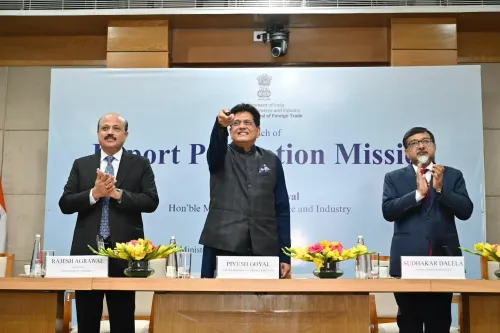
New Delhi, Dec 31 (NationPress) The introduction of the Market Access Support Intervention scheme as part of the Export Promotion Mission by the government signifies a pivotal evolution in India's export strategy. This initiative is specifically designed to bolster international market access for Indian exporters, especially micro, small, and medium enterprises (MSMEs) and first-time exporters, according to the PHD Chamber of Commerce and Industry (PHDCCI).
The Market Access Support Intervention (MAS) tackles structural limitations that have hindered India's exporters' involvement in global value chains. By offering both institutional and financial backing for international trade fairs, buyer-seller meetings, and reverse buyer-seller interactions, MAS effectively reduces entry barriers and enhances buyer discovery for Indian businesses, as stated by PHDCCI President Rajeev Juneja.
The Export Promotion Mission has an allocated budget of Rs 25,060 crore for the fiscal years 2025–26 to 2030–31, consolidating previously fragmented export support initiatives into a cohesive framework. It integrates financial assistance through Niryat Protsahan, which includes interest subvention, collateral support, and credit enhancement, as well as non-financial support mechanisms via Niryat Disha, covering quality certification, branding, logistics facilitation, and market access programs. These combined efforts are aimed at enhancing market readiness, simplifying compliance requirements, and boosting global competitiveness.
Within the MAS framework, cost-sharing mechanisms and a required minimum of 35 percent MSME participation, along with special assistance for priority sectors, are designed to foster opportunities for diversified export growth. Furthermore, partial airfare support for small exporters with revenue up to Rs 75 lakh alleviates participation challenges. This indicates a transition toward a more outcome-oriented, data-driven approach to export promotion, noted Juneja.
To further bolster exporter support, India's evolving international trade strategy for 2025 is characterized by the signing of several significant Free Trade Agreements (FTAs). A notable milestone was the signing of the India–United Kingdom Comprehensive Economic and Trade Agreement (CETA) in July 2025, aimed at increasing market access across goods and services within a prominent G7 economy. This agreement is anticipated to reduce export costs and enhance competitiveness in sectors such as engineering products, textiles, pharmaceuticals, and professional services.
In December 2025, India also finalized a Comprehensive Economic Partnership Agreement (CEPA) with Oman, fortifying India's trade foothold in the Gulf region, particularly for labor-intensive goods and services. Additionally, the completion of a Free Trade Agreement with New Zealand has granted zero-duty access to 100% of Indian exporters, unlocking new avenues in the Oceania region. These FTAs significantly expand India's preferential trading network while lowering tariff and non-tariff barriers in critical markets, emphasized PHDCCI CEO and Secretary General Ranjeet Mehta.
Point of View
I recognize the importance of India's proactive approach to enhancing its export framework. The introduction of the Market Access Support Intervention, coupled with strategic FTAs, reflects a commitment to empowering MSMEs and expanding market reach. Such initiatives are crucial for India's economic growth and its position in the global trade arena.
NationPress
29 Sept 2026
Frequently Asked Questions
What is the Market Access Support Intervention?
The Market Access Support Intervention is a scheme under the Export Promotion Mission aimed at enhancing international market access for Indian exporters, especially MSMEs and first-time exporters.
How much funding is allocated for the Export Promotion Mission?
The Export Promotion Mission has a total budget of Rs 25,060 crore for FY 2025–26 to FY 2030–31.
What are some key Free Trade Agreements signed by India?
Key FTAs include the India-UK Comprehensive Economic and Trade Agreement (CETA) and the Comprehensive Economic Partnership Agreement (CEPA) with Oman, among others.
How does the MAS support MSMEs?
The MAS includes cost-sharing mechanisms, a 35 percent minimum MSME participation requirement, and special support for priority sectors to foster export growth.
What sectors will benefit from reduced export costs due to FTAs?
Sectors such as engineering goods, textiles, pharmaceuticals, and professional services are expected to benefit from reduced export costs under the new FTAs.