Is India Now Among the Top Two Nations in Social Protection Coverage?
Synopsis
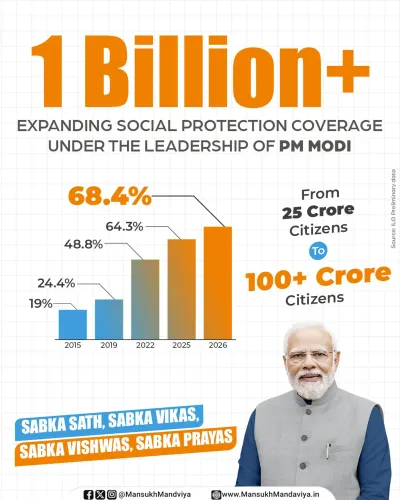
India's social protection coverage has surged impressively, climbing from 19% in 2015 to 64.3% in 2025. This accomplishment places India second in the world, just behind China. With robust reforms and new job creation initiatives under the Pradhan Mantri Viksit Bharat Rozgar Yojana, the future of social security in India looks promising.
Key Takeaways
India's social protection coverage has risen to 64.3%.
Significant labour reforms introduced in 2025.
Pradhan Mantri Viksit Bharat Rozgar Yojana aims to create 3.5 crore jobs.
ISSA Award 2025 for outstanding social security achievement.
Expansion of ESIC coverage to 713 districts.
New Delhi, Dec 30 (NationPress) India’s social protection coverage has experienced a remarkable surge, climbing from 19 percent in 2015 to 64.3 percent in 2025. This significant improvement has positioned the nation as the second-highest globally, following China, in terms of social protection for its citizens.
The expansion of various social welfare schemes aimed at assisting the impoverished, along with the recent labour reforms introduced by the government, are anticipated to further bolster this security.
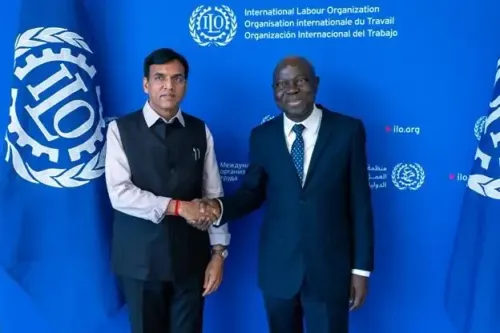
India has received the distinguished International Social Security Association (ISSA) Award 2025 for 'Outstanding Achievement in Social Security' during a ceremony in Malaysia in October.
Continuing the reform momentum, Prime Minister Narendra Modi unveiled the Pradhan Mantri Viksit Bharat Rozgar Yojana on August 15, 2025, with a budget of Rs 99,446 crore. This initiative aims to stimulate the creation of over 3.5 crore jobs within two years, with approximately 1.92 crore beneficiaries being first-time entrants into the workforce.
To date, more than 2.35 lakh establishments have registered on the PMVBRY portal, with the first-time employee beneficiary count surpassing 20.7 lakh.
This scheme is designed to foster employment generation, enhance employability, and ensure social security across various sectors, particularly focusing on manufacturing. Under the initiative, first-time employees will receive one month’s wage (up to Rs 15,000), while employers will benefit from incentives for up to two years for creating additional jobs, with further benefits extended for another two years in the manufacturing sector.
A groundbreaking reform has seen the government consolidate 29 existing labour laws into four comprehensive Labour Codes: the Code on Wages, 2019, the Industrial Relations Code, 2020, the Code on Social Security, 2020, and the Occupational Safety, Health and Working Conditions Code, 2020.
This new framework not only enhances the ease of doing business but also strengthens wage security, social protection, and workplace safety for all workers, including women, migrants, gig workers, and those in platform jobs.
The Code on Wages aims to fortify workers’ rights while simplifying wage-related compliance for employers, implementing a uniform definition of wages and statutory minimum wages across sectors to improve income security and minimize disputes.
The Industrial Relations Code streamlines laws regarding trade unions and employment conditions in industrial establishments, aiding in the investigation and resolution of industrial disputes.
The social security provisions now extend to all workers, including those in the unorganized, gig, and platform sectors, covering life, health, maternity, and provident fund benefits while introducing digital systems for more efficient compliance.
The Occupational Safety and Health Code focuses on protecting worker rights and ensuring safe working conditions, all while creating a business-friendly regulatory environment.
To further bolster social security, the EPFO has undergone a significant digital transformation this year, enabling the auto-settlement of claims up to Rs 5 Lakh, a centralized Pension System, and a FAT-enabled UAN activation to simplify the process for scheme subscribers.
Moreover, worker benefits have been enhanced with the Employees State Insurance Corporation (ESIC) expanding its coverage to 713 districts, up from 688 districts. The number of hospital beds under the ESIC scheme has tripled to 87,715 for FY 2024-25.
ESIC has also introduced the Scheme to Promote Registration of Employers/Employees (SPREE 2025), offering a unique opportunity for employers and employees who may have been inadvertently excluded from ESI coverage to register without facing retrospective coverage or punitive actions.
Point of View
It's vital to recognize India's commendable progress in social security. The advancements in coverage and reforms indicate a commitment to improving the lives of citizens. The government's strategic initiatives are aimed at not just economic growth but also at establishing a safety net for millions. This approach aligns with national goals and reflects a progressive vision for a more equitable society.
NationPress
24 Sept 2026
Frequently Asked Questions
What is the current social protection coverage in India?
As of 2025, India's social protection coverage stands at 64.3%, a significant increase from 19% in 2015.
What new initiatives has the Indian government introduced?
The government recently launched the Pradhan Mantri Viksit Bharat Rozgar Yojana, aimed at creating over 3.5 crore jobs in the next two years.
What awards has India received for its social security efforts?
India was awarded the ISSA Award 2025 for 'Outstanding Achievement in Social Security' in Malaysia.
How many districts are now covered by ESIC?
The ESIC has expanded its coverage to 713 districts from an earlier 688.
What are the benefits of the new Labour Codes?
The new Labour Codes aim to enhance wage security, social protection, and workplace safety for all workers.