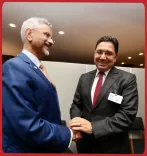
Jaishankar Greets Latvia on Independence Day
Synopsis
Union External Affairs Minister Dr. S. Jaishankar greeted Latvia on its Independence Day on November 18, 2026, pledging to strengthen ties. India and Latvia have maintained diplomatic relations since 1992, with the Baltic state's EU and NATO membership adding quiet strategic value to the relationship.
Key Takeaways
Jaishankar wished Latvia on its Independence Day, November 18, 2026 .
India and Latvia established diplomatic ties in 1992 , following Latvia's independence from the Soviet Union.
Latvia is a member of both the European Union and NATO , giving it relevance beyond its size in Indian diplomacy.
The greeting reflects India's consistent policy of engaging all EU member states as part of its multi-alignment foreign policy strategy.
Any follow-up bilateral engagement is expected at EU-India or UN multilateral forums.
Thirty-five years after Latvia broke free from the Soviet Union, Union External Affairs Minister Dr. S. Jaishankar extended India's warm wishes to Riga on Wednesday, November 18, 2026 — Latvia's Independence Day — signalling New Delhi's continued diplomatic courtship of the Baltic region.
In his post on X, Dr. Jaishankar wrote: 'Warm greetings to the Government and people of Latvia on their Independence Day. Look forward to further strengthening our ties.' The message, brief but deliberate, is part of a broader Indian diplomatic rhythm of engaging every EU and NATO member, however modest the current bilateral footprint.
Three Decades of Ties, Quietly Maintained
India and Latvia established formal diplomatic relations in 1992, the year after the Baltic state's independence from the Soviet Union was internationally recognised. That relationship has since been anchored in protocol-level exchanges rather than headline-grabbing summits — but protocol, in diplomacy, is never nothing.
Latvia today is both an EU member and a NATO ally, making it part of two blocs whose relationship with India carries significant weight. As New Delhi deepens its engagement with European capitals — driven by trade, technology, and the realignment of global supply chains — even smaller member states become useful nodes in a wider network.
India's Baltic Engagement and the Bigger Picture
The Baltic states — Latvia, Estonia, and Lithuania — have collectively grown in strategic relevance since Russia's war in Ukraine reshaped European security calculations. India's consistent goodwill gestures toward these nations help preserve open channels at a time when New Delhi's balancing act between Moscow and the West is under constant scrutiny in European capitals.
Dr. Jaishankar, as the architect of India's 'multi-alignment' foreign policy, has made a point of ensuring no European partner feels neglected — small or large. A single Independence Day greeting, multiplied across dozens of countries each year, adds up to a foreign policy posture: present, engaged, and reliably courteous.
Watch for whether the two sides find occasion to meet on the margins of an EU-India or UN forum in the months ahead — those margins are often where real diplomatic groundwork gets laid.
Point of View
Sustained goodwill toward Baltic states — which have been among Europe's most hawkish voices on Moscow — carries a quiet balancing function. The 'look forward to strengthening ties' formulation is standard diplomatic language, but its consistency across dozens of such messages each year is itself a strategy. New Delhi is signalling it has the bandwidth and the intent to be a present partner across the full breadth of Europe.
NationPress
18 Nov 2026
Frequently Asked Questions
When did India establish diplomatic relations with Latvia?
India established formal diplomatic relations with Latvia in 1992 , following Latvia's independence from the Soviet Union in 1991.
Why did Jaishankar greet Latvia on November 18?
November 18 is Latvia's Independence Day, marking its proclamation of independence. Dr. Jaishankar's greeting is part of India's standard diplomatic practice of acknowledging partner nations on their national days.
Is Latvia a member of NATO and the EU?
Yes, Latvia is a member of both the European Union and NATO , which gives the country strategic significance in India's broader European engagement.
What is India's foreign policy approach toward Baltic states?
India maintains protocol-level engagement with Baltic states as part of its wider multi-alignment strategy, keeping diplomatic channels open across all EU and NATO members without large-scale bilateral initiatives currently in place.
What could follow Jaishankar's Independence Day message to Latvia?
Analysts suggest a follow-up bilateral meeting on the margins of an EU-India or UN multilateral forum is the most likely next step in deepening India-Latvia ties.