Jaishankar Signs Dual MoUs With Ghana, Deepening South-South Ties
Synopsis
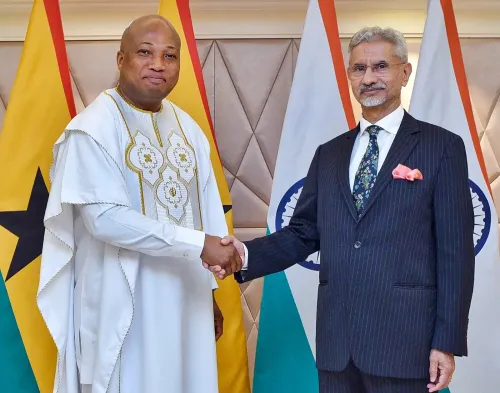
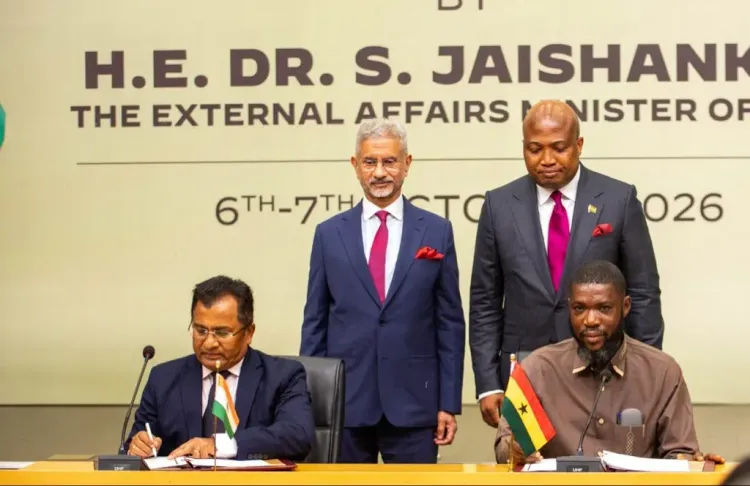
External Affairs Minister Dr. S. Jaishankar and Ghana's Foreign Minister witnessed the signing of two MoUs — one between ZSI and the University of Ghana, another between ICAR and Ghana's Crops Research Institute — advancing India's South-South cooperation agenda on October 7, 2026.
Key Takeaways
Two MoUs were signed between Indian and Ghanaian institutions on October 7, 2026 , witnessed by Dr.
Jaishankar and Ghana's Foreign Minister .
The Zoological Survey of India and the University of Ghana will cooperate in academics, scientific research, and capacity building.
The Indian Council of Agricultural Research (ICAR) and Ghana's CSIR-Crops Research Institute will collaborate on agricultural research and education.
The agreements are framed under South-South cooperation , emphasising knowledge and institutional exchange between developing nations.
The signings deepen India's multi-track engagement with West Africa , adding science and agriculture to existing ties.
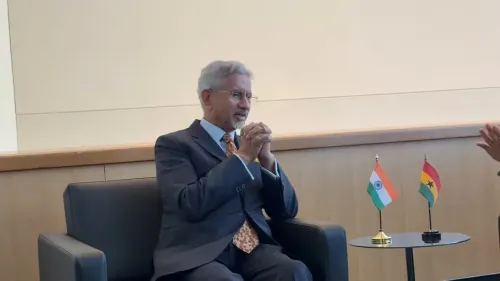
Two agreements, two institutions, one clear signal: Union External Affairs Minister Dr. S. Jaishankar on Wednesday, October 7, 2026, witnessed the exchange of a pair of Memoranda of Understanding between Indian and Ghanaian institutions — a concrete step in what New Delhi calls South-South cooperation, signed alongside Ghana's Foreign Minister Shirley Ayorkor Botchwey.
What Was Signed: Zoology, Agriculture, and Capacity Building
The first MoU links the Zoological Survey of India (ZSI) with the University of Ghana, covering cooperation in academics, scientific research, and capacity building. The ZSI, headquartered in Kolkata, is one of India's oldest and most respected natural-history institutions, and the tie-up opens a channel for shared biodiversity research across two of the world's most ecologically diverse nations.
The second agreement connects the Indian Council of Agricultural Research (ICAR), New Delhi with the CSIR-Crops Research Institute, Ghana — targeting cooperation in agricultural research and education. For a continent where food security is a defining challenge, India's crop-science expertise, built over decades across tropical and semi-arid geographies, carries real practical weight.
The South-South Logic Behind the Signings
South-South cooperation — the idea that developing nations can share knowledge, technology, and institutional expertise with each other rather than relying solely on traditional North-South aid flows — has been a cornerstone of India's Africa outreach. These two MoUs fit precisely into that framework: no financial transfer, but deep institutional linkage in domains where India has demonstrated technical strength.
Ghana is one of West Africa's most stable democracies and a growing partner for India in the region. Agricultural productivity and biodiversity conservation are both high-priority areas for Accra, making the choice of ICAR and ZSI as counterpart institutions deliberately practical rather than ceremonial.
India's Institutional Reach Into Africa Takes Shape
The signings come at a moment when India has been actively deepening its Africa engagement across multiple tracks — technology transfer, pharma, digital infrastructure, and now academic and agricultural science. Formalising research partnerships at the institutional level is how those broad commitments get embedded and made durable.
For India, every such MoU is also a quiet counter to other external actors competing for influence on the continent. Science and agriculture are not just soft power — they are the hard infrastructure of long-term partnership. Two agreements signed in a single ceremony rarely make headlines. But multiplied across a continent, they rewire the map.
Point of View
Going beyond high-level declarations to create durable, people-to-people and institution-to-institution bonds. Anchoring agreements in agriculture and biodiversity — two areas of genuine Indian technical strength — signals a pragmatic, needs-first approach to South-South engagement. In the broader competition for influence on the African continent, India is increasingly betting on science diplomacy as a differentiator. Repeated across enough capitals, this model could quietly reshape the architecture of India-Africa cooperation for the next decade.
NationPress
7 Oct 2026
Frequently Asked Questions
What MoUs did India and Ghana sign in October 2026?
India and Ghana signed two MoUs on October 7, 2026: one between the Zoological Survey of India and the University of Ghana for academic and scientific cooperation, and another between ICAR (New Delhi) and Ghana's CSIR-Crops Research Institute for agricultural research and education.
What is South-South cooperation and why does India promote it?
South-South cooperation refers to collaboration — in trade, technology, and knowledge — between developing nations, bypassing the traditional reliance on aid from wealthy countries. India promotes it as a way to share its own developmental expertise with African and other Global South partners on equal terms.
What does the Zoological Survey of India do?
The Zoological Survey of India (ZSI), headquartered in Kolkata, is one of India's premier natural-history research institutions. It conducts faunal surveys, biodiversity documentation, and scientific research, and is now extending its academic reach to Ghana through this new partnership.
What is ICAR and why does its Ghana partnership matter?
The Indian Council of Agricultural Research (ICAR) is India's apex body for agricultural science and education. Its tie-up with Ghana's CSIR-Crops Research Institute is significant because India's expertise in tropical and semi-arid crop science is directly applicable to Ghana's food-security challenges.
How does India's Ghana outreach fit into its broader Africa policy?
Ghana is one of West Africa's most stable democracies and a strategic partner for India. These MoUs are part of a wider Indian effort to deepen Africa engagement through science, technology, pharma, and digital infrastructure — building long-term institutional linkages rather than one-off financial aid.