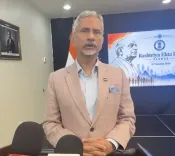
Jaishankar Greets Algeria on Revolution Day, Eyes Stronger Ties
Synopsis
External Affairs Minister Dr. S. Jaishankar greeted Algerian FM Ahmed Attaf on Algeria's Revolution Day, 1 November 2026, and expressed intent to advance bilateral ties — invoking a diplomatic friendship that dates to India's recognition of Algeria's independence movement in 1961.
Key Takeaways
Jaishankar extended Revolution Day greetings to Algerian FM Ahmed Attaf on 1 November 2026 .
Algeria's Revolution Day commemorates the start of the independence war against French rule on 1 November 1954 , which led to independence in 1962 .
India recognised the Provisional Government of the Algerian Republic in 1961 , ahead of formal independence — a foundational act of solidarity.
Both nations share a long history of cooperation within the Non-Aligned Movement on decolonisation and South-South issues.
Jaishankar's message signals continued Indian outreach to North Africa , with Algeria relevant to energy, trade and multilateral coordination.
Sixty-four years after India recognised Algeria's fight for freedom, Union External Affairs Minister Dr. S. Jaishankar sent warm wishes to Algerian Foreign Minister Ahmed Attaf on Algeria's Revolution Day, 1 November 2026 — and pointedly signalled that New Delhi wants to take the relationship further.
Writing to FM Attaf, the Government and people of Algeria, Jaishankar said he looks 'forward to advancing our ties,' pairing the greeting with the Indian and Algerian flag emojis — a compact but deliberate diplomatic gesture on a day Algerians hold deeply sacred.
What Algeria's Revolution Day means — and why India's greeting carries weight
Revolution Day, 1 November, marks the anniversary of the 1954 uprising that launched Algeria's eight-year war of independence against French colonial rule, culminating in independence in 1962. It is the most consequential date on Algeria's national calendar. India's connection to that moment is not incidental: New Delhi recognised the Provisional Government of the Algerian Republic in 1961 — a year before independence was formally achieved — and established diplomatic relations immediately after. That early solidarity still colours how both countries read each other.
The two nations subsequently found common cause within the Non-Aligned Movement, coordinating on decolonisation and South-South issues through the Cold War decades. That shared ideological scaffolding remains a quiet reference point in bilateral conversations today.
India's North Africa outreach and what 'advancing ties' could mean
Jaishankar's message fits into a consistent pattern of Indian diplomatic engagement with North Africa and the broader Global South. Maintaining goodwill with Algiers matters across several practical dimensions — energy cooperation, trade diversification, and coordination in multilateral forums including the United Nations General Assembly and India-Africa platforms.
Algeria is one of Africa's largest natural gas producers and a significant player in the African Union. For India, which is deepening its Africa strategy, keeping the channel warm at foreign-minister level is exactly the kind of quiet statecraft that precedes more substantive bilateral work.
Whether this exchange translates into a bilateral meeting — on the margins of the UN General Assembly, an India-Africa summit, or a dedicated visit — will be the test of how quickly the 'look forward' becomes a diary entry.
Point of View
But the phrase 'advancing our ties' gives it a forward edge that separates it from a bare formality. It fits a visible pattern: India under the current foreign policy dispensation has systematically refreshed its engagement with African and Global South capitals, framing them as partners of choice rather than legacy relationships on autopilot. Algeria — a major gas exporter, an African Union heavyweight and a former Non-Aligned Movement pillar — is a natural node in that calculus. The real signal will come if this exchange produces a structured bilateral meeting in the months ahead.
NationPress
1 Nov 2026
Frequently Asked Questions
Why does India celebrate Algeria's Revolution Day?
India does not celebrate it, but issues a greeting because Algeria's Revolution Day on 1 November holds deep historical significance and India has maintained diplomatic ties with Algeria since 1962, rooted in shared Non-Aligned Movement values and India's early recognition of Algeria's independence movement in 1961.
What is Algeria's Revolution Day?
Algeria's Revolution Day, observed on 1 November each year, commemorates the launch of the armed independence struggle against French colonial rule on 1 November 1954 , a war that ended with Algerian independence in 1962 .
What are India-Algeria relations like?
India and Algeria have maintained diplomatic relations since 1962 , cooperated within the Non-Aligned Movement , and share interests in energy, South-South cooperation and African multilateral forums, though the relationship has historically been more symbolic than intensive.
What could 'advancing ties' between India and Algeria involve?
Potential areas include energy cooperation given Algeria's large natural gas reserves, trade diversification, and coordination in multilateral forums such as the UN General Assembly and India-Africa summits. No specific projects or figures have been officially announced.