Javed Akhtar questions Delimitation Bill fairness in Pune
Synopsis
Javed Akhtar has raised one of the delimitation debate's sharpest questions: why should states that followed family planning lose seats while others gain? Speaking in Pune, the veteran lyricist said the government has not even revealed its final plan, and that he will watch which opposition members back or reject it.
Key Takeaways
Javed Akhtar questioned the fairness of the proposed Delimitation Bill in Pune on 28 November 2026 .
He said the final plan, including execution, new constituencies and criteria, has not yet been revealed .
Akhtar asked why regions that did not prioritise family planning get more seats while those that did get fewer.
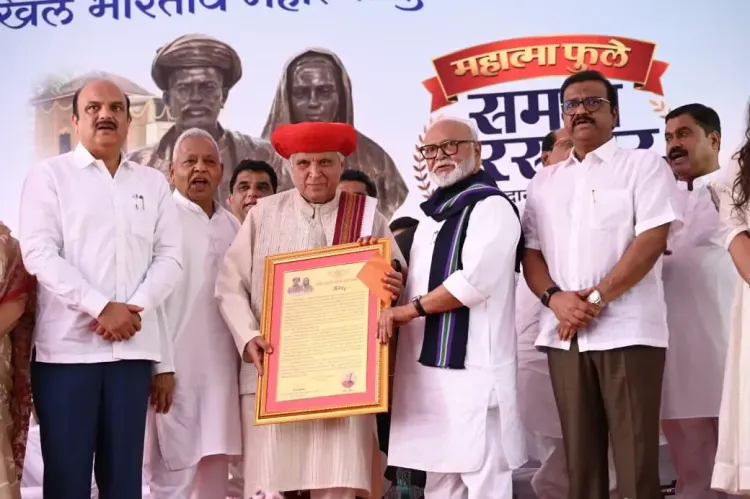
He received the Mahatma Phule Samata Award at Mahatma Phule Wada , presented by Maharashtra minister Chhagan Bhujbal .
Akhtar flagged the closure of government schools and rising education costs, calling education more essential than food.
Veteran lyricist and former Rajya Sabha member Javed Akhtar on Saturday, 28 November 2026, raised concerns over the proposed Delimitation Bill in Pune. He questioned whether it is fair to reallocate parliamentary seats on the basis of population growth, and said the government has not yet made its final blueprint public.
His remarks place one of India's best-known cultural voices in a national debate over how political representation should be shared among states.
Akhtar Flags Missing Details in the Blueprint
Speaking in Pune, Akhtar said key details on how the delimitation exercise will be carried out have not been disclosed. In his view, that makes it too early to judge the full impact of the exercise.
“First, the final plan has not yet been revealed—how it will be executed, whether new constituencies will be created, what criteria will be considered, and how the country will be divided into various constituencies,” Akhtar said.
He listed several open questions:
- how the exercise will be executed
- whether new constituencies will be created
- which criteria will be used
Taken together, these questions point to how much of the framework remains unknown.
The Family Planning Argument
Akhtar also took up one of the most disputed issues in the delimitation debate. He questioned whether higher population growth should be rewarded with greater political representation, at the cost of states that controlled their population.
“Second, I find it somewhat strange that regions that did not prioritise family planning are being granted more seats, while those that followed family planning are being allocated fewer seats... How does this create any balance?” he remarked.
This argument is not new. States with lower population growth, particularly in the south, have long argued that a strictly population-based redistribution would penalise them for meeting national family planning goals. Supporters of population-based seat allocation counter that representation should reflect the principle of equal value for each vote.
Opposition Response Under Watch
Akhtar said a clearer assessment will only be possible once the official framework is published. He added that the political response across party lines will be watched closely as the debate unfolds.
“We will examine the details once they are released... We will also observe which members of the opposition, beyond our own government, come forward to endorse or reject this,” he added.
Mahatma Phule Samata Award and Education Concerns
Earlier in the day, Akhtar received the Mahatma Phule Samata Award from the Akhil Bharatiya Mahatma Phule Samata Parishad at Mahatma Phule Wada in Pune. The event marked the death anniversary of Mahatma Jyotirao Phule.
The award was presented by Chhagan Bhujbal, Maharashtra's Minister for Food, Civil Supplies and Consumer Protection and national president of the Samata Parishad.
Accepting the award, Akhtar said the light of knowledge that rose from Mahatma Phule Wada has reached across the world. He praised Mahatma Phule and Savitribai Phule for opening the doors of education to marginalised groups who had been denied it.
He also voiced concern over the closure of government schools and the rising cost of education. Education, he said, is a core responsibility of the state, vital for every section of society, and even more essential than food.
Addressing the gathering, Bhujbal said the ideals of equality, education and social justice championed by Mahatma Phule and Krantijyoti Savitribai Phule remain relevant because caste and religious divides persist. He said their vision can guide the nation and the world toward freedom from discrimination, and called for the fight for equality to be carried forward more vigorously.
With the government's final delimitation framework still awaited, Akhtar's remarks are likely to add to pressure for transparency on how India's electoral map will be redrawn.
Point of View
Though, concerns process. A reform that will redraw the balance of power in Parliament is being debated before its criteria are even public. Federal trust depends on the Centre publishing a transparent framework early, along with safeguards for states that met their demographic targets. Without that, delimitation risks becoming a North-South fault line rather than a democratic correction.
NationPress
28 Nov 2026
Frequently Asked Questions
What did Javed Akhtar say about the Delimitation Bill?
Javed Akhtar questioned the fairness of reallocating parliamentary seats on the basis of population growth. He also said the government's final plan for the delimitation exercise has not yet been revealed.
Why does Javed Akhtar think delimitation is unfair?
Akhtar said it is strange that regions which did not prioritise family planning are being granted more seats, while those that followed family planning get fewer. He asked how such an outcome creates any balance.
Where did Javed Akhtar make his delimitation remarks?
He spoke in Pune on 28 November 2026. On the same day, he received the Mahatma Phule Samata Award at Mahatma Phule Wada.
Who presented the Mahatma Phule Samata Award to Javed Akhtar?
The award was presented by Chhagan Bhujbal, Maharashtra's Food, Civil Supplies and Consumer Protection Minister and national president of the Akhil Bharatiya Mahatma Phule Samata Parishad. The event marked Mahatma Jyotirao Phule's death anniversary.
What happens next in the delimitation debate?
Akhtar said a full assessment will be possible only once the official framework is released. He added that he will watch which opposition members come forward to endorse or reject it.