Jamia Millia Islamia, Delhi Police hold cyber safety drive on deepfakes, digital arrest
Synopsis
Jamia Millia Islamia and Delhi Police joined forces for a campus cyber safety event tackling deepfakes, digital arrest scams, and AI-enabled fraud — offering students a three-step digital safety rule and flagging the national helpline '1930' as a first response tool, as India's cyber crime rates continue to rise.
Key Takeaways
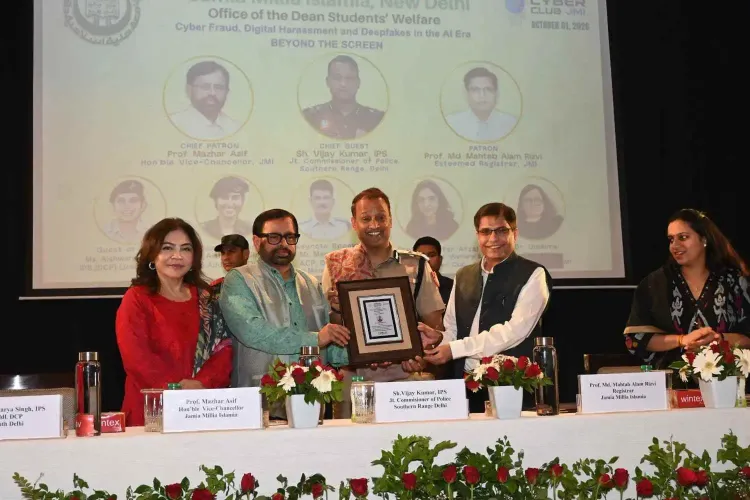
Jamia Millia Islamia's Cyber Club and Delhi Police co-organised a cyber safety event titled 'Beyond the Screen' on 1 October 2026 in New Delhi .
Joint CP Vijay Kumar was Chief Guest; ACP Manoj Kumar delivered the keynote on AI-enabled cyber threats including digital slavery .
DCP Aishwarya Sharma highlighted three key threat vectors: cyber fraud, digital harassment, and deepfakes .
ACP Kumar advised calling '1930' for immediate cyber crime reporting and flagged initiatives including Sanchar Saathi, M-Kavach 2, and Digi Kavach .
Dean Neelofer Afzal offered a three-step cyber safety rule: 'pause before you click', 'verify before you believe', 'speak up if something goes wrong' .
The Cyber Club of Jamia Millia Islamia (JMI), in collaboration with Delhi Police, organised a cyber safety and awareness programme on 1 October 2026 in New Delhi, tackling pressing threats including digital arrests, deepfakes, cyberbullying, and AI-enabled fraud. The event, titled 'Beyond the Screen: Cyber Fraud, Digital Harassment and Deepfakes in the AI Era', was conducted under the aegis of the Office of the Dean Students' Welfare at JMI.
Key Officials and Speakers
Joint Commissioner of Police (Southern Range) Vijay Kumar was the Chief Guest at the occasion. The keynote address was delivered by Assistant Commissioner of Police (ACP) Manoj Kumar, who also serves as an external member of the JMI Cyber Club, according to a statement issued by JMI Chief Public Relations Officer Saima Saeed. Deputy Commissioner of Police (DCP) Licensing Aishwarya Sharma and JMI Registrar Md. Mahtab Alam Rizvi also attended. The proceedings were presided over by Vice-Chancellor Mazhar Asif.
What the Speakers Said
Vice-Chancellor Mazhar Asif, in his presidential address, warned that financial criminals in the cyber realm 'exploit the greed of their victims' and stressed the importance of remaining guarded and educated. He urged students to exercise caution while using technologies such as mobile phones and not allow those technologies to control them.
Neelofer Afzal, JMI Dean Students' Welfare and Advisor of the Cyber Club, offered what she called a three-step rule for navigating the cyber world: 'pause before you click', 'verify before you believe', and 'speak up if something goes wrong'. She acknowledged knowledge as the greatest source of empowerment while cautioning that deception could be countered through responsible use of technology and AI.
DCP Aishwarya Sharma outlined three primary ways in which digital trust is exploited — cyber fraud, digital harassment, and deepfakes. She warned the audience about the permanence of digital footprints, noting that once created, they are difficult to remove. She also cautioned against allowing fear and anxiety to cloud judgment when responding to online threats.
AI-Era Threats and Preventive Measures
ACP Manoj Kumar addressed common AI-enabled threats accompanying increasing digital penetration, flagging digital slavery as a cause for urgent concern. He outlined practical preventive steps: keeping mobile software updated, preserving evidence in case of fraud, and calling '1930' — the national cyber crime helpline — for immediate reporting and intervention.
Kumar also introduced the audience to government cyber well-being initiatives including Sanchar Saathi, M-Kavach 2, and Digi Kavach, and warned against visiting dubious websites or downloading malware disguised as APK files. Notably, he cautioned attendees that 'claiming innocence cannot grant immunity from the law' — underscoring the legal dimensions of cyber negligence.
Context and Significance
The programme comes amid a marked rise in AI-generated deepfakes and digital arrest scams across India, with the Ministry of Home Affairs repeatedly flagging such tactics as among the fastest-growing categories of cyber crime. University-led awareness drives in partnership with law enforcement are increasingly being seen as a frontline response to the surge in online fraud targeting students and young professionals. This collaboration between JMI and Delhi Police reflects a broader national push to embed cyber literacy into academic institutions before threats escalate further.
Point of View
But their reach remains limited to those already inside campus halls. The harder challenge — and the one neither JMI nor Delhi Police addressed publicly — is scaling these interventions to first-generation smartphone users outside elite institutions, who are statistically the most targeted by digital arrest scams and deepfake blackmail. The three-step rule and helpline number '1930' are practical, but they depend on victims knowing them before a crisis hits. Embedding such protocols in school curricula and telecom onboarding, rather than one-off campus events, is where the real policy gap lies.
NationPress
6 Oct 2026
Frequently Asked Questions
What was the JMI cyber safety programme about?
The programme, titled 'Beyond the Screen: Cyber Fraud, Digital Harassment and Deepfakes in the AI Era', was organised by the Cyber Club of Jamia Millia Islamia in collaboration with Delhi Police on 1 October 2026. It aimed to educate students about emerging cyber threats including digital arrests, deepfakes, cyberbullying, password hacking, and AI-enabled fraud.
Who were the key speakers at the JMI cyber awareness event?
The Chief Guest was Joint Commissioner of Police (Southern Range) Vijay Kumar. The keynote was delivered by ACP Manoj Kumar, and DCP Licensing Aishwarya Sharma also addressed the audience. Vice-Chancellor Mazhar Asif presided over the proceedings.
What is the '1930' helpline mentioned at the event?
'1930' is India's national cyber crime helpline, recommended by ACP Manoj Kumar for immediate reporting and intervention in the event of online fraud. Citizens can call this number to report cyber crimes and seek prompt assistance.
What government initiatives were highlighted for cyber safety?
ACP Manoj Kumar highlighted three government-backed cyber well-being tools: Sanchar Saathi, M-Kavach 2, and Digi Kavach. He also warned against downloading APK files and visiting dubious websites, which can expose devices to malware.
Why are deepfake and digital arrest scams a growing concern in India?
Deepfake technology and digital arrest scams have emerged as among the fastest-growing categories of cyber crime in India, with fraudsters using AI-generated content to impersonate officials or individuals for extortion and fraud. The Ministry of Home Affairs has repeatedly flagged these tactics, prompting university and law enforcement partnerships like the JMI event to build awareness at the grassroots level.