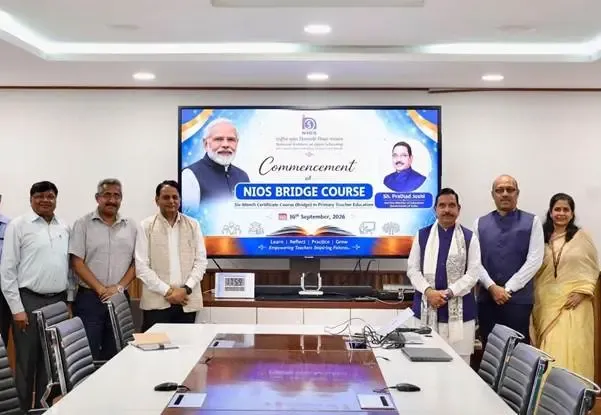
Pralhad Joshi launches 6-month Bridge Course in Primary Teacher Education via NIOS
Synopsis
A Supreme Court order from 2024 finally finds its policy answer: Union Education Minister Pralhad Joshi has launched a 6-month NIOS Bridge Course giving B.Ed.-qualified primary teachers — appointed without D.El.Ed between 2018 and 2023 — a formal certification pathway. The move directly affects teachers whose appointments were in regulatory limbo and signals a structural push to align primary pedagogy with NEP 2020 goals.
Key Takeaways
Union Education Minister Pralhad Joshi launched a six-month Bridge Course in Primary Teacher Education (PTE) on 17 September 2026 .
The course will be implemented through the National Institute of Open Schooling (NIOS) and is aligned with the NCTE framework .
It is designed for in-service primary teachers with a B.Ed. degree appointed between 28 June 2018 and 11 August 2023 without a D.El.Ed qualification.
The programme includes 6 theory courses , a minimum of 10 days online contact classes , and at least 20 days school-based experience .
The theory examination can be attempted in any of the 22 scheduled languages listed in the Eighth Schedule of the Constitution.
The course stems from a Supreme Court judgement dated 8 April 2024 in Civil Appeal No.
5068 of 2023 (Devesh Sharma vs.
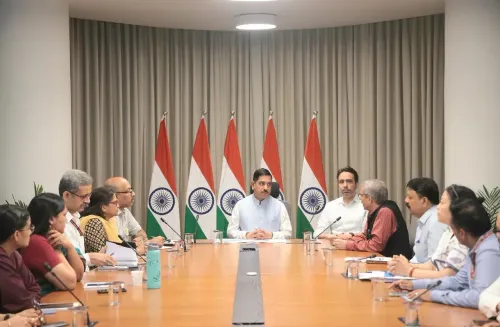
Union Education Minister Pralhad Joshi on Wednesday, 17 September 2026, launched a six-month certificate Bridge Course in Primary Teacher Education (PTE), designed to equip in-service primary school teachers with child-centred and development-appropriate pedagogical skills. The course will be implemented through the National Institute of Open Schooling (NIOS) and targets teachers holding a B.Ed. degree who were appointed to teach at the primary level without a D.El.Ed qualification.
Background and Legal Basis
The Bridge Course has a direct judicial origin. The Supreme Court of India, in its judgement dated 8 April 2024 in Civil Appeal No. 5068 of 2023 (Devesh Sharma vs. Union of India and Ors.), authorised the National Council for Teacher Education (NCTE) to devise such a course for primary teachers who lacked the D.El.Ed qualification at the time of appointment. The course is specifically intended for teachers appointed between 28 June 2018 and 11 August 2023, whose appointments are protected under the NCTE Gazette notification dated 28 June 2018.
Course Structure and Curriculum
Designed in alignment with the NCTE framework, the programme comprises six theory courses and a school-based practicum. It mandates a minimum of 10 days of online contact classes and at least 20 days of school-based experiential learning. This dual structure is intended to bridge the gap between educational theory and live classroom practice, covering Classes 1 to 5.
The programme emphasises inclusive and inquiry-based teaching approaches, targeting the diverse learning needs of young children. According to an official statement, it 'promotes a vision of teaching as a dynamic, context-sensitive, and inquiry-based profession.'
Language and Examination Provisions
The medium of instruction for the Bridge Course will be Hindi and English. However, teachers will be permitted to attempt the Public Examination (Theory) in any of the 22 scheduled languages listed in the Eighth Schedule of the Constitution, ensuring linguistic accessibility for teachers across India's diverse states.
Impact on Primary Education Quality
The launch addresses a long-standing gap in foundational-stage teacher certification. A significant number of primary teachers appointed in the window between 2018 and 2023 carry B.Ed. degrees — which are oriented toward upper-primary and secondary levels — rather than the D.El.Ed, which is specifically designed for early childhood and primary pedagogy. This course serves as their formal certification pathway for primary-level teaching. Educationists have broadly welcomed the step, noting that strengthening foundational-stage pedagogy is central to the goals of the National Education Policy (NEP) 2020.
What Comes Next
With NIOS as the implementing agency, the course is expected to be rolled out at scale given NIOS's established open-learning infrastructure across states. The next phase will involve enrolment processes and scheduling of the contact sessions. Completion of the Bridge Course will allow eligible teachers to attain full certification to teach at the primary level, securing their professional standing under the regulatory framework.
Point of View
But it also underscores a deeper structural problem: regulatory inconsistency in teacher appointment norms that left thousands of educators in professional limbo for years. A Supreme Court order in 2024 was needed to compel action that the system should have proactively built after NEP 2020 redrew foundational-stage requirements. The real test now is scale and rigour — NIOS has the infrastructure to enrol large cohorts, but whether 10 days of online contact and 20 days of school practice can meaningfully shift pedagogy remains an open question. If the course becomes a box-ticking compliance exercise rather than a genuine upskilling intervention, it will have solved a legal problem while leaving the educational one intact.
NationPress
17 Sept 2026
Frequently Asked Questions
What is the NIOS Bridge Course in Primary Teacher Education launched by Pralhad Joshi?
It is a six-month certificate programme launched by Union Education Minister Pralhad Joshi on 17 September 2026, implemented through the National Institute of Open Schooling (NIOS). The course is designed to certify B.Ed.-qualified primary school teachers — appointed between 28 June 2018 and 11 August 2023 — who did not hold the D.El.Ed qualification required for primary-level teaching.
Why was the Bridge Course introduced?
The course was introduced following a Supreme Court of India judgement dated 8 April 2024 in Civil Appeal No. 5068 of 2023, which directed the NCTE to devise a bridge course for primary teachers appointed without the D.El.Ed qualification. It addresses a regulatory gap for teachers whose appointments are protected under the NCTE Gazette notification of 28 June 2018.
Who is eligible for the NIOS Primary Teacher Education Bridge Course?
In-service primary school teachers who hold a B.Ed. degree and were appointed to teach Classes 1 to 5 between 28 June 2018 and 11 August 2023 are eligible. These are teachers whose appointments are protected under the NCTE Gazette notification dated 28 June 2018 but who lack the D.El.Ed qualification.
What does the Bridge Course curriculum include?
The programme comprises six theory courses and a school-based practicum. It requires a minimum of 10 days of online contact classes and at least 20 days of school-based experiential learning, aligned with the NCTE framework. Instruction is in Hindi and English, but the theory examination may be written in any of the 22 scheduled languages in the Eighth Schedule of the Constitution.
How does the Bridge Course connect to the National Education Policy 2020?
The NEP 2020 places strong emphasis on foundational and preparatory stage learning (Classes 1 to 5), requiring teachers with specific primary-stage pedagogical competencies. The Bridge Course aligns with these goals by training teachers in child-centred, inclusive, and development-appropriate practices, helping bridge the gap between B.Ed. training — which focuses on upper-primary and secondary levels — and the demands of primary-stage instruction.