Joshi Hails Modi as India's Longest-Serving Elected PM

Synopsis
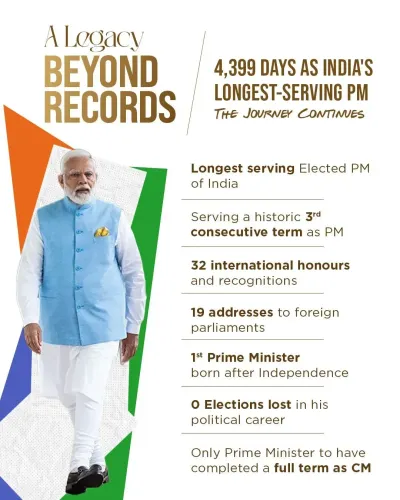
Union Consumer Affairs Minister Pralhad Joshi has hailed PM Narendra Modi as India's longest-serving continuously elected Prime Minister, marking 4,399 consecutive days in office since May 2014. Joshi linked the milestone to the Viksit Bharat vision and Modi's journey from Vadnagar to leading 140 crore Indians.
Key Takeaways
Pralhad Joshi posted on 10 June 2026 marking PM Modi's 4,399 consecutive days as Prime Minister.
Modi has been continuously in office since his first swearing-in on 26 May 2014 , re-elected in 2019 and 2024 .
Joshi described Modi as the longest-serving continuously elected Prime Minister in India's history.
The post invokes the Viksit Bharat vision, linking tenure length to India's long-term development target of 2047 .
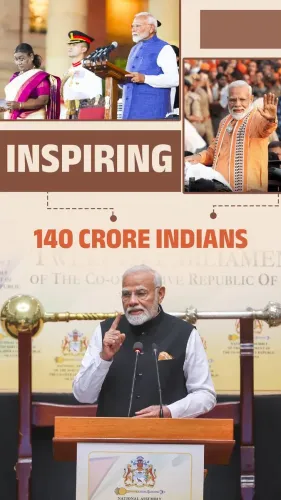
Modi's origins in Vadnagar, Gujarat are cited as symbolic of his rise to lead 140 crore Indians.
Union Consumer Affairs Minister Pralhad Joshi on Wednesday, 10 June 2026, took to X to mark what he described as a historic milestone — Prime Minister Narendra Modi completing 4,399 consecutive days in office, making him, in Joshi's words, the longest-serving continuously elected Prime Minister in India's history.
Context
Narendra Modi was first sworn in as Prime Minister on 26 May 2014 following the BJP-led NDA's decisive general election victory. He was subsequently re-elected in 2019 and again in 2024, completing over twelve years of uninterrupted tenure. Joshi's post, carrying the hashtag #LongestServingElectedPMModi, frames this continuity as a defining feature of modern Indian governance.
In his post, Joshi wrote: 'Some leaders govern a period. Some leaders define an era.' He added that Modi's journey — from a 'humble beginning in Vadnagar to leading the aspirations of 140 crore Indians' — 'reflects the spirit of a New India — confident, ambitious and determined.'
Policy Backdrop
The milestone is being marked against the backdrop of the government's flagship Viksit Bharat vision, which sets a target of transforming India into a fully developed nation by 2047. Joshi's post explicitly invokes the #ViksitBharat hashtag, tying the longevity of Modi's tenure to the long-term policy horizon the government has set for itself.
The BJP has consistently used anniversaries of the 2014 swearing-in to reinforce a narrative of policy continuity — linking sustained single-party leadership to India's economic growth, infrastructure expansion, and rising diplomatic profile. Programmes such as Digital India, Make in India, and Viksit Bharat have been central to this messaging.
Stakeholders and Impact
The post is directed at a broad national audience, including BJP supporters and citizens invested in India's developmental trajectory. As a senior minister from Karnataka and a prominent party voice in southern India, Joshi's amplification of the milestone carries both national and regional political significance.
For ordinary citizens, the messaging anchors the government's policy record — spanning welfare schemes, infrastructure projects, and foreign policy — to the continuity of a single leadership. Supporters of the government see the unbroken electoral mandate as a validation of those policies; critics may view the framing as partisan consolidation ahead of future electoral cycles.
What's Next
The Viksit Bharat 2047 agenda is expected to drive further scheme rollouts and budget allocations in the near term, with multiple ministries — including Joshi's own — aligning departmental targets to the overarching vision. Parliamentary statements and policy announcements linked to the milestone are likely to follow in the coming days, as the BJP sustains its communications around this occasion.
Point of View
The party signals that longevity in office is not merely symbolic but a precondition for long-horizon policy delivery. The Vadnagar-to-Delhi arc is a well-worn but electorally potent frame that the BJP deploys to sustain aspirational connect with first-generation voters. As a senior Karnataka minister, Joshi's voice adds regional weight to what is essentially a national party-messaging exercise.
NationPress
25 Oct 2026
Frequently Asked Questions
How many days has PM Modi been in office continuously?
According to Union Minister Pralhad Joshi's post on 10 June 2026, PM Narendra Modi has completed 4,399 consecutive days in office, making him the longest-serving continuously elected Prime Minister in India's history by this count.
When did Narendra Modi first become Prime Minister of India?
Narendra Modi was first sworn in as Prime Minister of India on 26 May 2014 following the BJP-led NDA's victory in the general election, and has remained in office continuously since then.
What is Viksit Bharat and how does it relate to Modi's tenure?
Viksit Bharat is the government's vision to transform India into a fully developed nation by 2047. The BJP has consistently linked the continuity of Modi's tenure to the sustained policy delivery required to achieve this long-term goal.
Who is Pralhad Joshi and why did he post about Modi's milestone?
Pralhad Joshi is the Union Minister of Consumer Affairs, Food and Public Distribution, and New and Renewable Energy, and a senior BJP leader from Karnataka. He posted the tribute as part of the party's broader communications marking the milestone.
Where is Vadnagar and why is it mentioned in connection with PM Modi?
Vadnagar is a town in Gujarat and PM Modi's birthplace. It is frequently referenced in official BJP narratives to highlight his rise from modest origins to leading the aspirations of 140 crore Indians.