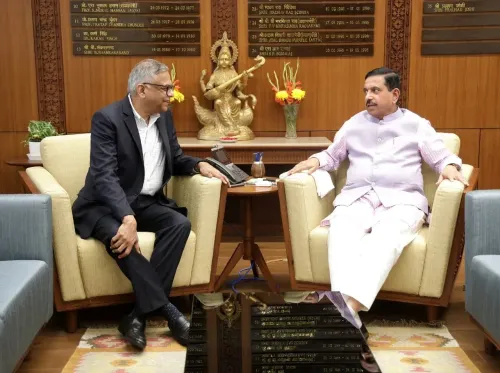
Pralhad Joshi meets Tata Sons chief N. Chandrasekaran in New Delhi

Synopsis
Union Minister Pralhad Joshi held a 'highly productive' meeting with Tata Sons Chairman and IIM Lucknow Board Governor N. Chandrasekaran in New Delhi, focusing on making India's higher education more innovation-driven, research-oriented, and aligned with industry needs under the NEP 2020 framework.
Key Takeaways
Union Minister Pralhad Joshi met N.
Chandrasekaran in New Delhi on 22 October 2026 for a high-level consultation on higher education.
Chandrasekaran holds the dual role of Chairman of Tata Sons Limited and Chairman of the Board of Governors of IIM Lucknow .
Discussions centred on making institutions more industry-complementary, innovation-driven, and research-oriented.
The meeting aligns with the National Education Policy 2020 's emphasis on industry-academia linkages.
Minister Joshi also holds the New and Renewable Energy portfolio, lending a 'sustainable development' dimension to the education agenda.
The IIM Act 2017 formally enabled corporate leaders to chair IIM governing boards, a model this meeting exemplifies.
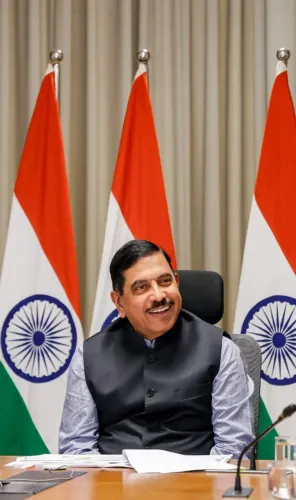
When the chairman of one of India's most powerful conglomerates sits down with a Union Minister to talk about classrooms, something bigger than a courtesy call is underway. Union Consumer Affairs Minister Pralhad Joshi met N. Chandrasekaran — Chairman of Tata Sons Limited and Chairman of the Board of Governors of IIM Lucknow — in New Delhi on Thursday, 22 October 2026, for what Joshi described as an 'extremely productive consultation' on strengthening India's higher education ecosystem.
Posting in Kannada on X, Minister Joshi wrote that Chandrasekaran's 'vast leadership experience in industry and management education provided invaluable ideas towards further empowering India's higher education system.' The discussion, he said, ranged widely over how institutions could become 'more complementary to industry, grow in an innovation- and research-oriented manner, and enable youth to effectively deploy their knowledge for India's sustainable development.'Why Chandrasekaran's dual role matters
N. Chandrasekaran occupies a rare position at the intersection of corporate India and academic governance. As Chairman of Tata Sons — the holding company behind one of India's largest and most diversified conglomerates — he commands strategic insight across technology, manufacturing, retail, and services. Simultaneously, his chairmanship of the IIM Lucknow Board of Governors places him at the helm of a premier management institution established in 1984 that shapes thousands of future business leaders annually. That combination makes any conversation he has about higher education structurally significant.Industry-academia alignment under NEP 2020
The meeting fits squarely into a policy momentum that has been building since the National Education Policy 2020. NEP 2020 specifically called for multidisciplinary education, stronger research orientation, and deeper industry-academia linkages at institutions like the IIMs. The IIM Act 2017 had already granted greater institutional autonomy — and one of its key provisions was formalising the role of corporate leaders on governing boards, precisely to ensure that what students learn tracks what the economy actually needs. Successive governments have leaned on this architecture, inviting industry chairpersons to bring boardroom thinking into campus governance. Thursday's discussion appears to be a live exercise of that intent — a minister whose portfolio touches millions of consumers and the energy transition sitting down with a corporate-academic leader to ask: are India's top institutions producing graduates ready for the economy India is building?The 'sustainable development' signal
One phrase in Joshi's post stands out: youth deploying their knowledge for India's 'sustainable development.' For a minister who also holds the New and Renewable Energy portfolio, the word 'sustainable' is not casual. It gestures at a potential alignment between India's clean-energy ambitions, the research pipelines of management institutions, and the kind of talent that corporates like Tata — deeply invested in electric vehicles, green hydrogen, and solar — will need at scale in the years ahead. Whether this consultation translates into a formal programme, a curriculum shift, or a research collaboration at IIM Lucknow remains to be seen. But the signal is deliberate: India's higher education institutions are being asked to look outward — to industry, to innovation, to the economy's next chapter.Point of View
But through elite convening: bring a corporate titan who already chairs an IIM board into the minister's room, let industry expertise shape the academic agenda. The 'sustainable development' framing is politically sharp; it ties Joshi's energy portfolio to his education conversation, signalling that clean-tech talent pipelines are part of the brief. For IIM Lucknow, a nudge from both its board chairman and a Union Minister toward industry alignment is unlikely to stay merely conversational — expect curriculum or research partnerships to follow. The broader arc is clear: India's premier management schools are being repositioned as national capability engines, not just elite degree factories.
NationPress
22 Oct 2026
Frequently Asked Questions
Why did Pralhad Joshi meet N. Chandrasekaran?
Minister Pralhad Joshi met N. Chandrasekaran on 22 October 2026 in New Delhi to discuss how India's higher education institutions can be made more industry-aligned, innovation-driven, and research-oriented — drawing on Chandrasekaran's experience as both Chairman of Tata Sons and Chairman of the IIM Lucknow Board of Governors.
What is N. Chandrasekaran's role at IIM Lucknow?
N. Chandrasekaran serves as Chairman of the Board of Governors of IIM Lucknow, a position that corporate leaders have held since the IIM Act 2017 granted greater institutional autonomy and formally integrated industry figures into top management-institute governance.
How does this meeting relate to the National Education Policy 2020?
NEP 2020 explicitly calls for stronger industry-academia linkages, multidisciplinary learning, and a research orientation at premier institutions. The Joshi-Chandrasekaran meeting directly addresses these goals, exploring how IIMs and similar institutions can better serve India's economic and sustainable development needs.
What is the IIM Act 2017 and why does it matter here?
The IIM Act 2017 granted IIMs greater autonomy and formalised the role of corporate leaders as chairpersons of their boards of governors. This structural change is why a figure like N. Chandrasekaran can simultaneously head Tata Sons and govern IIM Lucknow — and why such meetings carry institutional weight.
What could come out of this Joshi-Chandrasekaran consultation?
While no specific programme was announced, the discussion is expected to inform potential industry-linked curricula, research initiatives, or innovation partnerships at IIM Lucknow. Any formal follow-up would likely come from the institution or the Ministry of Education.