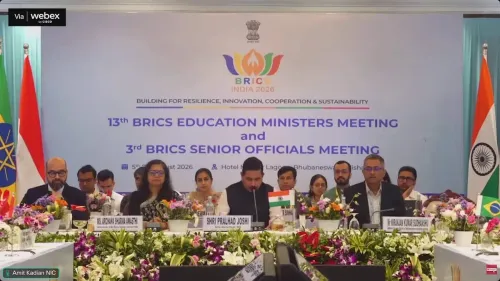
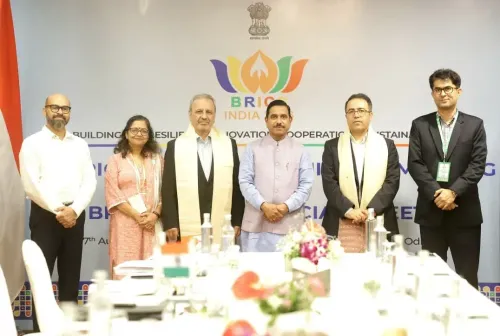
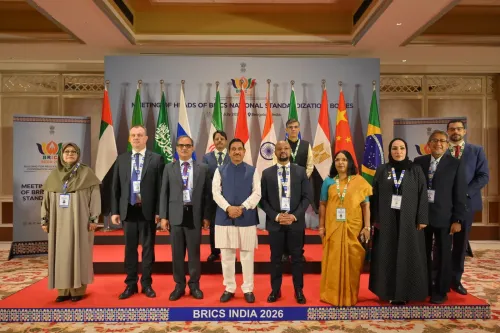
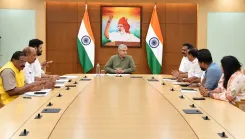
Pralhad Joshi addresses BRICS Education Ministers in Bhubaneswar
Synopsis
Union Minister Pralhad Joshi addressed the 13th BRICS Education Ministers' Meeting in Bhubaneswar on August 7, 2026, under India's BRICS Presidency. He highlighted that India is chairing the grouping for the fourth time, with three of those chairships under PM Modi, as ministers advanced a shared agenda of resilience, innovation, and sustainability.
Key Takeaways
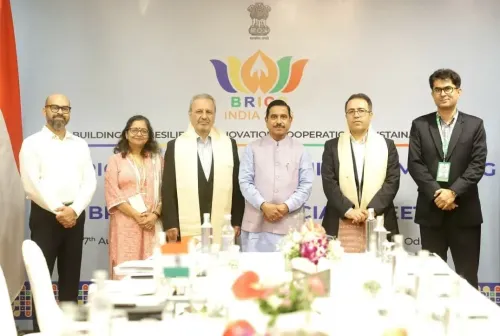
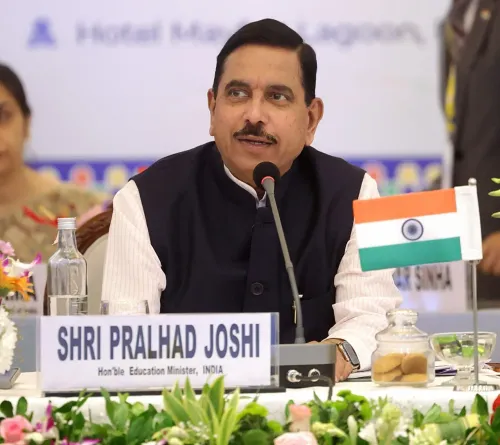
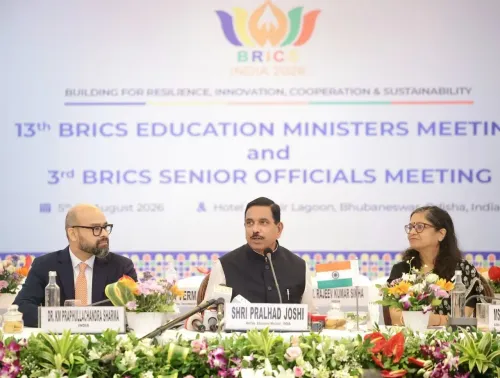
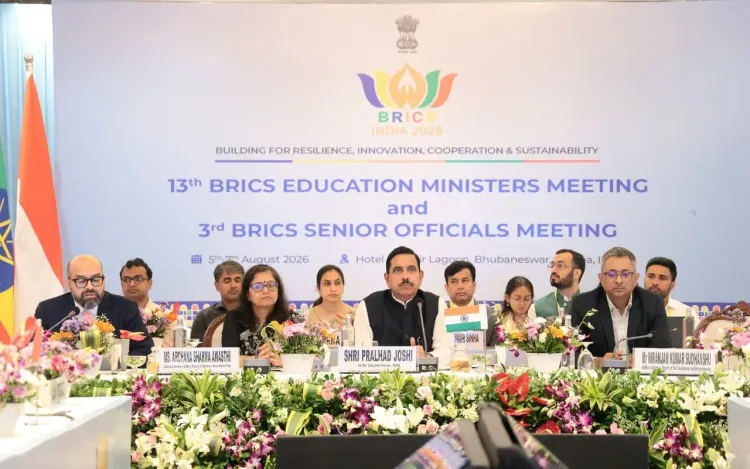
Pralhad Joshi addressed the opening ceremony of the 13th BRICS Education Ministers' Meeting in Bhubaneswar, Odisha on August 7, 2026 .
The meeting is held under India's BRICS Presidency , with the theme 'Building for Resilience, Innovation, Cooperation and Sustainability.' India is chairing BRICS for the fourth time , with three of those chairships occurring under PM Narendra Modi .
Hosting the ministerial in Bhubaneswar reflects India's decentralised approach to showcasing regional cities during its presidencies.
Joint declarations and new BRICS education initiatives are the key outcomes to watch as India's chairship continues.
Education ministers and delegates from across the BRICS grouping gathered in Bhubaneswar, Odisha, on Friday, August 7, 2026, as Union Consumer Affairs Minister Pralhad Joshi addressed the opening ceremony of the 13th BRICS Education Ministers' Meeting — a signal that India's current BRICS Presidency is pushing sectoral cooperation well beyond the summit table.
Joshi, who addressed the gathering under India's BRICS Chairship, framed the meeting around the theme 'Building for Resilience, Innovation, Cooperation and Sustainability' — a formulation that maps directly onto the post-pandemic priorities of South-South collaboration that BRICS nations have repeatedly championed. The choice of Bhubaneswar as the venue is itself deliberate: India has consistently used its presidencies to decentralise high-profile ministerial engagements across cities, showcasing regional capabilities rather than concentrating all diplomatic activity in the capital.
India's fourth turn at the BRICS helm
Joshi used the occasion to underscore a pointed political milestone: this is India's fourth BRICS Chairship, and three of those four have come under Prime Minister Narendra Modi. The observation was not incidental — it places Modi's tenure at the centre of India's sustained multilateral engagement within the grouping, which spans Brazil, Russia, India, China, and South Africa and has grown into one of the principal forums for multipolar global governance. India previously held the BRICS chair in 2021, a year when the grouping leaned heavily into themes of pandemic recovery and digital cooperation. The current chairship continues that arc, extending it into education — a domain where BRICS nations see room for joint curriculum frameworks, research partnerships, and student mobility.Why an education ministers' meeting matters in this forum
BRICS cooperation has historically been associated with finance, trade, and security. Convening a dedicated education ministerial — the thirteenth of its kind — reflects how deeply the grouping has institutionalised its sectoral architecture. For India, hosting it in Odisha's capital adds a layer of soft-power projection: Bhubaneswar has emerged as one of the country's better-planned urban centres, and putting it on a multilateral map carries its own message. The outcomes to watch are any joint declarations or initiative frameworks the ministers agree upon before India's chairship concludes — particularly in areas like digital education infrastructure and research collaboration, where BRICS members have overlapping but not always aligned interests. India has built the scaffolding; what gets constructed on it will define whether this chairship leaves a lasting mark on BRICS education cooperation.Point of View
Linking the PM's tenure to India's growing weight in South-South forums. The education track also signals that BRICS is maturing beyond its finance-and-trade origins into a broader institutional architecture. Whether that architecture produces binding cooperation or remains aspirational will depend on what emerges from the declarations before India's chairship closes.
NationPress
21 Sept 2026
Frequently Asked Questions
What is the 13th BRICS Education Ministers' Meeting?
It is a ministerial-level gathering of education officials from the five BRICS nations — Brazil, Russia, India, China, and South Africa — convened to advance cooperation in education, research, and innovation. The 13th edition was held in Bhubaneswar, Odisha, on August 7, 2026, under India's BRICS Presidency.
Why is India's BRICS Chairship significant in 2026?
India is holding the BRICS chair for the fourth time in 2026, and three of those four chairships have come under Prime Minister Narendra Modi, reflecting India's sustained leadership role within the grouping.
Who is Pralhad Joshi and why did he address this meeting?
Pralhad Joshi is India's Union Minister of Consumer Affairs, Food and Public Distribution, and New and Renewable Energy, and a senior BJP leader from Karnataka. He addressed the opening ceremony as a representative of the Indian government during its BRICS Presidency.
What is the theme of India's 2026 BRICS Presidency?
The theme is 'Building for Resilience, Innovation, Cooperation and Sustainability,' which aligns with BRICS priorities around post-pandemic recovery and South-South collaboration.
Why was Bhubaneswar chosen for the BRICS Education Ministers' Meeting?
India has adopted a decentralised approach during its BRICS presidencies, hosting ministerial meetings across different cities to showcase regional capabilities. Bhubaneswar, Odisha's capital, was selected as part of this strategy.