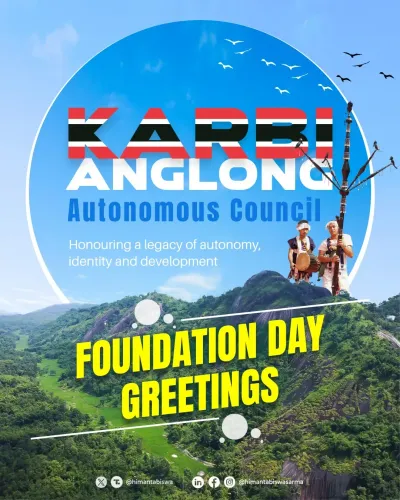
Karbi Anglong Autonomous Council turns 75: Assam CM Sarma extends greetings

Synopsis
The Karbi Anglong Autonomous Council — one of Northeast India's most consequential Sixth Schedule bodies — turned 75 on 23 June. Assam CM Himanta Biswa Sarma marked the occasion with a tribute to the council's role in protecting tribal identity and driving development across one of Assam's largest hill districts. Three-quarters of a century in, the KAAC's constitutional autonomy remains a model for tribal self-governance in India.
Key Takeaways
The Karbi Anglong Autonomous Council (KAAC) completed 75 years of its establishment on 23 June .
Assam CM Himanta Biswa Sarma extended greetings via social media, calling the milestone a reflection of the region's 'rich heritage, resilience and aspirations'.
The KAAC, headquartered in Diphu , operates under the Sixth Schedule of the Constitution with legislative, executive, and financial powers.
The council has driven socio-economic progress for the Karbi people and other tribal communities across Assam's hill areas for seven decades.
The anniversary is being marked by political leaders, council members, and residents reaffirming commitment to inclusive growth and lasting peace.
Assam Chief Minister Himanta Biswa Sarma extended greetings on the 75th Foundation Day of the Karbi Anglong Autonomous Council (KAAC) on 23 June, calling the milestone a reflection of the 'rich heritage, resilience and aspirations' of the people of Karbi Anglong. The occasion marks three-quarters of a century since the establishment of one of Assam's most significant constitutional bodies for tribal self-governance.
CM's Message and Key Tribute
In a message shared on social media, Sarma lauded the council's contributions towards preserving the identity of indigenous communities and promoting peace and development in the hill district. 'Warm greetings on the 75th Foundation Day of the Karbi Anglong Autonomous Council. This milestone reflects the rich heritage, resilience and aspirations of the people of Karbi Anglong. May the Council continue to strengthen peace and development across the region and empower all,' he said.
The message underscored the state government's continued emphasis on tribal welfare and regional autonomy as central pillars of its governance approach in Assam.
What the KAAC Is and How It Functions
The Karbi Anglong Autonomous Council, headquartered in Diphu, operates under the provisions of the Sixth Schedule of the Constitution of India. This grants it legislative, executive, and financial powers across specified subjects including local governance, land management, culture, education, and development. It was designed specifically to safeguard the interests, culture, and traditions of the tribal communities of the region.
Notably, the Sixth Schedule framework places KAAC among a select group of autonomous councils in Northeast India that wield constitutionally protected self-governance powers — a distinction that sets it apart from ordinary district administrations.
Seven Decades of Socio-Economic Progress
Over the past 75 years, the council has played a central role in promoting socio-economic development while protecting the distinct cultural identity of the Karbi people and other tribal communities in the district. Its initiatives have spanned infrastructure development, healthcare access, educational expansion, and livelihood programmes in the hill areas.
Karbi Anglong — known for its scenic hills, rich biodiversity, and vibrant tribal traditions — has seen considerable development momentum in recent years, with the state government focussing on connectivity, tourism, and welfare schemes in the region.
Significance of the 75th Year
The completion of 75 years is being viewed as a landmark in the journey of self-governance and regional development in one of Assam's largest districts by area. Political leaders, council members, and residents marked the occasion by recalling the institution's contributions and reaffirming their commitment to inclusive growth and lasting peace.
This comes amid a broader push by the Assam government to accelerate development in its hill districts, where connectivity and socio-economic indicators have historically lagged behind the plains. The anniversary offers both a moment of reflection and a renewed mandate for the council's next chapter.
Point of View
Socio-economic indicators in Karbi Anglong have historically trailed Assam's plains districts. CM Sarma's message, warm as it is, sidesteps the harder question: whether the council's constitutional powers have been fully utilised, or whether resource constraints and political dynamics have blunted its effectiveness. The anniversary is an opportunity to assess that record honestly, not just celebrate it.
NationPress
22 Sept 2026
Frequently Asked Questions
What is the Karbi Anglong Autonomous Council (KAAC)?
The Karbi Anglong Autonomous Council is a constitutionally empowered body headquartered in Diphu, Assam, established under the Sixth Schedule of the Constitution of India. It holds legislative, executive, and financial powers over local governance, land, culture, education, and development for tribal communities in the Karbi Anglong district.
How old is the Karbi Anglong Autonomous Council in 2025?
The KAAC completed 75 years of its establishment on 23 June 2025, marking its diamond jubilee as one of Assam's most significant institutions for tribal self-governance.
What did Assam CM Himanta Biswa Sarma say on KAAC's 75th Foundation Day?
CM Sarma extended greetings via social media, describing the milestone as a reflection of the 'rich heritage, resilience and aspirations' of the Karbi Anglong people. He expressed hope that the council would continue to strengthen peace, development, and empowerment across the region.
What is the Sixth Schedule of the Indian Constitution?
The Sixth Schedule provides for the creation of autonomous district councils in certain tribal areas of Northeast India, granting them legislative, judicial, and administrative powers to protect tribal customs, land rights, and culture. The KAAC is one of the bodies constituted under this framework.
Who are the primary communities the KAAC serves?
The KAAC primarily serves the Karbi people and other tribal communities residing in the Karbi Anglong district of Assam, one of the state's largest districts by area, known for its hills, biodiversity, and distinct tribal traditions.