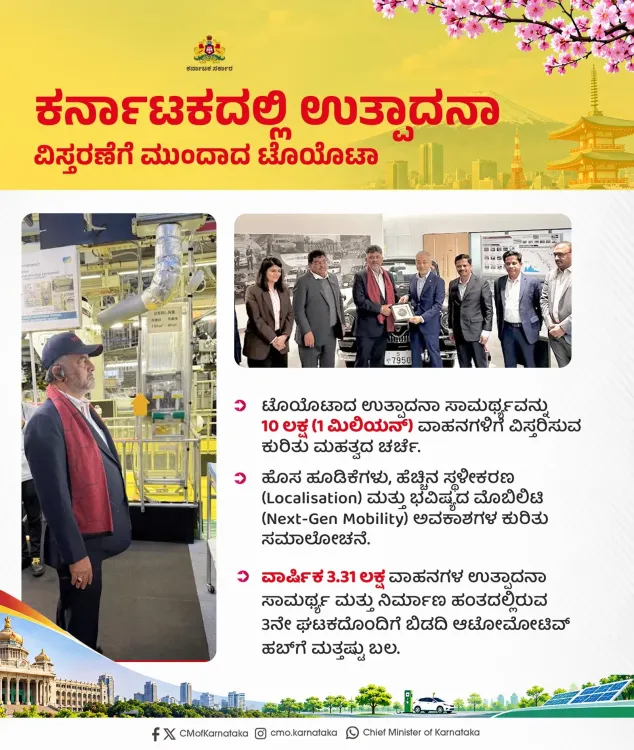
Karnataka CMO holds Toyota talks on expansion, localisation
Synopsis
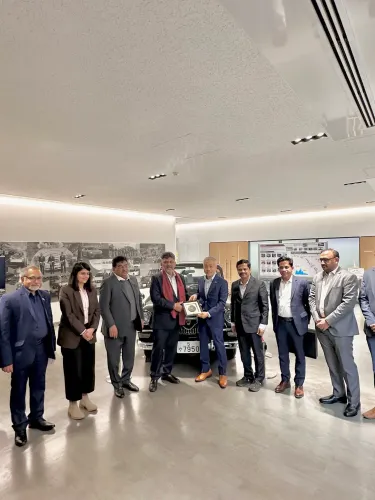
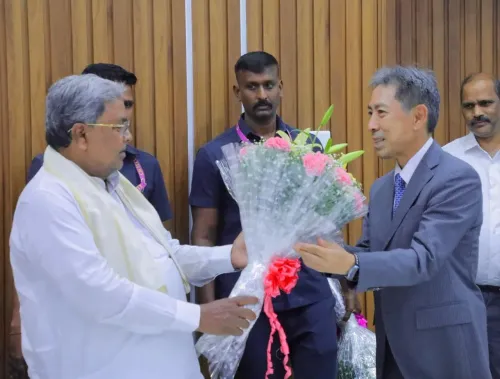
The Chief Minister's Office of Karnataka said talks with Toyota Motor Corporation focused on manufacturing expansion, greater localisation and next-generation mobility. The government said it aims to deepen the partnership and attract investment in advanced automotive technologies.
Key Takeaways
The Chief Minister's Office of Karnataka on 28 November 2026 said talks with Toyota Motor Corporation covered manufacturing expansion, greater localisation and next-generation mobility.
The government said it looks forward to deepening the partnership and attracting further investment in advanced automotive technologies.
Toyota Kirloskar Motor established its first Karnataka manufacturing facility between 1997 and 1999.
Karnataka competes with Tamil Nadu and Maharashtra for automobile assembly and component investments.
No specific investment figure or signed memorandum from this meeting was announced.
The next-generation mobility discussion aligns with national EV and auto-component incentive schemes such as FAME and PLI.
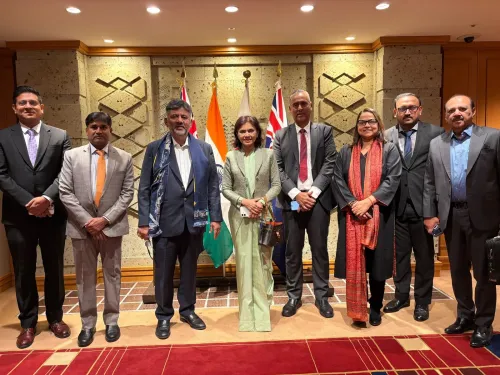
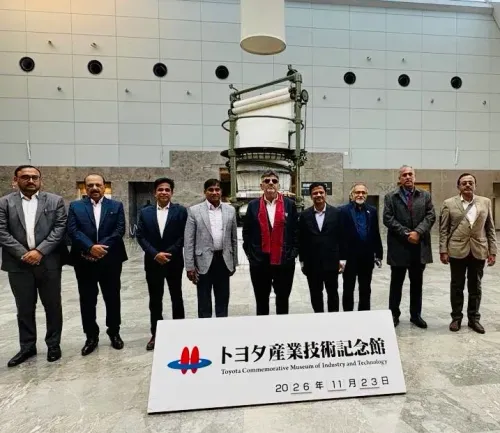
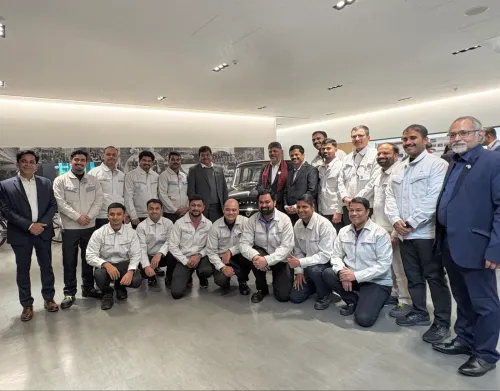
A Karnataka government delegation pressed Toyota Motor Corporation on manufacturing expansion, greater localisation and next-generation mobility, the Chief Minister's Office of Karnataka said on 28 November 2026. Framed as part of the state's Japan outreach, the talks are being positioned as a bid to pull more capital into advanced automotive technologies and lock in Karnataka as a leading manufacturing and export hub.
In a bilingual readout, the office said the engagement focused on exploring opportunities for manufacturing expansion, greater localisation and next-generation mobility. It added: 'Our government looks forward to deepening this partnership and attracting further investments in advanced automotive technologies, strengthening Karnataka's position as a leading automotive manufacturing and export hub.'
Expansion, localisation and the mobility ask
The agenda, as described by the CMO, had three legs: more production on the ground, a higher share of parts and processes made in India, and a window into future mobility technologies. That mix matters. Assembly without localisation leaves value — and jobs — on the table for other states and other countries.
The office said the government is committed to making the partnership stronger and to attracting further investments in advanced automotive technologies. No investment amount, plant timeline or signed memorandum was disclosed in the readout.
Toyota Kirloskar's long Karnataka footprint
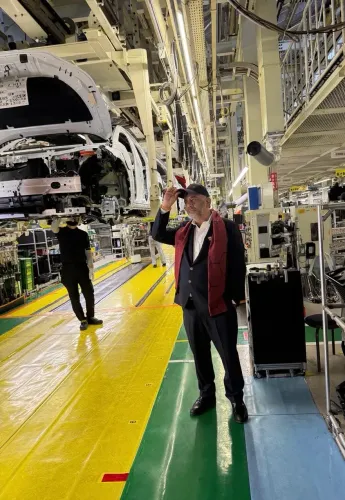
Toyota Kirloskar Motor set up its first manufacturing facility in Karnataka between 1997 and 1999, aiming to serve the Indian market and to grow local supply chains. That presence made the Japanese manufacturer a fixture of the state's auto cluster, with component suppliers feeding the assembly lines that followed.
Karnataka has chased automobile FDI in parallel with its IT story. It competes with Tamil Nadu and Maharashtra for vehicle assembly and component investments. State policy has leaned on localisation and technology upgrading so the state can sell itself as an export-oriented hub, not only a domestic assembly base.
The EV-era pitch hanging over Japan
Talk of next-generation mobility tracks a national turn toward electric vehicles and advanced auto technologies, including schemes such as FAME and the Production Linked Incentive programme for auto components. For Karnataka, the strategic prize is to keep a legacy OEM ecosystem and then add capacity that can export.
Follow-through would typically surface as announcements at later Invest Karnataka summits, or as automotive incentives in a state budget. Until then, the Japan round is a public signal, not a closed deal. The question hanging over it is simple. Can a decades-old plant relationship become an EV-era export engine?
For a state that already hosts Toyota's Indian manufacturing story, this is less a first handshake than a test of whether localisation and next-generation capacity can turn a long partnership into a bigger export machine.
Point of View
Not a cold pitch to a new manufacturer. Karnataka is trying to convert Toyota Kirloskar's decades-old plants into a larger localisation and export story as the industry shifts toward electric and advanced technologies. The state's real contest remains with Tamil Nadu and Maharashtra for assembly and component capital. Without a disclosed cheque or plant timeline, the Japan engagement is a positioning move whose value will be measured in follow-up announcements, not in the readout itself.
NationPress
28 Nov 2026
Frequently Asked Questions
What did the Karnataka CMO say about the Toyota meeting?
The Chief Minister's Office of Karnataka said the engagement focused on manufacturing expansion, greater localisation and next-generation mobility. It said the government looks forward to deepening the partnership and attracting further investment in advanced automotive technologies.
When did Toyota start manufacturing in Karnataka?
Toyota Kirloskar Motor established its initial manufacturing facility in Karnataka between 1997 and 1999. The plant was set up to serve the Indian market and to develop local supply chains.
What is localisation in the Toyota-Karnataka talks?
Localisation means producing a larger share of vehicles and components inside India rather than importing them. A higher local content can deepen supplier networks and support export-oriented manufacturing.
How does next-generation mobility fit Karnataka's auto strategy?
It aligns with India's national focus on electric vehicles and advanced automotive technologies under schemes such as FAME and the PLI for auto components. Karnataka is seeking to pair that shift with Toyota's existing manufacturing base in the state.
Has Karnataka announced a new Toyota investment from this meeting?
No specific investment figures or new memoranda from the November 2026 meeting have been announced. The CMO described exploratory talks and a commitment to attract further investment.