Karnataka CMO Launches Drive to Deliver Caste Certificates via WhatsApp
Synopsis
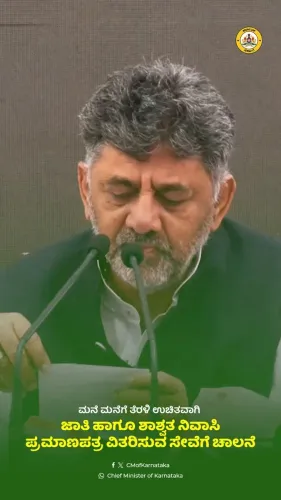
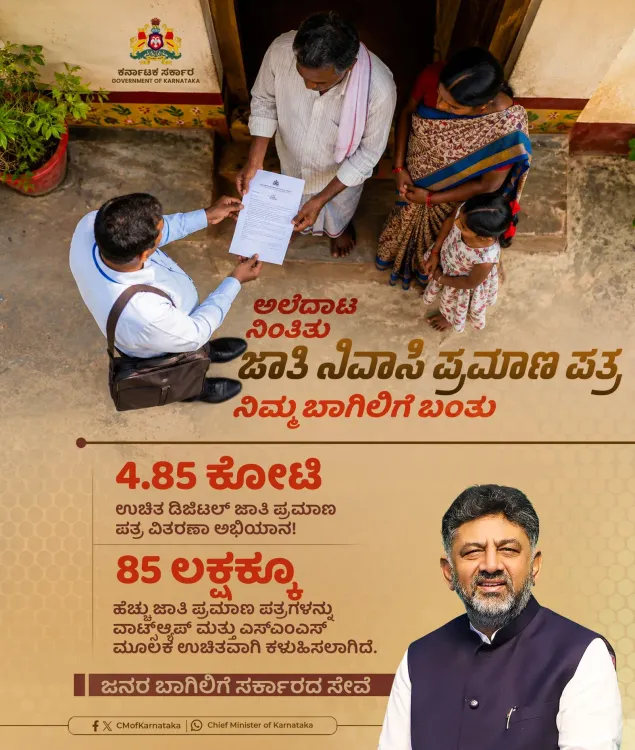
The Chief Minister's Office of Karnataka has launched a campaign to deliver 4.85 crore free digital caste and domicile certificates to citizens via WhatsApp and SMS, with over 85 lakh already dispatched as of 22 July 2026, removing the need for office visits.
Key Takeaways
The Chief Minister's Office of Karnataka announced the campaign on 22 July 2026 .
The drive targets delivery of 4.85 crore free digital caste and domicile certificates to state residents.
More than 85 lakh certificates have already been sent via WhatsApp and SMS .
The initiative aims to eliminate the need for citizens to visit government offices to collect documents.
The campaign builds on Karnataka's Sakala Act (2011) , which mandated time-bound service delivery.
Beneficiaries include SC, ST, and OBC communities who need certificates for education, jobs, and welfare entitlements.
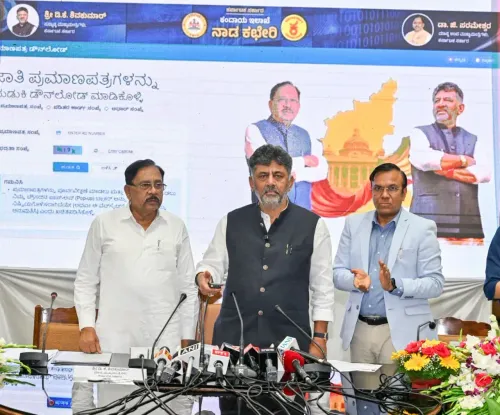
The Chief Minister's Office of Karnataka announced on Wednesday, 22 July 2026 that the state government has launched an ambitious campaign to deliver caste and domicile certificates directly to citizens through WhatsApp and SMS, eliminating the need for repeated office visits.
The CMO stated that of a planned 4.85 crore free digital caste certificates, more than 85 lakh have already been dispatched to residents via WhatsApp and SMS. The initiative aims to ensure that every citizen of Karnataka receives their caste and residential proof documents easily and swiftly — delivered, as the announcement put it, 'at the doorstep.'
Context
The post, written in Kannada, describes the campaign as mahatvakanshi abhiyana (an ambitious drive) under which the government is proactively pushing certificates to beneficiaries rather than waiting for them to apply or collect in person. Both caste certificates and domicile (resident) certificates are covered under the drive. The government framed the effort as ending the hardship of citizens 'wandering unnecessarily to offices.'Policy Backdrop
Karnataka has a legislative foundation for this kind of initiative in the Sakala Act of 2011, which mandated time-bound delivery of government services and documents to reduce bureaucratic delays. The current campaign extends that framework into the mobile era, using widely adopted platforms to push documents rather than requiring citizens to navigate portals or counters. Across India, states have progressively digitised certificate issuance since the mid-2010s, and Karnataka's use of WhatsApp and SMS represents a further step in aligning with Digital India frameworks that promote paperless administration.Stakeholders and Impact
The primary beneficiaries are citizens from Scheduled Castes, Scheduled Tribes, and Other Backward Classes who require caste certificates for access to reservations in education, employment, and welfare schemes. Domicile certificates are similarly essential for state-specific entitlements. By delivering these documents digitally to mobile phones, the government aims to reduce the burden on both applicants and government offices, cutting queues and processing backlogs. Rural and semi-urban residents, who often face the greatest travel burden to reach taluk or district offices, stand to benefit most directly.What's Next
The remaining balance of the 4.85 crore target certificates will be watched as a key completion metric for the campaign. Analysts and citizen groups will also track whether the digitally delivered certificates are accepted seamlessly by educational institutions, employers, and central government agencies — a practical test of interoperability with national verification databases. If the model proves effective, it could serve as a template for extending digital delivery to other official documents across Karnataka's administrative system.Point of View
4.85 crore certificates, signals that this is not a pilot but a state-wide administrative commitment, likely timed to demonstrate governance delivery ahead of electoral cycles. It also reflects a broader competitive dynamic among Indian states to operationalise Digital India rhetoric at the ground level, where the real test is whether digitally delivered documents are accepted without dispute by institutions. The durability of the initiative will depend on backend verification infrastructure and grievance redress for certificates that are rejected or incorrectly generated.
NationPress
22 Jul 2026
Frequently Asked Questions
What is the Karnataka government's caste certificate WhatsApp campaign?
The Karnataka government has launched a campaign to deliver free digital caste and domicile certificates directly to citizens via WhatsApp and SMS, targeting 4.85 crore certificates in total, with over 85 lakh already sent as of 22 July 2026.
How will I receive my caste certificate from the Karnataka government?
Eligible Karnataka residents will receive their digital caste certificate directly on their registered mobile number via WhatsApp or SMS, without needing to visit a government office.
Is the digital caste certificate from Karnataka valid for use?
The government has issued these as official digital certificates intended for use in accessing reservations, welfare schemes, education, and employment, though acceptance by specific institutions should be confirmed with the relevant authority.
What is the Sakala scheme in Karnataka?
The Sakala Act, passed in Karnataka in 2011, is a legislation that guarantees time-bound delivery of government services and documents to citizens, forming the policy foundation for initiatives like this certificate delivery campaign.
How many caste certificates has Karnataka distributed via WhatsApp so far?
As of the announcement on 22 July 2026, more than 85 lakh caste and domicile certificates have been delivered via WhatsApp and SMS under the campaign, out of a total target of 4.85 crore.