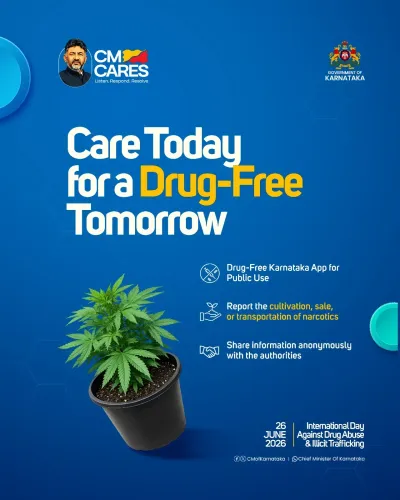
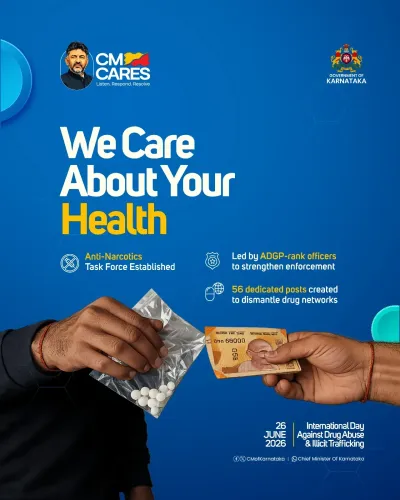
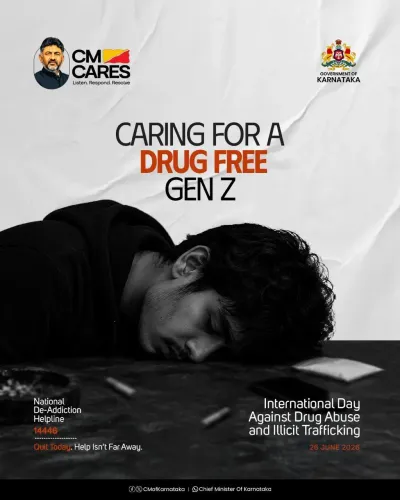
CM Karnataka Office Urges Early Drug Abuse Detection
Synopsis
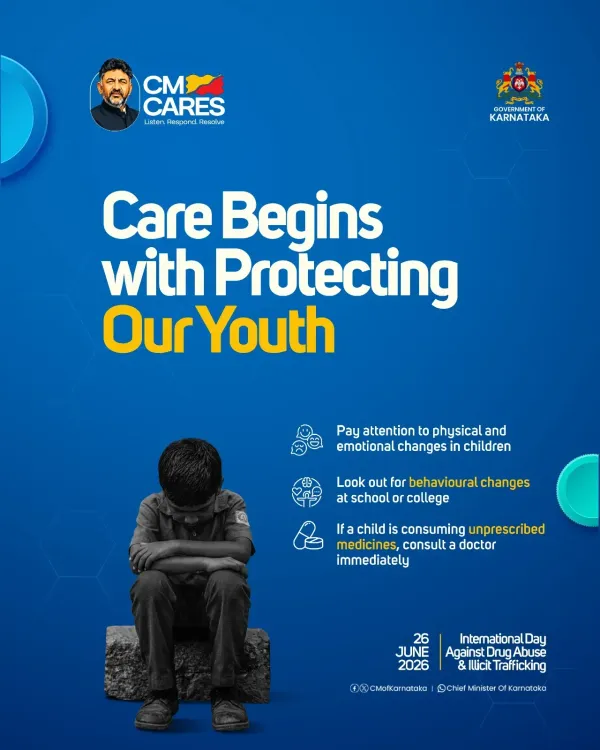
The Chief Minister's Office of Karnataka issued a bilingual advisory on 26 June 2026, calling on parents, teachers, and communities to detect early signs of drug abuse in children and seek timely medical help, under the hashtag #DrugFreeKarnataka.
Key Takeaways
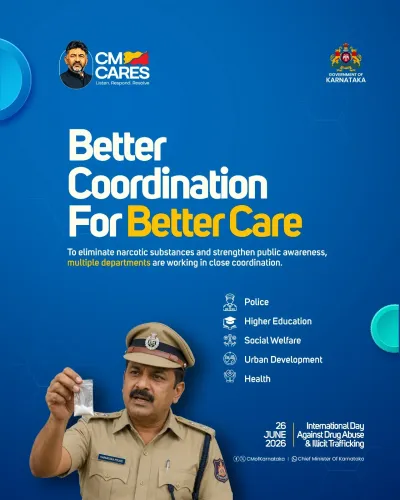
The Chief Minister's Office of Karnataka posted a public advisory on 26 June 2026 , coinciding with the International Day Against Drug Abuse.
Parents are urged to observe physical, emotional, and behavioural changes in children at home and in school.
The post recommends immediate medical consultation if a child is found consuming medicines unnecessarily.
The advisory was issued in both English and Kannada , broadening its reach across the state.
The messaging aligns with the Central government's Nasha Mukt Bharat Abhiyaan (launched 2020) and the NDPS Act, 1985 framework.
Policy observers will watch for follow-up actions including school awareness modules and state funding for de-addiction centres .
The Chief Minister's Office of Karnataka issued a public advisory on Friday, 26 June 2026, calling on parents, teachers, and communities across the state to watch for early physical, emotional, and behavioural signs of drug abuse in children, urging timely medical intervention to protect the youth.
The post, shared in both English and Kannada, carried a direct message: 'ಯುವಜನರ ರಕ್ಷಣೆ ನಮ್ಮೆಲ್ಲರ ಹೊಣೆ' ('Protecting our youth is all our responsibility'). It advised parents to observe physical and mental changes in children, stay informed about their behaviour in schools and colleges, and consult a doctor immediately if a child is found consuming medicines unnecessarily.
Context
The advisory was posted under the hashtags #CMCares, #DrugFreeKarnataka, and #SayNoToDrugs, signalling a sustained state-level communication push on substance abuse prevention. The Kannada portion of the post specifically directed parents to 'ask and find out' about children's conduct in schools and colleges — a call for active parental engagement rather than passive observation.
The post comes on the occasion of the International Day Against Drug Abuse and Illicit Trafficking, observed globally on 26 June each year, which typically prompts governments at all levels in India to renew public messaging on the issue.
Policy Backdrop
Drug abuse prevention in India is governed at the national level by the Narcotic Drugs and Psychotropic Substances (NDPS) Act, 1985, which regulates narcotics and psychotropic substances across the country. The Central government's Nasha Mukt Bharat Abhiyaan, launched in 2020, further institutionalised community-level awareness drives targeting youth, with a focus on schools, colleges, and vulnerable districts.
Karnataka, as a southern state with a growing urban youth population in cities such as Bengaluru, has periodically aligned its public health messaging with these national frameworks. State-level advisories of this nature emphasise community vigilance and early detection, complementing law-enforcement action with health and social outreach.
Stakeholders and Impact
The advisory is directed at three distinct groups: parents, who are asked to monitor children at home; teachers, who are positioned as frontline observers in educational institutions; and communities at large, who are called to share collective responsibility. This three-pronged approach reflects a broader Indian policy consensus that substance abuse prevention cannot rest on enforcement alone.
For children and youth, the practical implication of the advisory is increased adult scrutiny of behavioural changes — a measure public health practitioners associate with earlier access to counselling and de-addiction support. Timely medical referral, as the post explicitly recommends, can prevent dependency from taking hold at a formative stage.
What's Next
The advisory is likely to be followed by school and college awareness modules and, potentially, announcements on state budget allocations for de-addiction centres — areas identified by policy observers as the next logical step after public communication campaigns. Whether the Government of Karnataka translates this messaging into programmatic action — through counsellor deployments, helpline amplification, or dedicated funding — will determine the advisory's real-world reach beyond social media.
Point of View
Addressing both English-literate urban parents and Kannada-speaking communities, suggests an intent to reach beyond the usual policy echo chamber. However, advisories of this kind carry weight only when backed by measurable follow-through: counsellor deployments, de-addiction funding, and school-level interventions. The real test for the government will be whether this communication moment translates into programmatic action in the months ahead.
NationPress
25 Sept 2026
Frequently Asked Questions
What did the Karnataka Chief Minister's Office say about drug abuse?
The Chief Minister's Office of Karnataka urged parents, teachers, and communities on 26 June 2026 to watch for early physical, emotional, and behavioural signs of drug abuse in children, and to seek immediate medical help if needed.
What are the early signs of drug abuse in children parents should watch for?
Health authorities advise parents to look for unexplained physical changes, mood swings, withdrawal from family, declining school performance, and unusual medicine consumption — all flagged in the Karnataka CMO advisory as warning signs requiring medical consultation.
What is the #DrugFreeKarnataka campaign?
#DrugFreeKarnataka is a hashtag used by the Karnataka government in its public communication to promote awareness against drug abuse among youth, aligning with national initiatives like the Nasha Mukt Bharat Abhiyaan.
What is the Nasha Mukt Bharat Abhiyaan?
Nasha Mukt Bharat Abhiyaan is a Central government campaign launched in 2020 to raise awareness against drug abuse, focusing on youth in schools, colleges, and vulnerable communities across India.
Why is 26 June significant for anti-drug campaigns in India?
26 June is observed globally as the International Day Against Drug Abuse and Illicit Trafficking, prompting governments including Indian state administrations to issue public advisories and renew awareness drives on substance abuse prevention.