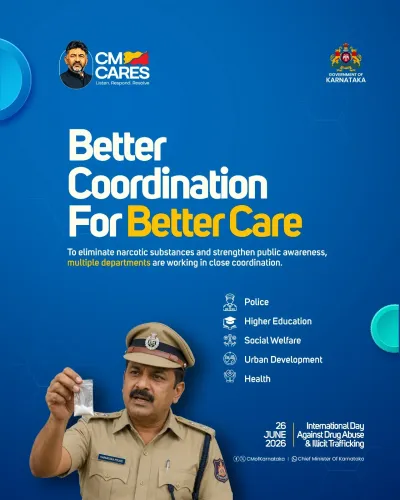
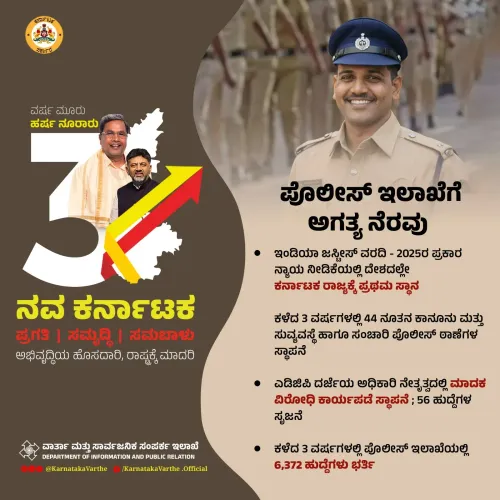
Karnataka CM Office launches ADGP-led Anti-Drug Task Force

Synopsis
Karnataka's Chief Minister's Office has announced the creation of an ADGP-led Anti-Drug Task Force backed by 56 new sanctioned posts, marking a structural escalation in the state's effort to dismantle narcotics networks and protect public health.
Key Takeaways
The Chief Minister's Office of Karnataka announced a dedicated Anti-Drug Task Force on June 26, 2026 .
The task force will be headed by officers of ADGP (Additional Director General of Police) rank.
56 new posts have been freshly created to staff the unit, indicating a long-term personnel commitment.
The initiative aims to 'uproot drug networks entirely' through dedicated enforcement and stronger inter-agency coordination.
The move aligns with the national Nasha Mukt Bharat Abhiyaan framework launched in 2020 .
Key metrics to watch include early seizure data, arrest figures, and the pace of recruitment for the new posts.
The Chief Minister's Office of Karnataka announced on Friday, June 26, 2026, the formation of a dedicated Anti-Drug Task Force headed by officers of Additional Director General of Police (ADGP) rank, along with the creation of 56 new posts to staff the unit — signalling a structural escalation in the state's war against narcotics.
Context
The announcement, made via the official CMofKarnataka account on X, carried both English and Kannada messaging. The Kannada portion states: 'ಡ್ರಗ್ಸ್ ಜಾಲವನ್ನು ಬುಡಸಮೇತ ಕಿತ್ತು ಹಾಕುವ ಸಲುವಾಗಿ ಎಡಿಜಿಪಿ ದರ್ಜೆಯ ಅಧಿಕಾರಿಗಳ ನೇತೃತ್ವದಲ್ಲಿ ಮಾದಕ ದ್ರವ್ಯ ವಿರೋಧಿ ಕಾರ್ಯಪಡೆ ಸ್ಥಾಪಿಸಲಾಗಿದೆ' — translated: 'To uproot the drug network entirely, an Anti-Drug Task Force has been established under the leadership of ADGP-rank officers.' The post adds that 56 new positions have been freshly created to support this force.
The English portion of the post frames the initiative in explicit terms: 'A drug-free Karnataka begins with decisive action. Dedicated enforcement, stronger coordination, and a clear commitment to dismantling drug networks — because every life is worth protecting.' The hashtags #CMCares, #DrugFreeKarnataka, and #SayNoToDrugs accompanied the post, underscoring the public-communication dimension of the drive.
Policy Backdrop
The move aligns with a broader national pattern in which state governments have progressively institutionalised specialised anti-narcotics units to sharpen enforcement under the Narcotic Drugs and Psychotropic Substances (NDPS) Act and improve coordination with central agencies such as the Narcotics Control Bureau (NCB). These initiatives typically combine new sanctioned posts with focused operations targeting supply networks at their root.
At the national level, the Nasha Mukt Bharat Abhiyaan, launched in 2020, set a framework for states to pursue demand reduction through awareness, enforcement, and rehabilitation in tandem. Karnataka's announcement of a dedicated ADGP-led task force represents the institutionalisation of sustained manpower — moving beyond periodic crackdowns toward a permanent enforcement structure.
Stakeholders and Impact
The task force is expected to directly affect Karnataka Police's operational capacity, giving field units a dedicated chain of command for narcotics cases rather than routing them through general law-and-order channels. Communities in districts identified as drug-supply corridors and urban centres with reported substance-abuse problems stand to see more focused enforcement activity.
Youth and families affected by substance abuse are the stated beneficiaries of the initiative. The creation of 56 new posts also has an administrative dimension — it signals a long-term budgetary and personnel commitment rather than a temporary deployment, lending institutional durability to the effort.
What's Next
The immediate milestones to watch are the recruitment and deployment process for the 56 newly sanctioned positions and the task force's first operational reports — including data on seizures, arrests, and inter-district coordination outcomes. How quickly the ADGP-led command structure integrates with district police and central agencies will determine the force's early effectiveness.
If the task force produces measurable results in its initial months, it could serve as a template for other states looking to institutionalise anti-drug enforcement within their police hierarchies — reinforcing the national push toward a coordinated, multi-agency approach to narcotics control.
Point of View
ADGP-led command structure — rather than periodic crackdowns — reflects a maturing understanding that narcotics enforcement requires institutional continuity, not just political signalling. The creation of 56 dedicated posts signals a budgetary commitment that outlasts any single campaign cycle, which is significant in a state where urban drug markets have drawn sustained public attention. Framed under the hashtag #CMCares, the announcement also carries a clear electoral messaging dimension, positioning the administration as proactive on a law-and-order issue that resonates with middle-class and youth voters. The real test, however, will come in the operational phase: whether the task force achieves genuine inter-agency integration with the NCB and produces verifiable enforcement outcomes.
NationPress
25 Sept 2026
Frequently Asked Questions
What is the Karnataka Anti-Drug Task Force announced in June 2026?
It is a dedicated enforcement unit established by the Karnataka government, headed by ADGP-rank officers, to dismantle drug networks across the state. The government also created 56 new posts to staff the force.
Who leads the new Karnataka Anti-Drug Task Force?
The task force is led by officers holding the rank of Additional Director General of Police (ADGP), ensuring senior-level command and accountability for anti-narcotics operations.
How many new posts have been created for the Karnataka drug task force?
The Karnataka government has created 56 new positions specifically to support the Anti-Drug Task Force, signalling a long-term institutional commitment to narcotics enforcement.
How does Karnataka's anti-drug task force relate to the Nasha Mukt Bharat Abhiyaan?
Karnataka's initiative aligns with the central government's Nasha Mukt Bharat Abhiyaan, launched in 2020, which encourages states to combine enforcement, awareness, and rehabilitation to reduce drug use.
What should we watch for after Karnataka's anti-drug task force is set up?
Key developments to track include the recruitment and deployment of the 56 new posts, the task force's first seizure and arrest data, and how effectively it coordinates with district police and central agencies like the Narcotics Control Bureau.