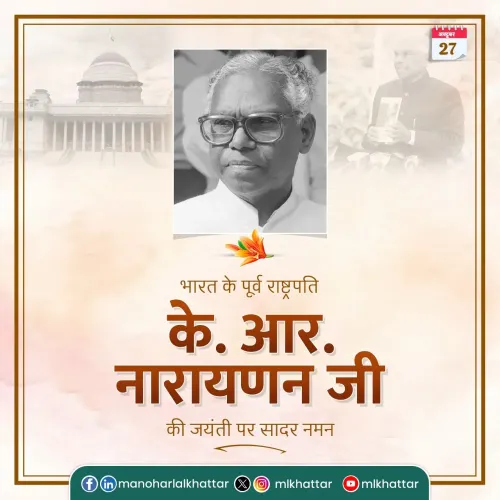
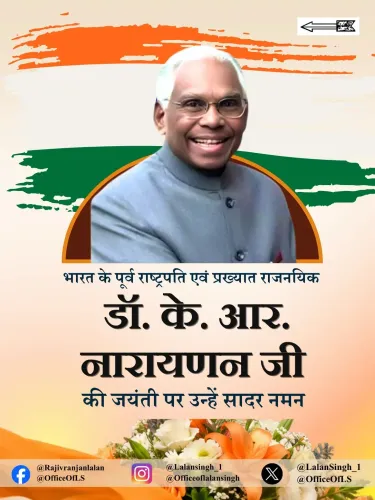
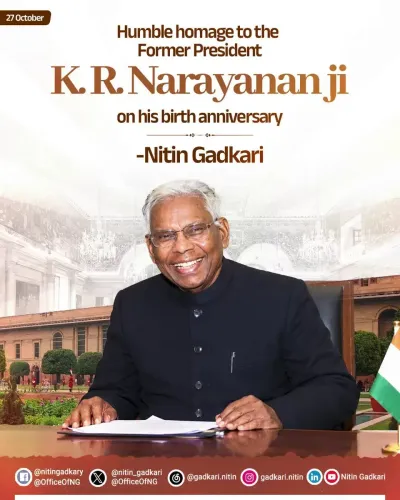
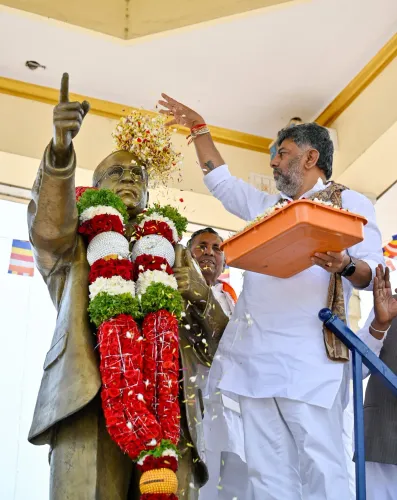
Karnataka CM's Office Pays Tribute to K.R. Narayanan on Birth Anniversary
Synopsis
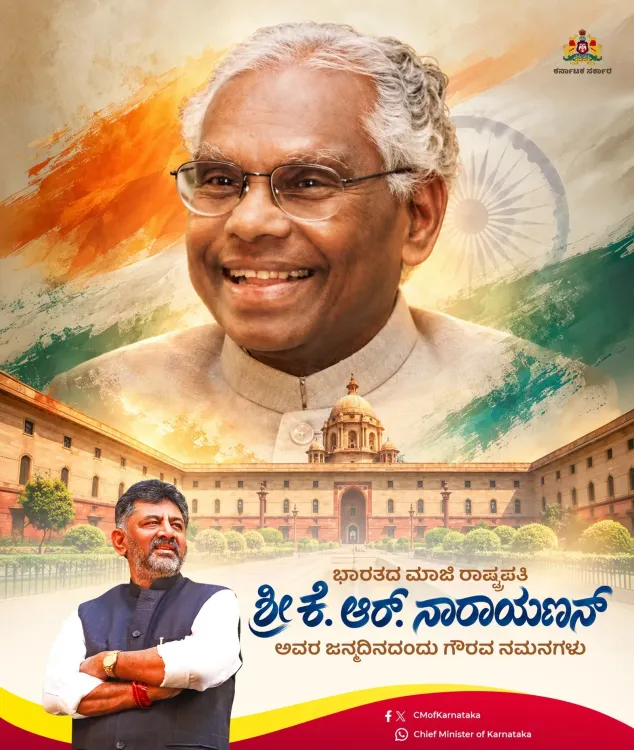
The Chief Minister's Office of Karnataka paid tribute to K.R. Narayanan on his birth anniversary, honouring India's 10th President as a constitutional guardian and living proof of Ambedkar's democratic vision.
Key Takeaways
Narayanan served as India's 10th President from 1997 to 2002 , the first from a backward-class background to hold the office.
He previously served as Vice President from 1992 to 1997 and as an Indian Foreign Service diplomat and ambassador.
Karnataka's Chief Minister's Office described him as a 'constitutional sentinel' who stood firm whenever democratic values were threatened.
The tribute explicitly credits Dr.
Ambedkar's Constitution of 1950 as the force that made Narayanan's rise from humble origins to the highest office possible.
The CMO called on citizens to uphold Narayanan's ideals of equality, education, and protection of democracy .
The tribute is part of a wider pattern of Ambedkarite constitutional messaging by the Karnataka government, ahead of Constitution Day on 26 November .
A boy from a humble household in Kerala who rose to become India's 10th President — the Chief Minister's Office of Karnataka paused on Tuesday, 27 October 2026, to honour K.R. Narayanan on his birth anniversary, saluting a life that remains the Constitution's most eloquent argument for itself.
From Diplomat to the First Citizen — Narayanan's Unlikely Arc
The Kannada-language tribute posted by the Chief Minister's Office of Karnataka described Narayanan as a person who served India as an rāyabhāri (ambassador) in the foreign service, then as Vice President (1992–1997), and finally as President of India from 1997 to 2002. The post called his personality a 'timeless model' — someone who stood firm like a constitutional sentinel whenever democratic values came under threat.
That framing is more than ceremonial. Narayanan's presidency was marked by active use of the constitutional office: he returned bills for reconsideration, exercised independent judgment on invoking President's Rule in states, and delivered Republic Day addresses that read as primers on constitutional morality. His biography — born into a Dalit family in Uzhavoor, Kerala, winning a scholarship to the London School of Economics, rising through the Indian Foreign Service — was itself a refutation of inherited hierarchy.
The Ambedkar Thread Karnataka's Post Draws
The CMO's tribute pointedly invokes Dr. B.R. Ambedkar, the principal architect of the Indian Constitution adopted in 1950, crediting his framework of equality and fundamental rights as the very force that made Narayanan's ascent possible. The post states that Narayanan's life is 'living proof that even the most ordinary among the ordinary can become the First Citizen of the country — only through the power of the Constitution given by Dr. B.R. Ambedkar.'
It is a deliberately constitutionalist argument: the post does not frame Narayanan's rise as personal triumph alone, but as institutional validation — proof that Ambedkar's architecture works when upheld. The CMO closes with a call to action: 'Let us all commit to upholding the ideals he stood for — equality, education, and the protection of democracy.'
A Recurring Ritual With Political Weight
Birth-anniversary tributes to former presidents are a fixture of Indian political life, but Karnataka's framing carries a particular edge. By threading Narayanan's presidency through Ambedkar's constitutional vision, the state government positions both figures inside the same moral argument — one that reasserts constitutional primacy at a moment when debates over democratic norms and federalism remain live across the country.
With Constitution Day falling on 26 November, such tributes in late October typically signal the run-up to a broader season of constitutional commemorations. Karnataka's government has previously anchored its public-welfare messaging in Ambedkarite language, and this tribute extends that idiom into the realm of presidential history.
K.R. Narayanan's life proved that the distance between the margins and the highest office in the land is, constitutionally speaking, zero. Karnataka's CMO is betting that reminding people of that fact still matters.
Point of View
The CMO frames both figures as co-authors of the same democratic project, lending Ambedkarite language the prestige of a former Head of State. In a political climate where federalism and institutional autonomy are contested, invoking a president known for actively wielding constitutional powers sends a pointed message about the value of independent constitutional offices. The timing, weeks ahead of Constitution Day, suggests the tribute is the opening note of a longer political and commemorative season.
NationPress
27 Oct 2026
Frequently Asked Questions
Who was K.R. Narayanan?
K.R. Narayanan was India's 10th President, serving from 1997 to 2002 . He was the first president from a Dalit background, and previously served as Vice President and as an Indian Foreign Service diplomat.
Why is K.R. Narayanan's birth anniversary celebrated?
Narayanan is remembered for his active use of presidential powers to defend constitutional principles, his extraordinary rise from a humble background in Kerala, and his commitment to equality and democracy.
What did Karnataka's CMO say about K.R. Narayanan?
The Chief Minister's Office of Karnataka called him a 'timeless model' and a 'constitutional sentinel,' and stated that his life is living proof of the power of Dr. B.R. Ambedkar's Constitution to elevate the most ordinary citizen to the highest office.
What is the connection between K.R. Narayanan and Dr. B.R. Ambedkar?
Karnataka's tribute argues that Narayanan's rise from a marginalised background to become President was made possible by the framework of equality and fundamental rights enshrined in the Indian Constitution drafted under Ambedkar's chairmanship in 1950 .
When was K.R. Narayanan elected President of India?
K.R. Narayanan was elected India's 10th President in 1997 , having served as Vice President from 1992. He held the presidency until 2002.