Karnataka High Court Upholds Tiger Safaris, Calls for Clear Zone Demarcation

Synopsis
In a pivotal ruling, the Karnataka High Court has opted not to ban tiger safaris, instead directing the government to clarify the boundaries of safari zones, emphasizing wildlife protection amidst increasing human-animal conflicts.
Key Takeaways
Karnataka High Court upholds tiger safaris in a recent ruling.
State government ordered to clarify core and buffer zone demarcations .
Public Interest Litigation challenges the ecological impact of safaris.
Previous bans were instituted due to human-animal conflicts .
Both Bandipur and Nagarahole are key reserves for tiger conservation.
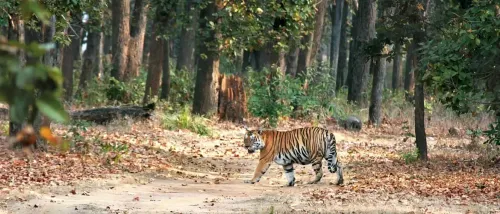
Bengaluru, April 15 (NationPress) In a significant turn of events, the Division Bench of the Karnataka High Court, led by Chief Justice Vibhu Bakhru and Justice C.M. Poonacha, has decided against imposing a ban on tiger safaris within the state.
The bench has instructed the state government to provide a comprehensive affidavit that details the delineation of core, buffer, and tourism zones, along with the specific areas where these safaris occur.
This ruling came in response to a Public Interest Litigation (PIL) filed by V. Ravikumar, a Mysuru resident, who sought a prohibition on tiger safaris.
The petition argued that conducting tiger safaris in reserve forests—vital habitats for tigers—contravenes established conservation protocols.
While the court declined to issue an immediate ban, it ordered the state to respond to the petition requesting a permanent injunction against such safaris.
Additionally, the court requested the government to submit maps marking the precise core, buffer, and tourism zones.
The petition referenced a landmark Supreme Court ruling regarding forest conservation and wildlife management in India, claiming that safaris are being conducted in core tiger habitats where such activities are prohibited. The decision to resume these safaris, the petition suggests, resulted from political and commercial pressures, which could exacerbate human-animal conflicts.
It is noteworthy that the state had previously suspended jungle safaris following incidents where tigers strayed from the Bandipur Tiger Reserve, leading to attacks on villagers, with one individual sustaining severe injuries in 2025. However, the Minister defended the resumption of safari operations, stating there is no scientific evidence to suggest that these activities disturb wildlife, particularly tigers, leopards, and elephants, thus causing man-animal conflict. Following recommendations from a technical committee, the state has initiated a phased reopening of tiger safaris.
The Bandipur Tiger Reserve spans across the Mysuru and Chamarajanagar districts, as well as Nagarahole in Mysuru and Kodagu districts.
Both Bandipur and Nagarahole Tiger Reserves are critical protected areas in southern India, renowned for their rich biodiversity and commitment to tiger conservation.
Located in southern Karnataka, the Bandipur Tiger Reserve is part of the expansive Nilgiri Biosphere Reserve. It is home to a significant population of tigers, elephants, and a variety of flora and fauna, creating a crucial wildlife corridor with adjacent reserves in Tamil Nadu and Kerala.
Nagarahole Tiger Reserve, also known as Rajiv Gandhi National Park, is situated in the Mysuru and Kodagu districts, characterized by its dense forests and a high density of wildlife, including tigers, leopards, and various deer species. The Kabini backwaters within the reserve are particularly famous for frequent wildlife sightings.
Both reserves are integral to Project Tiger and play a vital role in maintaining ecological balance and fostering wildlife conservation in the Western Ghats region.
Point of View
This ruling underscores the complex balance between wildlife conservation and tourism interests. While the court's decision aims to uphold economic benefits derived from safaris, it raises critical questions about the long-term impact on tiger habitats and human-animal interactions.
NationPress
19 Sept 2026
Frequently Asked Questions
Why did the Karnataka High Court refuse to ban tiger safaris?
The court refused to ban tiger safaris as it directed the state government to clarify the demarcation of safari zones, emphasizing the need for a detailed affidavit on core and buffer zones.
What prompted the Public Interest Litigation against tiger safaris?
The PIL was filed by V. Ravikumar, who argued that conducting tiger safaris in critical habitats contravenes conservation guidelines and could escalate human-animal conflicts.
What are the implications of this court ruling on wildlife conservation?
The ruling may create tension between tourism and conservation efforts, as it allows safaris to continue in sensitive areas, potentially impacting tiger populations and their habitats.
What steps has the Karnataka government been ordered to take?
The government has been instructed to submit maps showing core, buffer, and tourism zones, and to respond to the petition requesting a permanent ban on safaris.
How do the Bandipur and Nagarahole Tiger Reserves contribute to wildlife conservation?
Both reserves are vital for maintaining biodiversity and play a significant role in Project Tiger, supporting ecological balance in the Western Ghats.