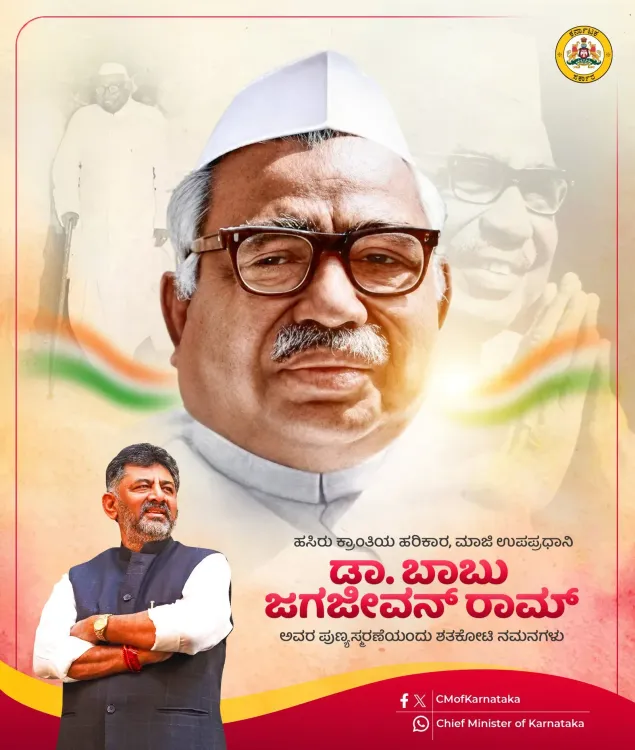
CM Karnataka Pays Tribute to Babu Jagjivan Ram on Death Anniversary
Synopsis
The Chief Minister's Office of Karnataka marked the death anniversary of Dr. Babu Jagjivan Ram on 6 July 2026, honouring the long-serving Dalit statesman for his historic role as Defence Minister in the 1971 India-Pakistan War and as the Agriculture Minister who advanced the Green Revolution.
Key Takeaways
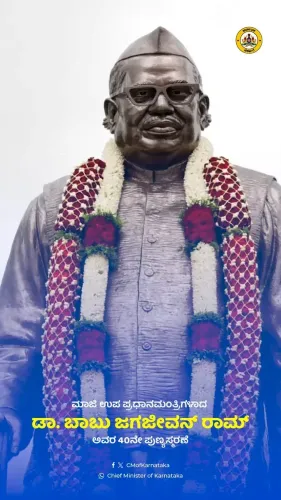
The Chief Minister's Office of Karnataka posted an official tribute to Dr.
Babu Jagjivan Ram on his death anniversary on 6 July 2026 .
Jagjivan Ram served as a Union Minister almost continuously from 1952 to 1979 , holding portfolios including Labour, Railways, Agriculture, and Defence.
As Defence Minister , he coordinated India's military operations in the 1971 India-Pakistan War , which resulted in the creation of Bangladesh .
As Agriculture Minister ( 1967–70 and 1973–77 ), he oversaw the Green Revolution , driving India toward food self-sufficiency.
The Karnataka CMO described him as 'the voice of the oppressed classes,' underlining his enduring significance for Dalit communities .
The tribute reflects a wider pattern of state governments invoking national leaders to align regional administrations with post-independence narratives of social inclusion.
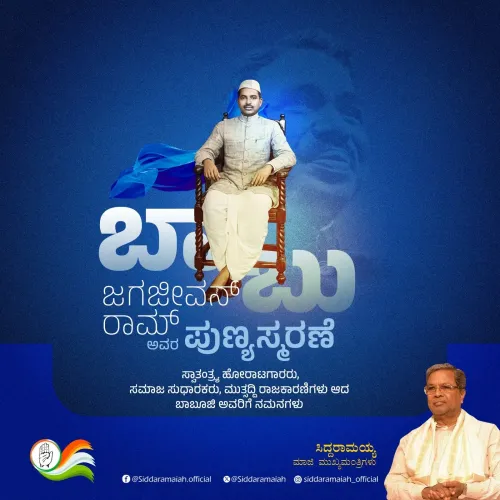
The Chief Minister's Office of Karnataka on Monday, 6 July 2026 paid tribute to Dr. Babu Jagjivan Ram on his death anniversary, honouring the veteran Dalit leader as a towering figure in Indian political history whose contributions to defence and agriculture shaped the modern republic.
The post, written in Kannada, described him as 'ಶೋಷಿತ ವರ್ಗಗಳ ಧ್ವನಿ' — 'the voice of the oppressed classes' — and recalled his role in steering India to a historic military victory in the 1971 India-Pakistan War as Defence Minister, as well as his stewardship of the Green Revolution as Agriculture Minister that moved the country toward food self-sufficiency.
Context
Born on 5 April 1908 in Chandwa, Bihar, Dr. Babu Jagjivan Ram rose from a marginalised Dalit background to become one of independent India's most enduring cabinet ministers. He was first elected to the Central Legislative Assembly in 1936 and remained a Union Minister almost continuously from 1952 to 1979, spanning the portfolios of Labour, Communications, Railways, Agriculture, and Defence. The Karnataka CMO's tribute invoked a popular saying that captures his administrative range: 'ಆಡು ಮುಟ್ಟದ ಸೊಪ್ಪಿಲ್ಲ, ಜಗಜೀವನ್ ರಾಮ್ ಅವರು ನಿರ್ವಹಿಸದೆ ಇರುವ ಖಾತೆಗಳಿಲ್ಲ' — loosely translated as 'just as there is no herb a goat has not grazed, there is no ministry Jagjivan Ram has not held' — a testament to his unmatched administrative versatility.Policy Backdrop
As Agriculture Minister across two stints (1967–70 and 1973–77), Jagjivan Ram oversaw the expansion of high-yielding seed varieties, irrigation infrastructure, and fertiliser use that defined India's Green Revolution. The programme transformed India from a food-deficit nation dependent on imports into a country capable of feeding its own population. As Defence Minister, he played a central role in coordinating logistics and military operations during the 1971 war, which culminated in the surrender of Pakistani forces in Dhaka and the creation of Bangladesh — widely regarded as one of the most decisive military victories in post-independence Indian history.Stakeholders and Impact
Jagjivan Ram's legacy carries particular resonance for Dalit communities across India, who regard him as a pioneer who demonstrated that social mobility and political leadership were achievable within the constitutional framework. Indian farmers, especially in states that benefited from Green Revolution-era investments, also trace improved rural livelihoods to policies he championed. For the defence establishment, his tenure as Defence Minister during 1971 remains a benchmark of civilian-military coordination. Karnataka's official tribute signals the state government's intent to place itself within a broader national narrative of social inclusion and institution-building.What's Next
State governments across India typically follow such anniversary observances with commemorative events, possible announcements on scholarships or infrastructure named after the leader, and references in legislative proceedings. In Karnataka, the tribute may feed into ongoing discussions around Dalit welfare schemes and agricultural policy priorities in the 2026–27 budget cycle. As India continues to debate food security and social equity, Jagjivan Ram's dual legacy in agriculture and defence representation offers a recurring reference point for policymakers seeking historical legitimacy for inclusive governance.Point of View
Positioning the state's ruling dispensation as the inheritor of a legacy rooted in Dalit empowerment and pro-farmer governance. By foregrounding his roles in the 1971 war and the Green Revolution, the post draws a direct line between historical nation-building and current policy priorities around food security and social equity. Such commemorations also serve to consolidate support among Dalit voters and farming communities, two constituencies of enduring electoral significance in Karnataka. In a broader arc, the tribute reflects how Indian state governments increasingly use official digital channels to claim ideological continuity with foundational national figures.
NationPress
5 Oct 2026
Frequently Asked Questions
Who was Babu Jagjivan Ram?
Dr. Babu Jagjivan Ram was a prominent Dalit freedom fighter and politician who served as a Union Minister almost continuously from 1952 to 1979, holding key portfolios including Agriculture and Defence, and is regarded as one of the most significant Dalit leaders in Indian political history.
What was Jagjivan Ram's role in the 1971 India-Pakistan War?
Jagjivan Ram served as India's Defence Minister and played a central role in coordinating military logistics and operations during the 1971 war, which ended with the surrender of Pakistani forces in Dhaka and the creation of Bangladesh.
How did Jagjivan Ram contribute to the Green Revolution?
As Agriculture Minister during 1967–70 and 1973–77, Jagjivan Ram oversaw the expansion of high-yielding crop varieties, irrigation, and fertiliser use that formed the backbone of India's Green Revolution, helping the country achieve food self-sufficiency.
Why did Karnataka's CMO post a tribute to Jagjivan Ram in 2026?
The Chief Minister's Office of Karnataka posted the tribute on 6 July 2026 to mark Jagjivan Ram's death anniversary, honouring his contributions to Indian defence, agriculture, and Dalit representation.
What does the Kannada saying about Jagjivan Ram mean?
The saying — loosely translated as 'just as there is no herb a goat has not grazed, there is no ministry Jagjivan Ram has not held' — is a popular phrase that highlights the extraordinary breadth of portfolios he managed across his decades-long ministerial career.