Karnataka CM Office Pays Tribute to Poet D.R. Bendre
Synopsis
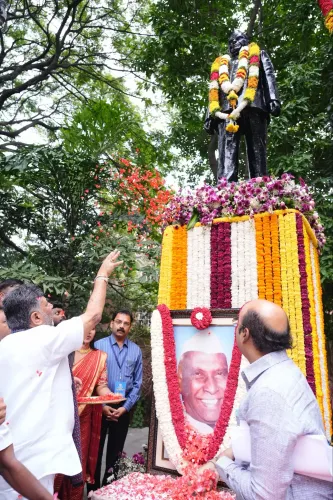
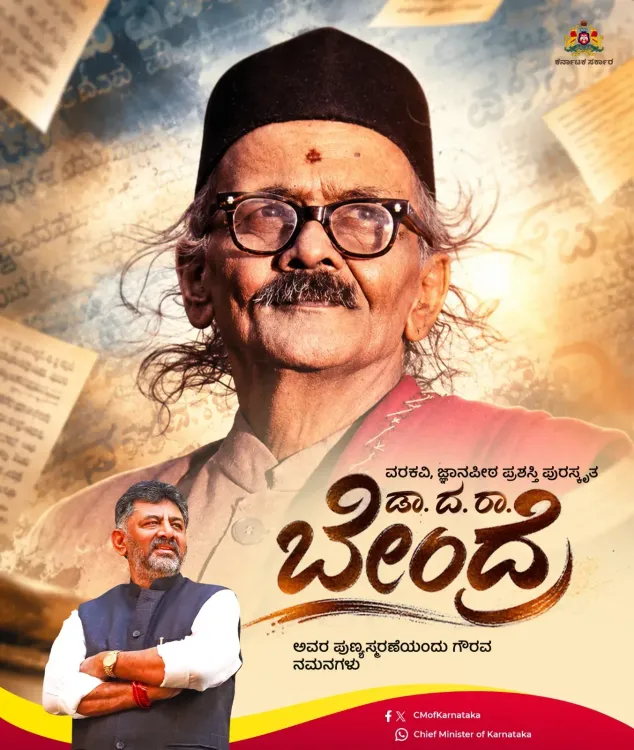
The Chief Minister's Office of Karnataka paid tribute to legendary Kannada poet D.R. Bendre — known as Ambikatanayadatta — honouring his unparalleled body of work rooted in Dharwad's Sadhanakeri and his historic 1973 Jnanpith Award, the second ever for Kannada literature.
Key Takeaways
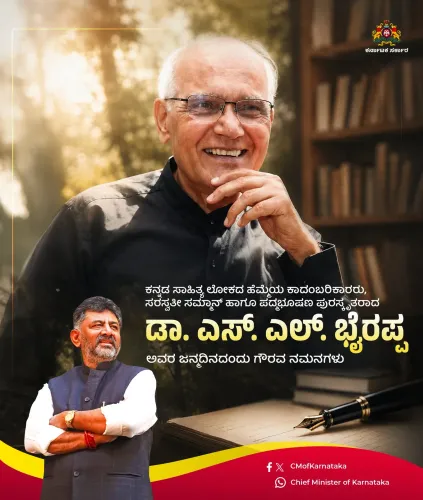
The Chief Minister's Office of Karnataka posted a tribute to poet D.R.
Bendre on 26 October 2026 .
Bendre, known by his pen name Ambikatanayadatta , lived and wrote at Sadhanakeri, Dharwad .
His celebrated works include 'Gari' , 'Aralu Maralu' , 'Sakhigita' , and the internationally acclaimed 'Naakutanti' .
In 1973 , Bendre received the Jnanpith Award — India's highest literary honour — becoming the second Kannada poet after Kuvempu to be so honoured.
The CMO described his memory as 'chirantana' (eternal), noting his poetry continues to resonate in every Kannadiga's heart.
From the quiet lanes of Sadhanakeri in Dharwad, a poet once built a universe in words — and the Chief Minister's Office of Karnataka honoured that legacy on Monday, 26 October 2026, with a heartfelt tribute to D.R. Bendre, the towering Kannada literary figure known by his pen name Ambikatanayadatta.
A poetry world born in Sadhanakeri
The CMO's post, written in Kannada, captures the essence of Bendre's creative world with quiet reverence: 'ಧಾರವಾಡದ ಸಾಧನಕೇರಿಯ ಮಡಿಲಿನಲ್ಲಿ ಕುಳಿತು... ಸೃಷ್ಟಿಸಿದ ಕಾವ್ಯಲೋಕ ಅದ್ವಿತೀಯ' — 'the poetic world he created, seated in the lap of Sadhanakeri in Dharwad, is unparalleled.' Bendre fused the rhythms of folk tradition, the depths of spirituality, and the philosophy of everyday life into simple, native Kannada idioms — a combination that felt intimate yet universal.
His celebrated works — 'Gari', 'Aralu Maralu', 'Sakhigita', and the internationally recognised 'Naakutanti' — are named explicitly in the tribute. Together, they represent a body of verse that the CMO describes as still resonating in the hearts of every Kannadiga today.
The second Jnanpith to grace Kannada literature
Bendre's place in literary history is anchored by a singular distinction: in 1973, he became the second Kannada poet to receive the Jnanpith Award — India's highest literary honour — following the pioneering Kuvempu. The CMO's tribute refers to him as 'Nadabrahma', meaning 'the divine sound' or 'the Brahma of melody', underscoring the musical quality that set his verse apart.
That Jnanpith recognition was itself a signal moment: it confirmed that Kannada literature, shaped in places like Dharwad's Sadhanakeri, could stand on the world stage. Bendre's work carried the local — the desi idiom, the folk lilt — and made it global.
Karnataka's recurring salute to its literary giants
The Karnataka government's official communication channels have a long practice of invoking the state's Jnanpith laureates to assert and celebrate Kannada's distinct linguistic identity within India. Bendre sits at the heart of that tradition — his life in Dharwad, his pen name drawn from his mother Ambika, and his insistence on writing in the vernacular idiom all make him an enduring symbol of the language's vitality.
For the Kannada literary community, such official tributes carry weight beyond ceremony. They signal that the state's cultural memory remains alive — and that the poet who once wrote in the lanes of Sadhanakeri still speaks to those who govern from Bengaluru.
Bendre's memory, the CMO closes, is 'chirantana' — eternal — in all our hearts. Some poets make you feel that word is exactly right.
Point of View
The tribute reinforces the state's claim to an unbroken, globally significant literary tradition. At a time when regional language politics remain sensitive across India, such official messaging carries a quiet but pointed subtext: Kannada's heritage needs no introduction. The tribute also signals continued state interest in keeping past Jnanpith laureates visible ahead of any upcoming literary or cultural calendar events.
NationPress
26 Oct 2026
Frequently Asked Questions
Who was D.R. Bendre?
D.R. Bendre, also known by his pen name Ambikatanayadatta, was one of the greatest Kannada poets of the 20th century. He lived and wrote in Sadhanakeri, Dharwad, and was renowned for blending folk rhythms, spirituality, and philosophy in native Kannada idioms.
Which Jnanpith Award did D.R. Bendre receive?
D.R. Bendre received the Jnanpith Award in 1973, making him the second Kannada poet to receive India's highest literary honour, after Kuvempu.
Why did Karnataka's CMO pay tribute to D.R. Bendre?
The Chief Minister's Office of Karnataka posted a tribute honouring Bendre's unparalleled contribution to Kannada literature, highlighting his works and his 1973 Jnanpith Award as part of the state's ongoing efforts to celebrate its literary heritage.
Where did D.R. Bendre live and write?
D.R. Bendre lived and created his celebrated body of poetry in Sadhanakeri, a locality in Dharwad, Karnataka, which has historically been a major centre of Kannada literary activity.