Karnataka CM's Office announces India's first Quantum City at Hesaraghatta
Synopsis
The Chief Minister's Office of Karnataka announced plans for India's first Quantum City at Hesaraghatta on August 9, 2026, backed by the Karnataka Quantum Mission. The initiative aims to unite researchers, universities, startups and industry under a single quantum-technology ecosystem, complementing the Centre's Rs 6,003-crore National Quantum Mission.
Key Takeaways
The Chief Minister's Office of Karnataka announced India's first Quantum City at Hesaraghatta , northwest of Bengaluru, on August 9, 2026 .
The Karnataka Quantum Mission will serve as the institutional framework, bringing together researchers, universities, startups and industry.
Target sectors include quantum computing, communication, healthcare and advanced manufacturing.
The initiative is designed to complement the Centre's National Quantum Mission , approved in April 2023 with an outlay of Rs 6,003 crore over eight years.
Hesaraghatta already hosts established research facilities, giving the site existing scientific infrastructure to build on.
Formal MoUs with institutions such as IISc or DRDO labs, a detailed project report and state budget allocations are yet to be announced.
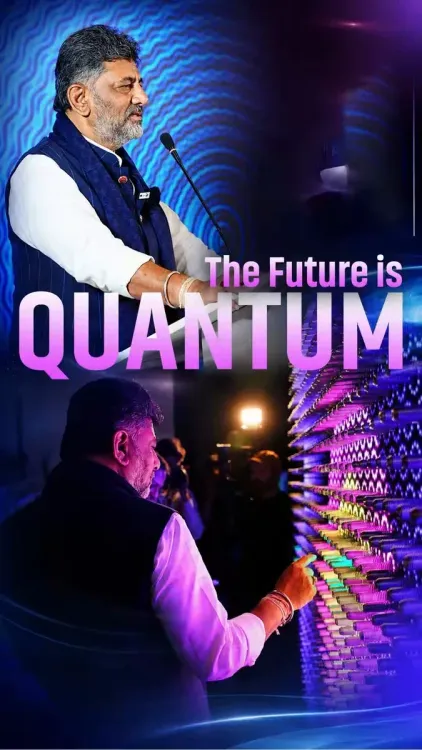
A suburb northwest of Bengaluru best known for its horticultural research stations is about to become the address of something far more futuristic. The Chief Minister's Office of Karnataka announced on Sunday, August 9, 2026 that the state is building what it calls India's first Quantum City at Hesaraghatta, backed by a dedicated Karnataka Quantum Mission designed to pull researchers, universities, startups and industry into a single quantum-technology ecosystem.
What Hesaraghatta is being built to become
The announcement positions Hesaraghatta — a peri-urban belt that already hosts astrophysics and horticulture facilities — as the physical anchor for the state's quantum ambitions. The stated goal is a 'world-class ecosystem for quantum research, innovation and entrepreneurship,' with the Karnataka Quantum Mission serving as the institutional spine that coordinates the four pillars: academia, research institutions, startups, and industry partners.
Quantum technology is not a single product but a stack — quantum computing, quantum communication, quantum sensing and quantum-secured networks all feed into one another. The CMO's post flags computing, communication, healthcare and advanced manufacturing as the sectors Karnataka expects quantum to reshape.
Where this sits inside India's national quantum push
The state move lands on ground already prepared by the Centre. The Union Cabinet approved India's National Quantum Mission in April 2023 with an outlay of Rs 6,003 crore over eight years — one of the largest science-and-technology commitments in recent memory — aimed at building domestic quantum computing hardware, secure communication networks, and sensing platforms to reduce reliance on foreign technology.
State-level missions have historically amplified central schemes by offering what Delhi cannot provide at speed: land, local academic linkages, and startup incentive pipelines. Karnataka's track record in doing exactly that — across IT, biotechnology and aerospace clusters around Bengaluru — gives the Hesaraghatta play a credible institutional logic. The natural partners would be institutions like IISc and DRDO labs already embedded in the Bengaluru corridor, though formal MoUs have not yet been announced.
The global race Karnataka is trying to enter
India is not the only country treating quantum as a strategic priority. The United States, the European Union, and China have each committed multi-billion-dollar programmes, making quantum one of the defining technology competitions of the decade. For India, closing that gap is as much a sovereignty question — secure communications, encrypted government networks, next-generation defence sensors — as it is an economic one.
Karnataka's pitch is that it can be the domestic node where that capability is built. Whether the Quantum City clears the gap between announcement and operational infrastructure will depend on what the detailed project report, formal budget lines, and institutional partnerships look like when they are made public.
India's technology capital is placing a very large bet on a very small particle. The world will be watching whether Hesaraghatta delivers.
Point of View
003-crore National Quantum Mission into a state-level, place-based industrial cluster — a playbook the state has used successfully with IT and biotech. By anchoring the initiative at Hesaraghatta rather than central Bengaluru, the government signals intent to build dedicated physical infrastructure rather than layer policy onto existing campuses. The credibility test will come when budget lines, land acquisition timelines and institutional MoUs are made public; without those, the announcement remains a strategic signal rather than an operational plan. For the broader India quantum story, a functioning state-level hub would meaningfully accelerate domestic capability-building in a sector where the US, EU and China already hold substantial leads.
NationPress
24 Sept 2026
Frequently Asked Questions
Where is India's first Quantum City being built?
India's first Quantum City is being built at Hesaraghatta , a suburb located northwest of Bengaluru in Karnataka, as announced by the Chief Minister's Office on August 9, 2026.
What is the Karnataka Quantum Mission?
The Karnataka Quantum Mission is a state-level initiative announced by the Karnataka government to create an integrated ecosystem for quantum research, innovation and entrepreneurship, bringing together universities, research institutions, startups and industry partners.
How does this relate to India's National Quantum Mission?
India's National Quantum Mission was approved by the Union Cabinet in April 2023 with an outlay of Rs 6,003 crore over eight years. Karnataka's state mission is designed to complement it by providing land, academic linkages and startup incentives at a local level.
What sectors will quantum technology impact according to Karnataka's plan?
According to the Chief Minister's Office, quantum technology is expected to reshape computing, communication, healthcare and advanced manufacturing — all sectors Karnataka's Quantum City aims to develop capability in.
When will the Karnataka Quantum City at Hesaraghatta be operational?
No operational timeline has been officially announced yet. Key next steps include the release of a detailed project report, formal budget allocation and MoUs with research institutions, none of which have been made public as of the August 9, 2026 announcement.