CM Siddaramaiah marks 3 years in office with STEM outreach data
Synopsis
The Chief Minister's Office of Karnataka marked three years in power on 23 May 2026, releasing data on science education initiatives including 3,282 school visits by a mobile planetarium, ₹7.23 crore in PhD scholarships for 248 researchers, and upgrades to six regional science centres across the state.
Key Takeaways
The Karnataka government completed three years in office on 23 May 2026 , marking the occasion under the #NavaKarnataka banner.
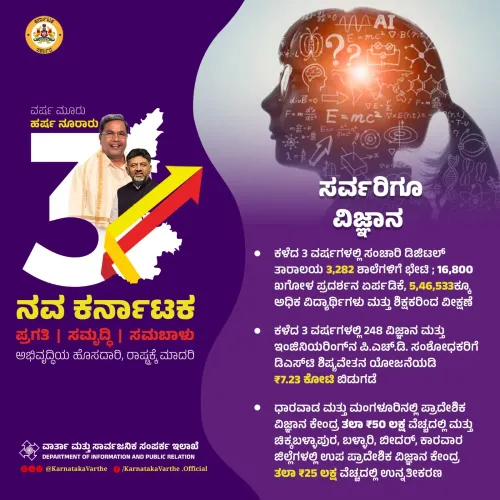
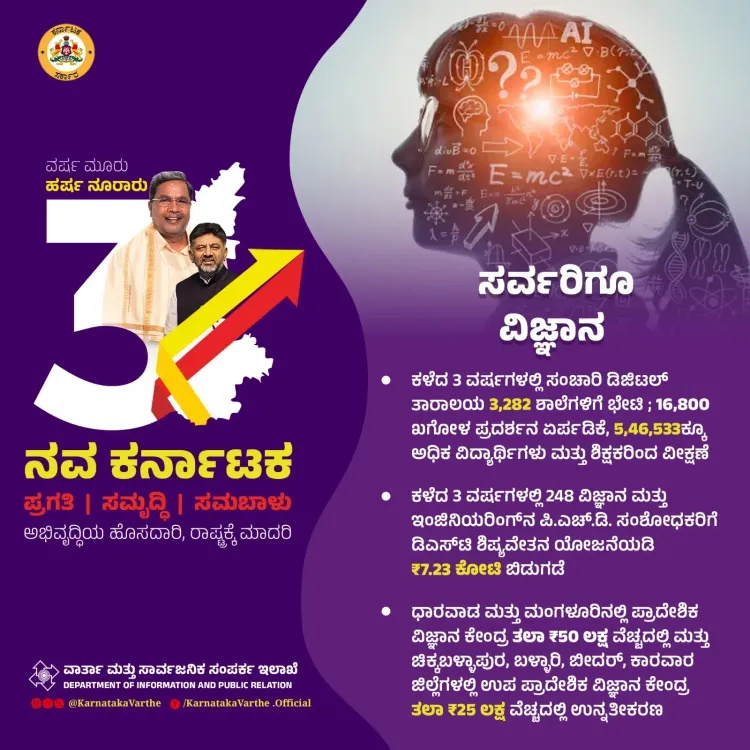
The Mobile Digital Planetarium visited 3,282 schools and organised 16,800 astronomy shows , reaching over 5,46,533 students and teachers .
248 PhD researchers in science and engineering received ₹7.23 crore under the DST Scholarship Scheme over three years.
Regional Science Centres in Dharwad and Mangaluru were upgraded at ₹50 lakh each .
Sub-Regional Science Centres in Chikkaballapur , Ballari , Bidar , and Karwar received upgrades at ₹25 lakh each .
The government pledged that its development efforts will accelerate in the years ahead.
The Chief Minister's Office of Karnataka marked the completion of three years in government on Saturday, 23 May 2026, publishing a detailed account of the state's science education and research initiatives delivered since the Congress government assumed office in May 2023.
Context
The post, written in Kannada, dedicates the occasion to every Kannadiga: 'ಪ್ರತಿಯೊಬ್ಬ ಕನ್ನಡಿಗನಿಗೂ ಅರ್ಪಿಸುತ್ತಿದ್ದೇವೆ' ('we dedicate this to every Kannadiga'). The government asserts it has honoured each pre-election commitment, describing its mission as rebuilding a 'strong, prosperous, and self-respecting Karnataka' — ಸಶಕ್ತ, ಸಮೃದ್ಧ, ಸ್ವಾಭಿಮಾನಿ ಕರ್ನಾಟಕ. The post is tagged #3YearsOfNavaKarnataka and #NavaKarnataka, the branding the government has used for its governance agenda.
Policy Backdrop
Among the specific claims, the government states its Mobile Digital Planetarium visited 3,282 schools over the past three years, organising 16,800 astronomy shows viewed by more than 5,46,533 students and teachers. The mobile planetarium is a science-outreach vehicle that brings live-sky simulations and astronomy demonstrations directly to government schools, particularly in rural and semi-urban districts that lack fixed science infrastructure.
On research funding, the post states that 248 PhD researchers in science and engineering received a combined ₹7.23 crore under the DST Scholarship Scheme over the three-year period. The Department of Science and Technology scholarship programme is a central-government mechanism implemented in partnership with state governments to support doctoral research in STEM disciplines. Karnataka has maintained this partnership since the early 2000s.
The government also highlights infrastructure upgrades: Regional Science Centres in Dharwad and Mangaluru were upgraded at a cost of ₹50 lakh each, while Sub-Regional Science Centres in Chikkaballapur, Ballari, Bidar, and Karwar districts received upgrades at ₹25 lakh each.
Stakeholders and Impact
The primary beneficiaries cited are school students, science teachers, and doctoral researchers across Karnataka. The mobile planetarium outreach, if the figures hold, represents one of the larger school-contact programmes in the state's recent science communication history. PhD scholars in science and engineering disciplines — a cohort that often struggles with research funding gaps — are the direct recipients of the DST scholarship disbursements.
The upgraded regional and sub-regional science centres are spread across geographically distinct parts of the state: Dharwad and Karwar in the north and coastal west, Mangaluru on the coast, and Chikkaballapur, Ballari, and Bidar in the south and north-east. This distribution suggests an intent to extend science infrastructure beyond the Bengaluru metropolitan corridor.
What's Next
The Chief Minister's Office says the government's efforts will become 'faster and more effective' going forward, signalling continued investment in these programmes. Observers will watch whether the state's forthcoming budget allocations expand the science-centre network further and whether the mobile planetarium programme is formally integrated into the school curriculum. The #NavaKarnataka anniversary communication also sets the political stage ahead of the next electoral cycle.
Point of View
Ballari, Bidar, and Karwar — regions with historically uneven infrastructure — suggests a conscious effort to counter the perception that the Siddaramaiah government's benefits flow primarily to southern Karnataka. The DST scholarship numbers, while modest in absolute terms, signal alignment with central government priorities on scientific temper, which matters for state-Centre funding negotiations. How these figures are received will depend on whether independent audits or beneficiary surveys corroborate the government's own reporting.
NationPress
7 Oct 2026
Frequently Asked Questions
How many schools did Karnataka's Mobile Digital Planetarium visit in three years?
According to the Chief Minister's Office, the Mobile Digital Planetarium visited 3,282 schools over the past three years, organising 16,800 astronomy shows for more than 5,46,533 students and teachers .
How much did Karnataka give PhD scholars under the DST scheme?
The Karnataka government released ₹7.23 crore to 248 PhD researchers in science and engineering under the DST Scholarship Scheme over the three-year period.
Which science centres were upgraded by the Karnataka government?
Regional Science Centres in Dharwad and Mangaluru were upgraded at ₹50 lakh each , and Sub-Regional Science Centres in Chikkaballapur , Ballari , Bidar , and Karwar were upgraded at ₹25 lakh each .
When did the Karnataka Congress government complete three years in office?
The Karnataka Congress government completed three years in office on 23 May 2026 , having come to power in May 2023 after winning the state assembly elections.
What is the Nava Karnataka campaign?
'Nava Karnataka' is the governance branding used by the Siddaramaiah-led Karnataka government to describe its agenda of rebuilding a strong, prosperous, and self-reliant Karnataka, and has been used consistently across official communications since 2023.