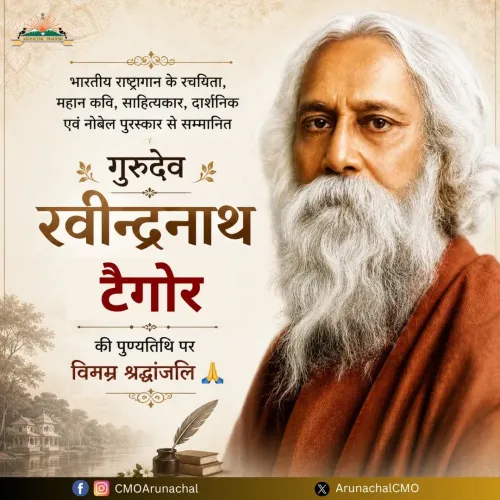
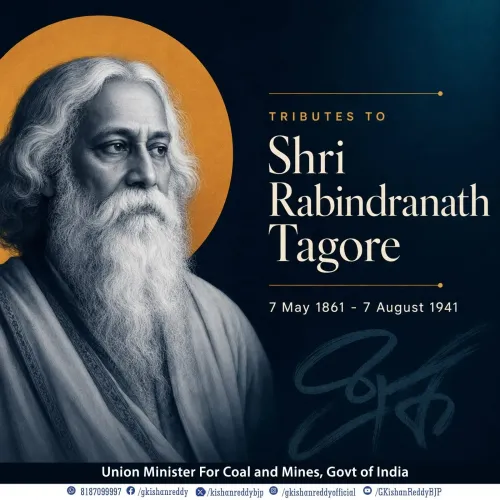
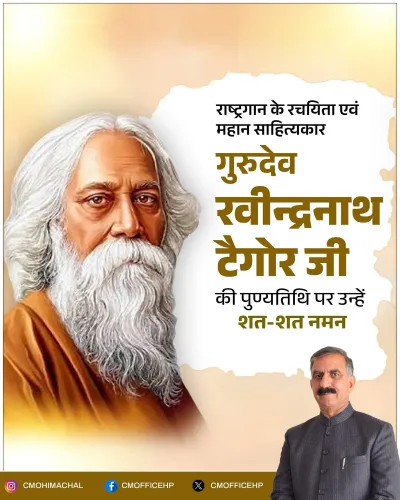
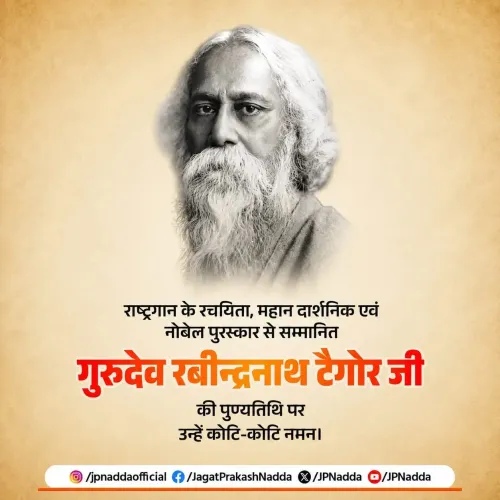
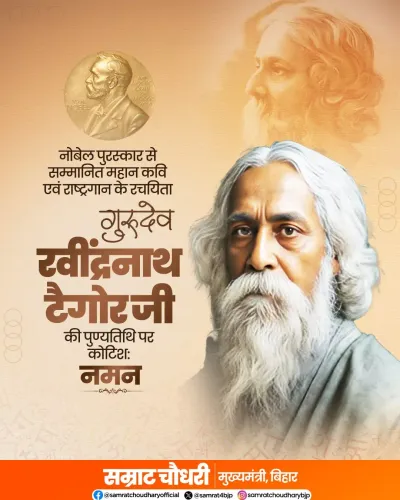
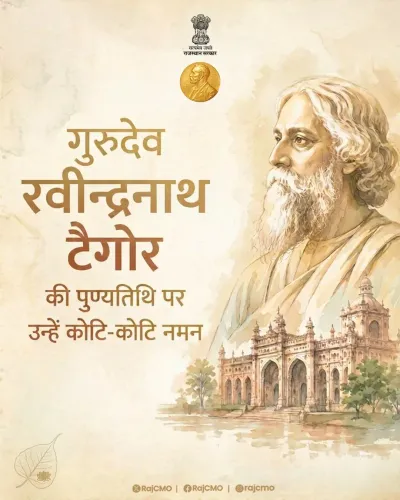
CM Karnataka Pays Tribute to Rabindranath Tagore on Death Anniversary
Synopsis
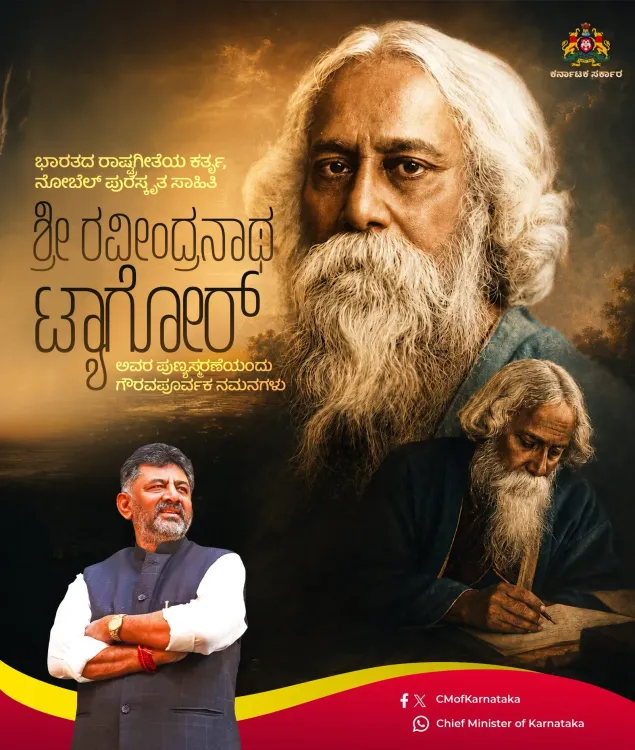
The Chief Minister's Office of Karnataka honoured Rabindranath Tagore on his death anniversary, saluting the Vishwakavi's Nobel Prize-winning Gitanjali and his unique distinction of composing national anthems for both India and Bangladesh.
Key Takeaways
The Chief Minister's Office of Karnataka posted a tribute to Rabindranath Tagore on his death anniversary, 7 August 2026 .
Tagore ( 1861–1941 ) was honoured with the titles Vishwakavi (World Poet) and Gurudev (Revered Teacher).
He won the Nobel Prize in Literature in 1913 for Gitanjali , becoming the first Asian laureate.
Tagore composed 'Jana Gana Mana' (India's national anthem, adopted 1950 ) and 'Amar Sonar Bangla' (Bangladesh's national anthem, adopted post- 1971 ).
Annual tributes on 7 May and 7 August by state governments reflect Tagore's enduring, pan-Indian cultural significance.
On the death anniversary of Rabindranath Tagore, the Chief Minister's Office of Karnataka paused to honour the man who gave two nations their voices — and a third, the world, its first Asian Nobel laureate in literature. The tribute, posted on 7 August 2026, salutes Tagore's towering role in shaping Indian poetry, nationalist thought, and the shared cultural identity of the subcontinent.
The post, in Kannada, hails Tagore as Vishwakavi ('World Poet') and Gurudev ('Revered Teacher') — the two honorifics that have followed his name for over a century. It describes him as one who 'gave new lustre to the world of Indian poetry through his pen and awakened nationalism through literature,' a recognition that travels well beyond Karnataka's borders.
The man who wrote two nations' anthems
Rabindranath Tagore (1861–1941) holds a distinction no other writer in history shares: he authored the national anthems of two sovereign countries. 'Jana Gana Mana', composed in 1911 and adopted as India's national anthem in 1950, and 'Amar Sonar Bangla', written in 1905 and adopted as Bangladesh's anthem after its independence in 1971, both flowed from the same pen. The Karnataka CMO's tribute specifically names both anthems — a pointed reminder that Tagore's legacy is not a regional inheritance but a subcontinent-wide one.
Gitanjali and Asia's first Nobel
In 1913, Tagore became the first Asian to win the Nobel Prize in Literature, awarded for Gitanjali ('Song Offerings') — a collection of devotional poems that stunned the Western literary world with their spiritual depth and lyrical precision. The CMO's post calls him 'the rare distinction of one who wove the soul of India into his literature,' a line that captures why annual tributes to Tagore remain a fixture across every Indian state, regardless of political colour.
Karnataka's recognition is part of a broader, pan-Indian pattern: state governments and cultural institutions mark both 7 May (Tagore's birth anniversary) and 7 August (his death anniversary) each year, underscoring that his influence on modern Indian literature and nationalist imagination has never faded into the archive.
A poet who made two countries sing — and the world listen. That is the legacy Karnataka stopped to remember today.
Point of View
Pluralist cultural identity, and Karnataka's Kannada-language post underscores that this legacy transcends linguistic and regional boundaries. The annual ritual also quietly reinforces the argument that Indian nationalism was always literary and civilisational before it was political — a framing that suits multiple ideological camps simultaneously.
NationPress
21 Sept 2026
Frequently Asked Questions
Why is 7 August significant for Rabindranath Tagore?
7 August marks the death anniversary of Rabindranath Tagore , who passed away on this date in 1941 . State governments and cultural institutions across India observe the day with tributes and commemorations each year.
Which national anthems did Rabindranath Tagore write?
Tagore wrote 'Jana Gana Mana' , adopted as India's national anthem in 1950 , and 'Amar Sonar Bangla' , adopted as Bangladesh's national anthem after its independence in 1971 — making him the only poet to have authored the national anthems of two countries.
Why did Rabindranath Tagore win the Nobel Prize?
Tagore was awarded the Nobel Prize in Literature in 1913 for his collection Gitanjali ('Song Offerings'), a body of devotional and lyrical poetry. He was the first Asian writer to receive the Nobel Prize in Literature.
What does Vishwakavi mean and why is Tagore called that?
Vishwakavi means 'World Poet' in Sanskrit and several Indian languages. Tagore earned the title because his poetry, philosophy, and music transcended national and linguistic boundaries, earning global recognition and admiration.
Why did the Karnataka government pay tribute to Tagore?
Annual tributes to Tagore by state governments, including Karnataka, reflect his pan-Indian cultural stature. The Chief Minister's Office posted the homage in Kannada on 7 August 2026 , honouring Tagore's contribution to Indian literature and nationalist thought.