Will the Karnataka government also withdraw the VB- G RAM G Act like the farm laws?
Synopsis
The Karnataka government plans to withdraw the VB- G RAM G Bill, similar to the repeal of controversial farm laws. Minister Priyank Kharge criticizes the central government's approach, highlighting potential negative impacts on rural employment and constitutional rights. This unfolding situation could lead to significant protests and intensifying scrutiny on federal policies.
Key Takeaways
The Karnataka government plans to withdraw the VB- G RAM G Bill.
The Bill aims to alter the MGNREGA framework, potentially harming rural employment.
Minister Priyank Kharge condemned the central government's lack of discussion before passing the Bill.
There are concerns about the rights of Panchayati Raj institutions being weakened.
Protests against this Bill are anticipated from rural communities.
Bengaluru, Dec 27 (NationPress) In a move similar to the repeal of farm laws, the Karnataka government has announced that the VB- G RAM G Bill, which had been passed in Parliament with the intent of undermining the Mahatma Gandhi National Rural Employment Guarantee Act (MGNREGA), will also be rescinded.
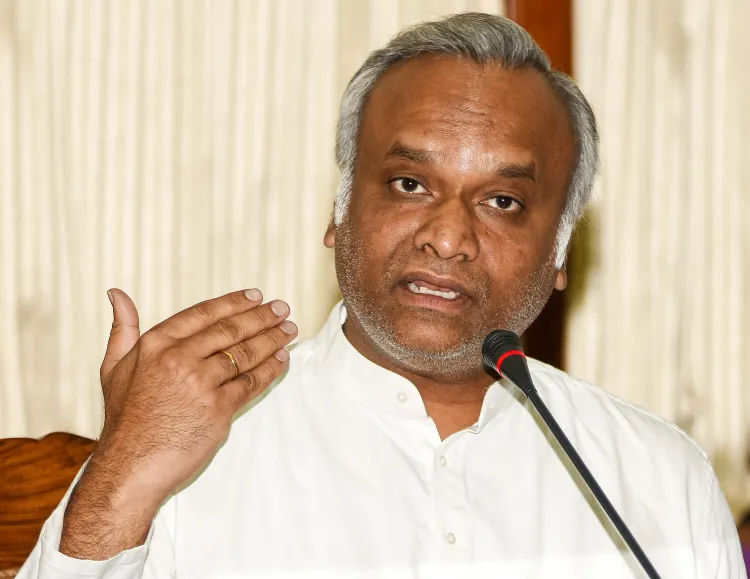
During a press conference on Saturday, Priyank Kharge, the Minister for Rural Development and Panchayat Raj, IT and BT, made this declaration.
He criticized the central government, stating, "As the farm laws were abolished, so too will this be nullified. There is widespread discontent from villages to the national capital. Citizens are ready to protest. Our administration denounces these anti-people policies," he asserted.
The Modi administration has pushed the VB- G RAM G Bill through Parliament without any meaningful discussion. While it claims to have reformed the MGNREGA Act, the reality is that there has been neither genuine reform nor empowerment. Essentially, the MGNREGA Act has been effectively abolished, he noted.
The implementation of the VB- G RAM G scheme is projected to cause increased unemployment in rural regions. This will lead to the suppression of minimum wages and exploitation of workers, he warned, predicting a gradual decline in the current 58 percent participation of women in the workforce.
He questioned, "If the central government’s financial status is robust, why is it increasing the financial strain on state governments under central initiatives?"
"Our opposition isn't merely due to the removal of Gandhi's name from the scheme. We recognize the disdain directed towards Gandhi. Why is this animosity being aimed at the youth and rural populations of our nation?" Priyank criticized.
"If Nathuram Godse is favored, then name the scheme after him. But prioritize job creation in rural areas, fortify Panchayati Raj institutions, and develop village assets. Since assuming power, what employment-generating initiatives has the Modi government introduced? After pledging to generate 2 crore jobs annually, it is now stripping away the livelihoods of rural citizens," he charged.
Over the past 19-20 years, the MGNREGA employment guarantee scheme has secured livelihoods in rural locales. The Modi government has rescinded this guarantee, he alleged.
A demand-driven initiative has shifted to a distribution-based model. Previously, the Union government held full accountability. Now, this has been downgraded from a statutory right to merely another governmental scheme, he expressed.
By enacting the VB- G RAM G Bill, the Modi administration has curtailed three vital constitutional rights: the right to livelihood has been stripped away, the authority of Panchayats has been undermined, and a financial burden has been imposed on states without their agreement, Priyank stated.
Under MGNREGA, there existed a legal right to employment. In contrast, the new scheme will only offer employment contingent on Union government approval, he indicated.
"Section 5 of the Bill mandates that work must be performed based on the funds allocated by the Union government to states each fiscal year. Section 5(1) specifies that state governments will only provide funds in rural areas designated by the Union government, and only job card holders in those specified regions will qualify for work. Previously, any individual with an MGNREGA job card could seek employment anywhere. That right has been revoked," Priyank elaborated.
Under MGNREGA, work could be initiated at any time throughout the year. However, the VB- G RAM G Bill's Section 6(1) stipulates that employment under the scheme will be unavailable for 60 days during peak agricultural periods, he noted.
Wage revisions were conducted annually under the employment guarantee scheme. This provision has been eliminated in the new scheme. Formerly, project decisions were made by Panchayats. Now, decisions regarding work will be determined by officials in Delhi, he highlighted.
The scheme has been integrated into the PM Gati Shakti Master Plan, a portal dedicated to overseeing central government projects exceeding Rs 500 crore. Is it feasible for farmers to upload their field work details onto the PM Gati Shakti portal? Priyank questioned.
"In the past, MGNREGA was entirely financed by the Union government. Now, a 60:40 funding ratio has been enforced, shifting the burden to state governments, as outlined in Section 22(1). Panchayats must first issue notifications, then adhere to Union government standards, after which the state government must contribute its 60 percent share. Any additional costs will fall on the state government," he added.
"Under MGNREGA, rural assets could be developed through gram sabhas, tailored to the needs of villagers and Panchayats. Over the last two-and-a-half years, 17 lakh village-level assets have been established, providing livelihoods for 80 lakh families, with an expenditure of Rs 21,144 crore. Due to the changes instituted by the Union government, the scheme is transitioning towards contractor-driven projects. Section 21(2) allows for contractor involvement. This concept was nonexistent under MGNREGA," he pointed out.
Furthermore, the Union government has breached the principles of federalism. The Centre aims to exploit the labor, efforts, taxes, and talents of Kannadigas. Kannadigas are expected to pursue the dream of a 'developed India,' yet receive little in return, he asserted.
The 16th Finance Commission has submitted its report to the Union government. Did the Centre consult states regarding the 60:40 funding ratio under the VB- G RAM G scheme? Was the Finance Commission informed? Priyank probed.
If states are expected to contribute Rs 3,000-4,000 crore annually, was this communicated to the Finance Commission? By doing so, the Union government has violated Article 280 and Article 258 of the Constitution, he stated.
"With whom did the Centre discuss the 60:40 funding ratio? The Prime Minister seems to envision a scheme overnight and presents a Bill the next morning. Are state governments merely expected to comply without question? This government is diminishing the rights of Panchayats, livelihood entitlements, and state government rights, operating in a wholly unconstitutional manner," he concluded.
Point of View
The ongoing debate surrounding the VB- G RAM G Bill reflects broader tensions between state and central governance. As the Karnataka government seeks to protect rural employment rights, it raises essential questions about federal policies and the implications for citizens. The situation warrants close monitoring, as it may lead to significant political and social repercussions.
NationPress
4 Oct 2026
Frequently Asked Questions
What is the VB- G RAM G Bill?
The VB- G RAM G Bill is legislation passed by the Indian Parliament aimed at altering the Mahatma Gandhi National Rural Employment Guarantee Act (MGNREGA).
Who announced the withdrawal of the VB- G RAM G Bill?
The Karnataka government, represented by Minister Priyank Kharge, announced the intention to withdraw the VB- G RAM G Bill.
What are the potential impacts of this Bill?
The Bill is expected to affect rural employment negatively, lead to unemployment, and undermine the rights of Panchayati Raj institutions.
How has the central government approached this Bill?
The central government passed the VB- G RAM G Bill without comprehensive discussions, which has raised concerns among various stakeholders.
What is the significance of MGNREGA?
MGNREGA provides legal guarantees for employment in rural areas, ensuring livelihood security for millions of families.