Karnataka targets 30% salt reduction by 2030 in new state action plan
Synopsis
Karnataka has become one of India's first states to launch a dedicated multisectoral salt-reduction plan, setting a 30% intake reduction target by 2030. With Indians consuming up to 11 grams of salt daily — more than double the WHO limit — the plan targets households, food outlets, and packaged foods, backed by a Technical Advisory Group drawn from RGUHS, NIMHANS, and Jayadeva Institute.
Key Takeaways
Karnataka Health Minister U.T.
Khader launched the state's Multisectoral Action Plan for Salt Reduction on 22 September 2026 at Vidhana Soudha, Bengaluru .
The plan targets a 30% reduction in population salt intake by 2030 , in line with India's global health commitments.
Indians currently consume 8–11 grams of salt per day — nearly twice the WHO recommendation of under 5 grams .
The strategy covers three settings : households, out-of-home food, and processed and packaged foods.
A Technical Advisory Group chaired by RGUHS Vice-Chancellor Bhagavan B.C. will provide expert guidance.
Technical support came from Resolve to Save Lives and Vision for Social Development .
Karnataka Health and Family Welfare Minister U.T. Khader on Tuesday, 22 September 2026, launched the Karnataka State Multisectoral Action Plan for Salt Reduction and Promotion of Healthy Dietary Habits in Bengaluru, marking a significant step in the state's effort to curb non-communicable diseases (NCDs) through dietary reform. The plan sets a target of reducing population-level salt intake by 30 per cent by 2030, in alignment with India's global health commitments.
Key Targets and WHO Benchmarks
The action plan is anchored to the World Health Organization's recommendation of consuming fewer than 5 grams of salt per person per day. Currently, Indians are estimated to consume between 8 and 11 grams of salt daily — nearly twice that threshold. Excessive salt intake is directly associated with high blood pressure and elevated risk of stroke and other cardiovascular diseases, the government noted.
What the Plan Covers
The strategy addresses salt consumption across three key settings: households, out-of-home food consumption, and processed and packaged foods. Specific measures include reducing discretionary salt use, promoting healthier food choices, encouraging salt reduction by food processors, strengthening dietary counselling within the health system, and supporting research into potassium-enriched low-sodium salt alternatives.
Karnataka has already introduced measures addressing foods high in fat, sugar and salt (HFSS), which officials say provides a regulatory foundation for building healthier food environments. The plan also builds on existing programmes including salt-reduction measures under PM POSHAN, dietary counselling through Gruha Arogya, and risk-factor management under the National Programme for Prevention and Control of Non-Communicable Diseases (NP-NCD).
Institutional Framework and Key Voices
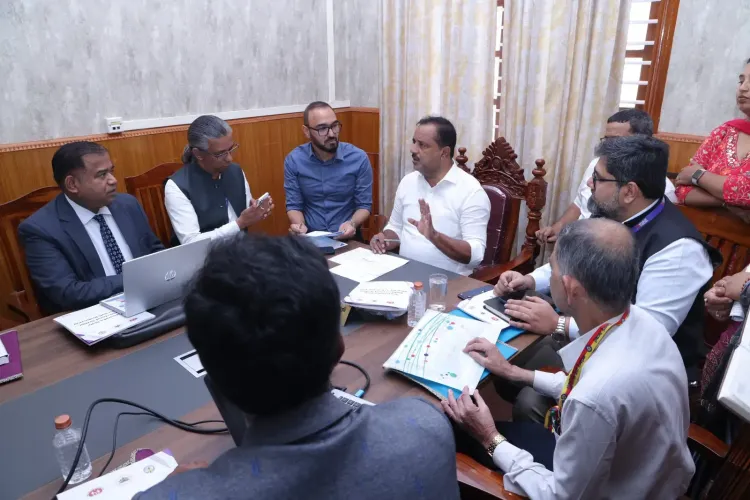
The plan was unveiled during a Technical Advisory Group (TAG) meeting held at Vidhana Soudha, Bengaluru. The TAG is chaired by Bhagavan B.C., Vice-Chancellor of Rajiv Gandhi University of Health Sciences (RGUHS), and includes experts from the Department of Health and Family Welfare, Sri Jayadeva Institute of Cardiovascular Sciences and Research, NIMHANS, and various academic, nutrition, and public health bodies.
Former minister Dinesh Gundu Rao and Rajya Sabha MP Mansoor Ali Khan were among those present at the launch. Dinesha B., Director of Shri Jayadeva Cardiovascular Health Research Institute, participated in technical deliberations, while Jnanesh Kamath, Joint Director of Health and Family Welfare, outlined key priorities under the plan.
Minister Khader called for a State Steering Committee involving multiple departments to ensure coordinated and sustained implementation of healthier dietary habits across Karnataka.
Collaboration and Technical Support
The action plan was developed through collaboration between government departments, academic institutions, public health experts, development partners, and civil society organisations. Technical support was provided by Resolve to Save Lives and Vision for Social Development.
With Karnataka becoming one of the first Indian states to adopt a dedicated multisectoral salt-reduction plan, the initiative is being watched as a potential model for other states grappling with rising NCD burdens.
Point of View
Multisectoral policy that names specific targets, timelines, and institutional ownership rather than folding a dietary nudge into a broader wellness slogan. The harder question is enforcement: India has long had food-labelling rules on HFSS products that are weakly monitored, and discretionary salt use at the household level is notoriously difficult to measure. The plan's credibility will hinge on whether the State Steering Committee produces verifiable intake surveys rather than process metrics. If Karnataka can demonstrate a measurable population-level shift, it offers a replicable blueprint for other high-NCD states like Andhra Pradesh and Maharashtra.
NationPress
22 Sept 2026
Frequently Asked Questions
What is the Karnataka State Multisectoral Action Plan for Salt Reduction?
It is a government policy launched on 22 September 2026 by Karnataka Health Minister U.T. Khader, aimed at reducing population salt intake by 30% by 2030 and preventing non-communicable diseases. The plan covers households, out-of-home food, and processed foods, with technical guidance from a multi-institutional advisory group.
Why is salt reduction a public health priority in Karnataka?
Indians consume an estimated 8–11 grams of salt per day, nearly double the WHO recommendation of under 5 grams per day. High salt intake is a leading driver of hypertension, stroke, and cardiovascular disease — NCDs that are rising sharply across Indian states including Karnataka.
What is the WHO recommendation on daily salt intake?
The World Health Organization recommends consuming fewer than 5 grams of salt per person per day. Karnataka's plan explicitly targets progress toward this benchmark as part of India's global health commitments.
Who is overseeing the implementation of the plan?
A Technical Advisory Group chaired by Bhagavan B.C., Vice-Chancellor of Rajiv Gandhi University of Health Sciences (RGUHS), will provide technical guidance. Minister Khader has also called for a State Steering Committee involving multiple departments to coordinate sustained action.
How does this plan build on existing Karnataka health programmes?
The action plan integrates with existing initiatives such as salt-reduction measures under PM POSHAN, dietary counselling through Gruha Arogya, and risk-factor management under the National Programme for Prevention and Control of Non-Communicable Diseases (NP-NCD), using them as a foundation for broader dietary reform.