Kejriwal Accuses Modi of Using Police to Block E20 Townhall
Synopsis
AAP convenor Arvind Kejriwal accused PM Modi of deploying police to stop a 'National Townhall Against E20' on 29 July 2026, demanding a rollback of India's 20% ethanol-blending mandate and warning that public opposition will not be suppressed.
Key Takeaways
Arvind Kejriwal alleged on 29 July 2026 that the Modi government used police to block a 'National Townhall Against E20.' He demanded the E20 ethanol-blending mandate be withdrawn, calling it a policy the government 'will have to' reverse.
India's National Policy on Biofuels 2018 set the E20 target; the deadline was advanced from 2030 to 2025 in 2021 .
Key stakeholders affected include vehicle owners, oil marketing companies, and sugarcane farmers .
The central government had not publicly responded to Kejriwal's allegation at the time of publication.
The townhall format signals an opposition strategy of citizen-facing consultations on central government schemes.
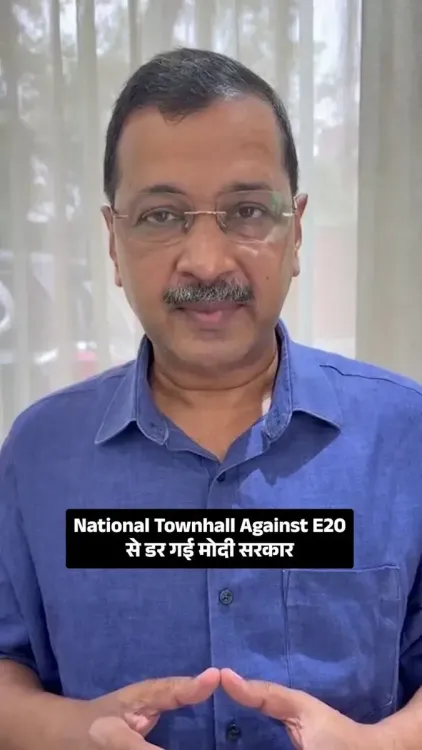
A fuel-policy fight is spilling into the streets. AAP national convenor Arvind Kejriwal on Wednesday, 29 July 2026 accused the central government of deploying police to prevent a 'National Townhall Against E20' — and issued a direct warning to Prime Minister Narendra Modi that the E20 ethanol-blending mandate will have to be rolled back.
Posting in Hindi, Kejriwal declared: 'Modi ji, E20 toh aapko wapas lena hi padega. Ab yeh desh aapki police se darne wala nahin hai.' ('Modi ji, you will have to withdraw E20. This country is no longer afraid of your police.') The post, which accompanied a video, frames the dispute not merely as a policy disagreement but as a confrontation over the right to public assembly.
What E20 is and why it has become a flashpoint
India's National Policy on Biofuels, 2018 set a roadmap for progressively blending ethanol — derived largely from sugarcane and surplus grain — into petrol. The government accelerated that timeline in 2021, pushing the 20% blending target (E20) forward from 2030 to 2025, citing energy-security gains and a guaranteed market for farmers. Oil marketing companies and automobile manufacturers were directed to align their supply chains and engine specifications accordingly.
Critics, however, have raised concerns about engine compatibility for older vehicles, potential increases in consumer costs, and the pace of infrastructure rollout at fuel stations. Opposition voices have periodically questioned whether the transition is being managed equitably for ordinary vehicle owners who cannot easily upgrade their engines.
Kejriwal's escalation and the police allegation
The 'National Townhall Against E20' appears to have been conceived as a platform for citizens — vehicle owners, small-fleet operators, and affected communities — to register grievances against the mandate. Kejriwal's allegation that police were used to obstruct the event represents a significant escalation in the political battle over the policy. Disputes over protest management and the use of law enforcement against opposition-organised events have been a recurring source of friction between the central government and AAP in recent years.
The central government and Prime Minister Modi had not issued a public response to the allegation at the time of publication. The specific details of the townhall event and the police action described in the post postdate publicly available records and could not be independently verified.
The political stakes around a fuel mandate
Ethanol blending sits at the intersection of energy policy, farm income support, and consumer rights — a combination that makes it both politically valuable and politically vulnerable. Sugarcane farmers, a key constituency in states like Uttar Pradesh and Maharashtra, benefit from a guaranteed ethanol-purchase market. But urban vehicle owners — another large bloc — bear the transition costs if engine wear or mileage loss materialises at scale.
By framing E20 as a people-versus-government issue and invoking police overreach, Kejriwal is attempting to pull those urban consumers into an opposition coalition. Whether that framing holds will depend on how visible the compliance burden becomes at the pump — and whether the government mounts a credible public defence of the mandate's benefits.
The townhall format, if it proceeds, could become a template for opposition-led citizen consultations on central schemes — a pressure valve that bypasses Parliament and goes directly to voters.
Point of View
Broadening its political resonance well beyond policy circles. The tactic fits a wider AAP pattern of using street-level mobilisation to contest central government decisions that Parliament cannot easily reverse. If the police-obstruction allegation gains traction, it shifts the debate from 'is E20 good policy' to 'is the government suppressing dissent' — a far more damaging frame for the ruling establishment. The government's silence, if prolonged, risks ceding that narrative ground entirely.
NationPress
13 Sept 2026
Frequently Asked Questions
What is E20 fuel and why is Kejriwal opposing it?
E20 is petrol blended with 20% ethanol under India's biofuel policy. Kejriwal opposes it citing concerns about engine compatibility and consumer costs, and has called for its rollback.
What happened at the National Townhall Against E20?
Kejriwal alleged on 29 July 2026 that the Modi government deployed police to prevent the 'National Townhall Against E20' from taking place. Specific details of the event could not be independently verified.
When did India set the E20 ethanol blending target?
The National Policy on Biofuels 2018 established the E20 target. In 2021 , the government advanced the deadline from 2030 to 2025 .
Has the Modi government responded to Kejriwal's E20 allegations?
As of the time of publication, the central government and Prime Minister Modi had not issued a public response to Kejriwal's allegations about police action or the E20 rollback demand.
Who benefits and who is hurt by the E20 mandate?
Sugarcane farmers benefit from a guaranteed ethanol market, while vehicle owners — especially those with older engines — face potential compatibility and cost concerns under the E20 transition.