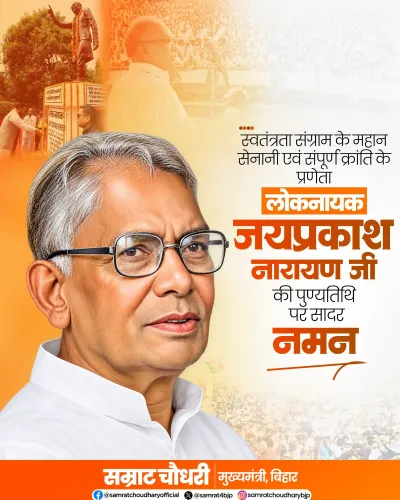
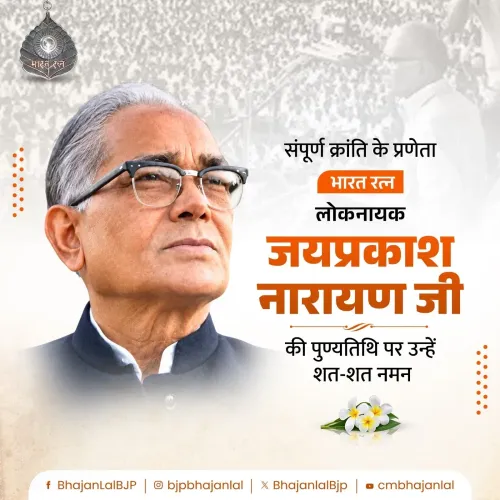
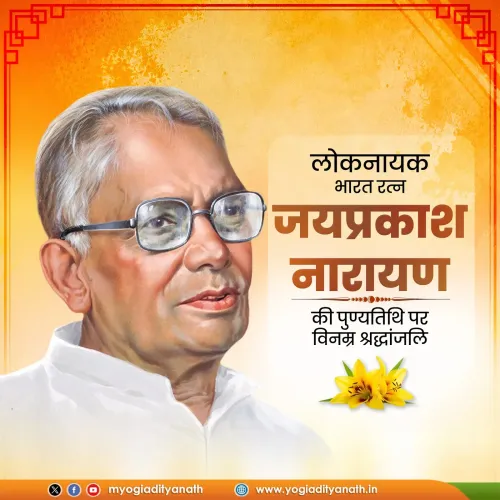
Kejriwal pays tribute to JP Narayan on death anniversary
Synopsis
AAP convenor Arvind Kejriwal marked the death anniversary of Bharat Ratna Loknayak Jayaprakash Narayan on October 8, honouring the democratic icon's legacy of resistance against oppression and his enduring call to defend democracy.
Key Takeaways
AAP convenor Arvind Kejriwal paid tribute to Loknayak Jayaprakash Narayan on his death anniversary, October 8, 2026 .
Kejriwal called JP an 'immortal symbol in every fight against oppression and injustice.' Jayaprakash Narayan passed away on October 8, 1979 , in Patna , after leading the historic Sampoorna Kranti (Total Revolution) movement against the Emergency.
JP was awarded the Bharat Ratna posthumously in 1999 .
Kejriwal's tribute frames JP's legacy as directly relevant to contemporary democratic struggles in India.
On the death anniversary of one of India's most revered democratic voices, AAP convenor Arvind Kejriwal offered a heartfelt tribute to Bharat Ratna Loknayak Jayaprakash Narayan, honouring a leader whose defiance of authoritarianism remains a living reference point in Indian political memory.
Posting on Thursday, October 8, 2026, Kejriwal wrote — 'भावभीनी श्रद्धांजलि' ('heartfelt tribute') — invoking JP Narayan's 'unwavering resolve, fierce patriotism, and spirit of struggle' as a perennial source of inspiration for citizens to defend democracy. He described the iconic leader as 'an immortal symbol in every fight against oppression and injustice.'
The legacy of Loknayak Jayaprakash Narayan
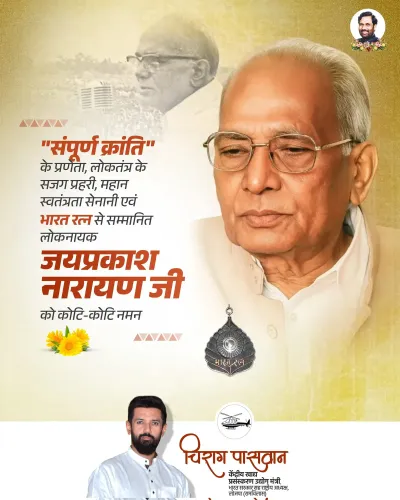
Jayaprakash Narayan, popularly known as JP or Loknayak ('Leader of the People'), was a towering freedom fighter and socialist thinker who became the moral face of India's resistance to the Emergency (1975–77) declared by then Prime Minister Indira Gandhi. His clarion call — 'Sampoorna Kranti' ('Total Revolution') — galvanised millions of Indians, especially students and youth, against authoritarian rule. He was awarded the Bharat Ratna, India's highest civilian honour, posthumously in 1999.
JP Narayan passed away on October 8, 1979, in Patna. His death anniversary is observed each year as a moment of reflection on democratic values, civil liberties, and the cost of dissent — themes that continue to resonate across India's political spectrum.
Why JP's name carries weight in today's politics
Invocations of JP Narayan are rarely ceremonial in Indian politics. His image is claimed by leaders across ideological lines — from socialists to the BJP to regional parties — precisely because his struggle transcended party affiliation. For Kejriwal and the Aam Aadmi Party, whose own political identity was shaped in part by the 2011 anti-corruption movement that drew explicit parallels to JP's 1974 movement, the tribute carries a specific resonance: both movements mobilised civil society against entrenched power.
Kejriwal's framing — 'every fight against oppression and injustice' — situates JP's legacy not as frozen history but as active political grammar, available to any generation that finds itself in confrontation with state power.
As long as democratic contests remain sharp in India, Jayaprakash Narayan's name will be the standard every side reaches for — and that, perhaps, is the most honest measure of his enduring stature.Point of View
Using that continuity to claim democratic legitimacy. By framing JP as a beacon for 'every fight against oppression,' Kejriwal extends the tribute beyond the ceremonial into an implicit commentary on present-day political conditions. JP's cross-ideological appeal makes such tributes both safe and strategically potent — any party can claim him, but the language chosen reveals which battles the claimant considers live. For Kejriwal, that language is unmistakably pointed.
NationPress
8 Oct 2026
Frequently Asked Questions
When did Jayaprakash Narayan die?
Jayaprakash Narayan passed away on October 8, 1979 , in Patna , Bihar. His death anniversary is observed each year on this date.
Why is Jayaprakash Narayan called Loknayak?
'Loknayak' means 'Leader of the People.' The title was bestowed on Jayaprakash Narayan in recognition of his mass following, especially during his Sampoorna Kranti (Total Revolution) movement of 1974–75 against authoritarianism.
Did Jayaprakash Narayan receive the Bharat Ratna?
Yes. Jayaprakash Narayan was awarded the Bharat Ratna , India's highest civilian honour, posthumously in 1999 .
What was JP Narayan's Sampoorna Kranti movement?
The Sampoorna Kranti ('Total Revolution') movement was a mass agitation led by JP Narayan in 1974–75 demanding political, social, and economic transformation and opposing what he called authoritarianism under the Indira Gandhi government. It directly preceded the declaration of the Emergency in 1975 .
Why did Arvind Kejriwal pay tribute to JP Narayan?
Arvind Kejriwal paid tribute on JP Narayan's death anniversary, honouring his legacy of democratic resistance. AAP's political identity shares symbolic roots with JP's mass movements, making the tribute both commemorative and politically resonant.