Kejriwal calls National Town Hall against E20 fuel policy on August 1
Synopsis
Arvind Kejriwal is mobilising national opposition against the Centre's E20 ethanol-blending mandate, invoking the NEET-UG protest playbook that forced Dharmendra Pradhan's resignation. The 1 August town hall at Constitution Club is AAP's bid to turn a fuel policy dispute into a mass political movement — and a test of whether street momentum can shift energy policy.
Key Takeaways
Arvind Kejriwal announced a National Town Hall Against E20 on 27 July 2026 , scheduled for 1 August 2026 at Constitution Club, New Delhi .
The event is open for both in-person and online participation, starting at 11:30 a.m.
Opposition leaders allege the Centre bypassed a 2021 NITI Aayog report 's phased rollout safeguards before making E20 the standard fuel nationwide in April 2025 .
The Union government told Parliament on 23 July that no decision has been taken to increase ethanol blending beyond 20 per cent .
Minister of State Suresh Gopi clarified that E85 fuel is limited to Flex Fuel Vehicles and does not change the national base blending level.
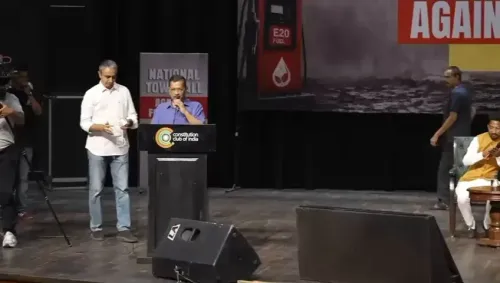
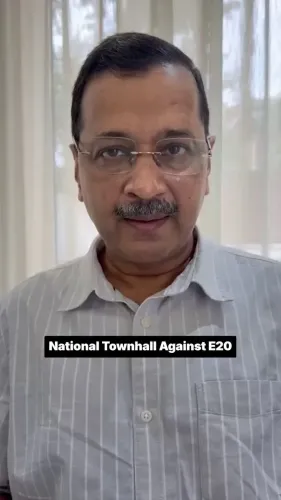
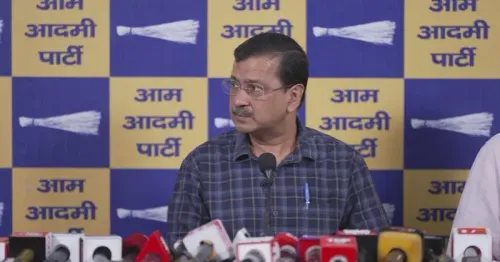
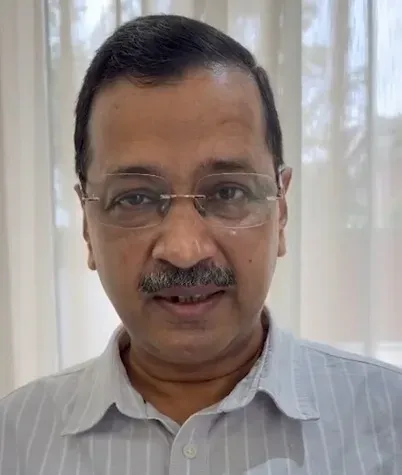
Aam Aadmi Party (AAP) National Convenor and former Delhi Chief Minister Arvind Kejriwal on Monday, 27 July 2026, announced a National Town Hall Against E20 — a public meeting to protest the Centre's 20 per cent ethanol-blended petrol (E20) policy — scheduled for 1 August 2026 at the Constitution Club, New Delhi. The event, open for both in-person and online participation, signals a fresh opposition offensive against a fuel policy that has already ignited political controversy.
What Kejriwal Said
In a post on social media platform X, Kejriwal drew a direct parallel to the recent political pressure that led to the resignation of former Union Education Minister Dharmendra Pradhan. 'When the country's youth united and raised their voices, Dharmendra Pradhan was forced to resign. We must similarly unite and raise our voices regarding E20,' he wrote. He added that the town hall — set for 11:30 a.m. on 1 August — would give citizens a platform to share their views on the issue, with online participation available for those unable to attend in person.
The E20 Controversy
The Centre's move to make E20 the standard fuel at petrol pumps nationwide — rolled out in April 2025 — has drawn sustained criticism from opposition parties. Leaders have cited a 2021 NITI Aayog report, alleging that the government bypassed the phased implementation and safety safeguards the report recommended before proceeding with the nationwide rollout. Critics argue the transition was rushed, potentially affecting vehicle performance and consumer choice.
Government's Position
The Union government, however, has defended the policy. On 23 July, it told Parliament that no decision has been taken to increase ethanol blending beyond 20 per cent, and that any future move to higher blends would follow detailed scientific and technical studies in consultation with automobile manufacturers, oil marketing companies, and research institutions.
Minister of State for Petroleum and Natural Gas Suresh Gopi, in a written reply to a Lok Sabha query, clarified that E85 fuel — containing 85 per cent ethanol — has been introduced exclusively for Flex Fuel Vehicles (FFVs) and does not alter the nationwide base blending level. He also noted that ethanol has been used globally for over a century, with countries such as Brazil operating on higher blends for decades.
The Policy's Background
India's Ethanol Blended Petrol (EBP) Programme has been developed through a consultative process involving NITI Aayog, automobile manufacturers, oil marketing companies, the Automotive Research Association of India (ARAI), the Society of Indian Automobile Manufacturers (SIAM), and the Indian Institute of Petroleum (IIP). The government maintains the rollout was scientifically validated at each stage.
What Comes Next
The 1 August town hall is likely to sharpen opposition messaging on E20 ahead of upcoming legislative sessions. With AAP seeking to rebuild its national profile following electoral setbacks, the event also carries political significance beyond the fuel debate. Whether it translates into sustained pressure on the Centre — as the NEET-UG protests did on Dharmendra Pradhan — remains to be seen.
Point of View
And public anger over fuel blending has not yet reached the emotional pitch that drove students to the streets. The deeper question the town hall must answer is whether opposition to E20 is a genuine consumer grievance or a political opportunity being dressed as one. The government's parliamentary defence — citing Brazil, ARAI, and SIAM — is not without substance; the opposition's strongest card remains the allegation that the NITI Aayog's own phasing safeguards were quietly shelved.
NationPress
25 Oct 2026
Frequently Asked Questions
What is the National Town Hall Against E20 announced by Kejriwal?
It is a public meeting organised by AAP National Convenor Arvind Kejriwal to protest the Centre's E20 ethanol-blended petrol policy, scheduled for 1 August 2026 at 11:30 a.m. at Constitution Club, New Delhi. The event is open for both in-person and online participation.
What is the E20 fuel policy and why is it controversial?
E20 refers to petrol blended with 20 per cent ethanol, which the Centre made the standard fuel at pumps nationwide in April 2025. Opposition leaders allege the government bypassed phased implementation and safeguards recommended in a 2021 NITI Aayog report before the rollout.
What has the government said about E20 and higher ethanol blends?
The Union government told Parliament on 23 July 2026 that no decision has been taken to increase ethanol blending beyond 20 per cent. Any future increase would follow scientific and technical studies with stakeholders including automakers, oil marketing companies, and research institutions.
What is E85 fuel and is it being rolled out nationally?
E85 is a fuel containing 85 per cent ethanol and 15 per cent petrol, introduced exclusively for Flex Fuel Vehicles (FFVs) certified for its use. Minister of State Suresh Gopi clarified it does not constitute a change to the nationwide base blending level of 20 per cent.
Why did Kejriwal reference Dharmendra Pradhan's resignation in his announcement?
Kejriwal cited the resignation of former Union Education Minister Dharmendra Pradhan — which followed sustained protests over NEET-UG paper leak irregularities — as a model for collective public pressure. He argued that similar unity on E20 could force a policy rethink by the Centre.