CM Sawant launches book on Goa's Shuddhi movement in Panaji
Synopsis
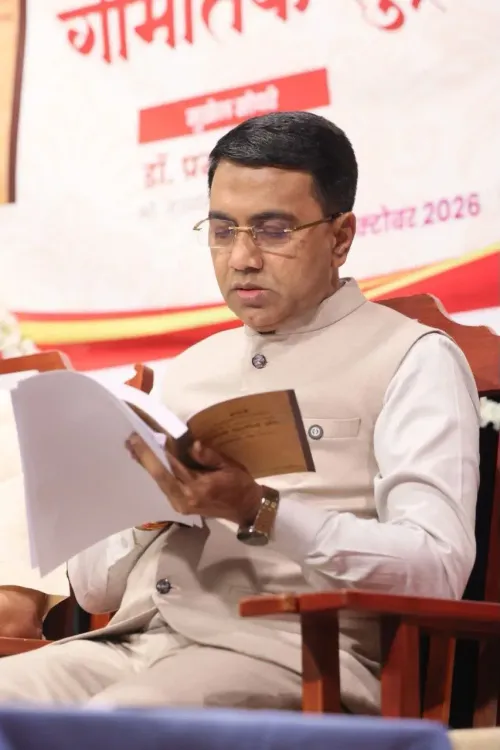
Goa Chief Minister Pramod Sawant launched 'Goencho Shuddhicho Itihas', a book on the Shuddhi movement published by Mumbai Tarun Bharat, at the Institute Menezes Braganza in Panaji on 25 October 2026, with RSS Sah Sarkaryavah Dattatreya Hosabale in attendance.
Key Takeaways
Goa CM Pramod Sawant launched 'Goencho Shuddhicho Itihas' at Institute Menezes Braganza, Panaji on 25 October 2026 .
The book is reproduced and published by Mumbai Tarun Bharat and documents the history of the Shuddhi movement in Goa.
Dattatreya Hosabale , Sah Sarkaryavah of the RSS , was among the distinguished guests at the launch.
The event focused on preserving historical records, cultural memory, and generational traditions connected to Goa's social history.
The launch fits a broader pattern of BJP -led state governments supporting publications on regional Hindu reform histories.
A piece of Goa's contested social history came back into public focus on Sunday, 25 October 2026, when Goa Chief Minister Pramod Sawant launched 'Goencho Shuddhicho Itihas' — a reproduced and published documentation of the Shuddhi movement in Goa — at the Institute Menezes Braganza, Panaji.
The volume, brought out by Mumbai Tarun Bharat, aims to preserve records of the Shuddhi movement, a chapter in Goa's social and religious history that has received intermittent scholarly attention since the state's liberation from Portuguese rule in 1961. CM Sawant extended congratulations to the book's author, translators, and Mumbai Tarun Bharat for their role in documenting the history and contributing to the preservation of Goa's cultural heritage.
Hosabale's presence and the RSS connection
The launch was marked by the attendance of Dattatreya Hosabale, Sah Sarkaryavah (Joint General Secretary) of the Rashtriya Swayamsevak Sangh, lending the event visible ideological and organisational weight. RSS leaders have frequently participated in cultural documentation initiatives alongside elected officials, particularly those focused on Hindu reform movements and regional social history. Hosabale's presence at an official state event in Panaji underlines the convergence of BJP governance and RSS cultural programming that is a recurring feature of this political landscape.
The Shuddhi movement's place in Goa's historiography
The Shuddhi movement, broadly a Hindu reconversion effort, has been a recurring subject in Goa's post-liberation historical discourse, which has grappled with the legacy of Portuguese-era conversions spanning nearly 450 years. The Institute Menezes Braganza, a heritage institution in the heart of Panaji, provided a historically resonant setting for the launch — it has long served as a venue for intellectual and cultural events in the state.
State governments led by the BJP have periodically supported publications and public events focused on such regional histories. This launch fits a visible pattern of deploying cultural memory as part of a broader heritage preservation agenda, drawing on Goa's distinctive and layered identity — one shaped by indigenous traditions, Portuguese colonial rule, and a post-liberation resurgence of local historical inquiry.
What comes next for Goa's heritage documentation
The publication of 'Goencho Shuddhicho Itihas' — with the title in Konkani, Goa's official language — signals continued interest in vernacular-language documentation of social history. Watchers of Goa's cultural policy will follow whether Mumbai Tarun Bharat pursues subsequent volumes on Goan social history, and whether the state government announces any formal heritage grants or institutional support linked to this initiative in the Goa Legislative Assembly.
The Shuddhi movement's history, once largely confined to specialist archives, now has a published, accessible volume — and a chief minister's endorsement on the record.
Point of View
CM Sawant signals that cultural memory work is a governing priority — not merely a ceremonial gesture. This fits a discernible BJP pattern of using state platforms to elevate narratives centred on Hindu reform and reconversion movements, particularly in states with layered colonial histories. The Konkani-language title also gestures at vernacular identity politics, making heritage both ideologically purposeful and locally resonant.
NationPress
26 Oct 2026
Frequently Asked Questions
What is 'Goencho Shuddhicho Itihas'?
'Goencho Shuddhicho Itihas' is a book documenting the history of the Shuddhi movement in Goa, reproduced and published by Mumbai Tarun Bharat. It was launched by Goa CM Pramod Sawant at the Institute Menezes Braganza, Panaji, on 25 October 2026.
What is the Shuddhi movement in Goa?
The Shuddhi movement in Goa refers to a Hindu reconversion effort that became part of the state's social history, particularly in the context of Portuguese-era religious conversions that lasted nearly 450 years until Goa's liberation in 1961.
Who is Dattatreya Hosabale and why was he at the book launch?
Dattatreya Hosabale is the Sah Sarkaryavah (Joint General Secretary) of the RSS. He attended the launch of 'Goencho Shuddhicho Itihas' in Panaji as a distinguished guest, reflecting the RSS's engagement with cultural documentation initiatives tied to Hindu social history.
Who published 'Goencho Shuddhicho Itihas'?
The book was reproduced and published by Mumbai Tarun Bharat, an organisation that has contributed to documenting Goa's regional history.
Where was the book launch held?
The book launch was held at the Institute Menezes Braganza in Panaji, Goa — a historic cultural and intellectual institution in the state capital.