Khattar Invokes BJP's Jana Sangh Roots in Party Post
Synopsis
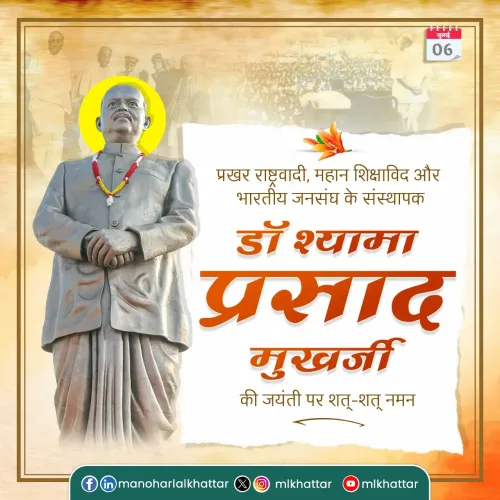
Union Power Minister Manohar Lal Khattar invoked the BJP's foundational lineage on X, tracing an 'unbroken ideological journey' from the Bharatiya Jana Sangh's 1951 founding by Syama Prasad Mookerjee to the BJP's establishment in 1980.
Key Takeaways
Union Power Minister Manohar Lal Khattar posted on X on 21 October 2026 celebrating the BJP's ideological continuity.
The post describes the Jana Sangh-to-BJP arc as an 'unbroken ideological journey' ( anwarat vaicharik yatra ).
The Bharatiya Jana Sangh was founded in 1951 by Syama Prasad Mookerjee with RSS organisational backing.
The Bharatiya Janata Party was formally established in 1980 as the Jana Sangh's direct successor.
BJP leaders routinely invoke this lineage to assert ideological permanence, especially around organisational events.
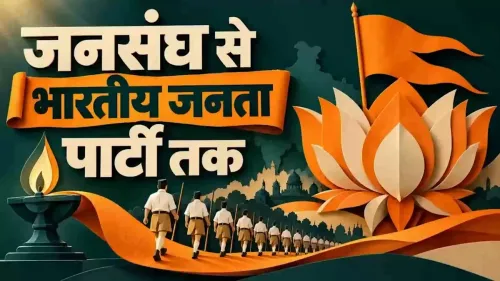
Seventy-five years of ideological continuity, distilled into a single line. Union Power Minister Manohar Lal Khattar on Wednesday, 21 October 2026, posted a tribute to the Bharatiya Janata Party's foundational journey, tracing the arc from the Bharatiya Jana Sangh all the way to the BJP of today.
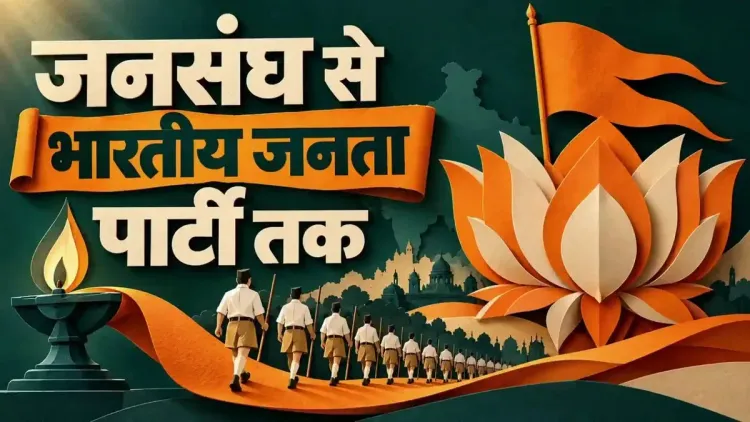
In Hindi, the post reads: 'Jansangh se Bharatiya Janata Party tak: ek anwarat vaicharik yatra!' — 'From the Jana Sangh to the Bharatiya Janata Party: an unbroken ideological journey!' — accompanied by a lamp and lotus emoji and a tag to the BJP's official handle.
The 1951 Seed and the 1980 Harvest
The story Khattar is pointing to has a precise origin. The Bharatiya Jana Sangh was founded in 1951 by Syama Prasad Mookerjee as a political vehicle for Hindu nationalist thought with deep organisational ties to the RSS. For nearly three decades it remained the ideological anchor of the Indian right, surviving as a minority opposition force through the Nehruvian era and the Emergency.
The decisive rupture — and relaunch — came in 1980. The Bharatiya Janata Party was formally established that year, explicitly inheriting the Jana Sangh's cadre, its ideological DNA, and its organisational discipline. What Khattar calls an 'unbroken journey' is, in party lore, a deliberate act of institutional memory: the BJP has never let go of the Jana Sangh founding myth as its legitimising anchor.
Why BJP Leaders Keep Returning to This Narrative
This kind of historical messaging is not incidental. Senior BJP leaders periodically invoke the Jana Sangh-to-BJP transition to reinforce two things simultaneously: ideological permanence and organisational resilience. The argument, implicit in Khattar's post, is that the party is not a political convenience but a civilisational project with a documented lineage.
For a leader of Khattar's stature — a former Chief Minister of Haryana who now holds the twin portfolios of Power and Housing and Urban Affairs at the Centre — amplifying this narrative signals alignment with the party's internal communication cadence, often intensifying ahead of organisational conclaves or electoral cycles.
The lamp emoji (diya) and lotus, the BJP's official symbol, are not decorative. They are a shorthand the party's base reads instantly: continuity, light, and a rooted identity stretching back to 1951. That's the entire argument, compressed into punctuation.
Point of View
Amplifying this narrative aligns him with the party's broader effort to frame its politics as civilisational continuity rather than electoral opportunism. The timing, absent a concurrent event in the research record, suggests this is cadence-driven: periodic historical affirmation that keeps the foundational story alive in the party's digital ecosystem and among its grassroots workers.
NationPress
21 Oct 2026
Frequently Asked Questions
What is the connection between Jana Sangh and BJP?
The Bharatiya Jana Sangh, founded in 1951 by Syama Prasad Mookerjee, is the direct ideological predecessor of the BJP. When the BJP was established in 1980, it explicitly inherited the Jana Sangh's cadre, ideology, and RSS-linked organisational base.
Who founded the Bharatiya Jana Sangh?
The Bharatiya Jana Sangh was founded in 1951 by Syama Prasad Mookerjee as a political expression of Hindu nationalist thought linked to the RSS.
When was the BJP formed?
The Bharatiya Janata Party was formally established in 1980, positioning itself as the continuation of the Bharatiya Jana Sangh.
Who is Manohar Lal Khattar?
Manohar Lal Khattar is a senior BJP leader and former Chief Minister of Haryana who currently serves as the Union Minister of Power and Housing and Urban Affairs in the central government.
Why do BJP leaders talk about Jana Sangh history?
BJP leaders invoke the Jana Sangh-to-BJP transition to underscore ideological continuity and organisational resilience, framing the party as a movement with roots going back to 1951 rather than just a post-1980 political formation.