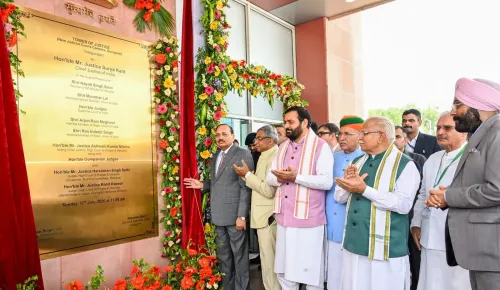
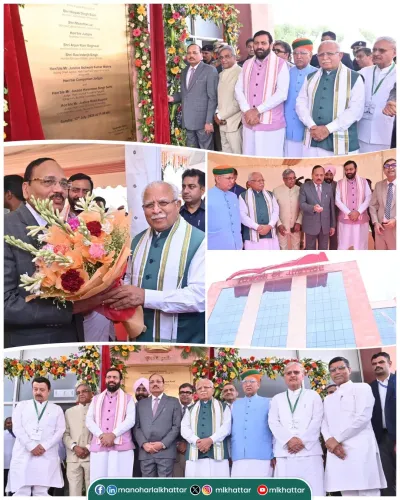
Khattar inaugurates Tower of Justice in Gurugram
Synopsis
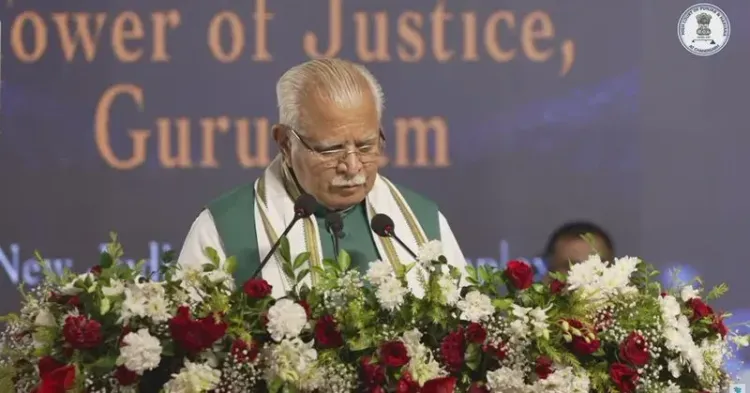
Union Minister Manohar Lal Khattar inaugurated the Tower of Justice in Gurugram on 13 July 2026, addressing the ceremony of a new judicial complex in one of the NCR's fastest-growing districts, reflecting the government's push to expand court infrastructure capacity.
Key Takeaways
Union Minister Manohar Lal Khattar inaugurated the Tower of Justice in Gurugram on 13 July 2026 .
Khattar served as Chief Minister of Haryana from 2014 to 2024 before taking charge as Union Minister of Power and Housing & Urban Affairs.
The new judicial complex is intended to address growing caseload pressures in Gurugram , a high-growth city in the National Capital Region .
Key stakeholders include the judiciary, legal professionals, and litigants in Gurugram district .
The project aligns with the central and state governments' broader push to expand physical court infrastructure across India.
Further judicial infrastructure announcements for Haryana and the NCR are expected in the coming months.
Union Power Minister and Housing & Urban Affairs Minister Manohar Lal Khattar addressed the inauguration ceremony of the Tower of Justice in Gurugram, Haryana, on Sunday, 13 July 2026, marking the opening of a new judicial infrastructure facility in one of the National Capital Region's fastest-growing cities.
Context
The Tower of Justice is a new court complex in Gurugram, a city that has seen explosive population and commercial growth over the past two decades, placing considerable strain on existing judicial infrastructure. Khattar, who served as Chief Minister of Haryana from 2014 to 2024 before being elevated to the Union Cabinet, has maintained a close administrative connection with the state and its urban centres.
His presence at the inauguration as a senior central minister underscores the convergence of his prior state-level responsibilities and his current portfolio covering urban affairs. The event signals continued government attention to expanding physical infrastructure for the judiciary in high-demand districts.
Policy Backdrop
Expanding court infrastructure has been a stated priority for both the central and state governments in recent years, driven by a mounting backlog of cases across district and subordinate courts in India. Gurugram district, owing to its dense corporate and residential population, generates a disproportionately high volume of civil and commercial litigation.
The Ministry of Housing and Urban Affairs, which Khattar now heads, plays a role in urban planning approvals and funding frameworks that support projects of this nature in cities across the country. Investments in purpose-built judicial complexes are seen as a structural response to the judiciary's long-standing capacity constraints.
Stakeholders and Impact
The primary beneficiaries of the Tower of Justice are the judiciary, legal professionals, and litigants who currently navigate overcrowded and under-resourced court facilities in Gurugram. A modern, purpose-built complex is expected to improve case management, provide better facilities for witnesses and victims, and reduce logistical delays.
For the BJP government in Haryana and at the Centre, the project also represents a visible infrastructure deliverable in a politically significant urban constituency within the NCR. Gurugram's electorate includes a large professional and business class that places a premium on governance quality and rule-of-law institutions.
What's Next
The inauguration of the Tower of Justice is expected to prompt further scrutiny of judicial infrastructure pipelines across Haryana and the broader NCR. Observers will watch for announcements from the Ministry of Housing and Urban Affairs regarding similar projects in other high-caseload districts.
Any follow-up policy directives from Khattar's ministry linking urban development funds to judicial infrastructure expansion could set a precedent for how such projects are financed and executed in other rapidly urbanising cities across India.
Point of View
Blurring the line between law-and-order delivery and electoral optics in urban Haryana. For the Ministry of Housing and Urban Affairs, such inaugurations serve as proof-of-concept for its urban infrastructure mandate beyond housing and transit. The NCR's chronic court-capacity deficit means this project, if successful, could become a template for similar investments in Faridabad, Noida, and Ghaziabad.
NationPress
11 Oct 2026
Frequently Asked Questions
What is the Tower of Justice in Gurugram?
The Tower of Justice is a newly inaugurated court complex in Gurugram, Haryana, designed to expand judicial infrastructure capacity in one of the NCR's most densely populated and commercially active districts.
Why did Union Minister Manohar Lal Khattar inaugurate a court building in Gurugram?
Khattar, as Union Minister of Housing and Urban Affairs and a former Chief Minister of Haryana, has both a policy mandate and a political connection to Gurugram, making him a natural choice to represent the central government at the inauguration.
What is Manohar Lal Khattar's current role?
Manohar Lal Khattar is currently the Union Minister of Power and Housing & Urban Affairs. He previously served as Chief Minister of Haryana from 2014 to 2024.
Why does Gurugram need a new court complex?
Gurugram has experienced rapid population and corporate growth, leading to a sharp rise in civil and commercial litigation that has overwhelmed existing court facilities and contributed to case backlogs.
What comes next after the Tower of Justice inauguration?
Observers expect further announcements on judicial infrastructure projects in Haryana and the NCR, and will watch whether the Ministry of Housing and Urban Affairs links urban development funding to similar court complex projects in other cities.